
BWSENSING Modbus Dual Axis Inclinometer (BWH527)
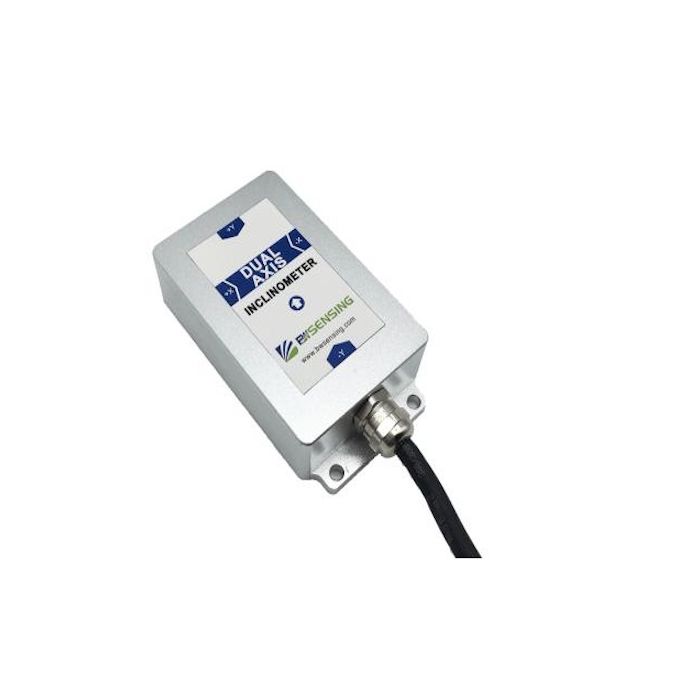
In stock
- BRAND:
- BWSENSING
- PART #:
- BWH527
- ORIGIN:
- China
- AVAILABILITY:
- SUBJECT TO AVAILABILITY
- SKU:
- BWSENSING-BWH527
BWSENSING Modbus Dual Axis Inclinometer (BWH527)
Most things that fail slowly, fail at an angle first. A BWSENSING Modbus Dual Axis Inclinometer (BWH527) is built to notice that angle: a small, sealed tilt sensor that sits on a tower, a bridge or a piece of equipment and reports two axes of lean over a serial line, day after day, without anyone climbing up to look.
The product is available through this page, by quotation.
Background
The company behind the BWH527
The BWH527 is made by Wuxi Bewis Sensing Technology LLC in Wuxi, Jiangsu, China, and sold under the BWSENSING brand. The company works in inclination and tilt measurement, and its catalog covers single-axis and dual-axis units with different output styles. The BWH527 sits in the group of lower-cost, compact models that speak Modbus, which makes it a practical choice where many sensors must be wired into one monitoring network.
If you are comparing the wider family, our BWSensing brand page and the Sensors category list the related models in one place.
Positioning and key technology
The manufacturer describes the BWH527 as a low cost and small Modbus protocol output double-axes inclinometer. Two things define it. The first is the combination of a ±30° range with a resolution of 0.0007° and a highest accuracy of 0.003°, which is fine enough for structural watching rather than only coarse leveling. The second is its wide supply window of 9-36V, which lets one unit run from many different industrial power arrangements without a dedicated regulator in front of it.
The sensor is offered with three electrical interfaces: RS232, RS485 and TTL. The sources name the versions BWH527-30-485 (RS485), BWH527-30-232 (RS232) and BWH527-30-TTL (TTL), so the suffix on the model code tells you which serial standard the unit speaks. Baud rate is adjustable from 2400 to 115200, and the output frequency is adjustable from 5 to 100Hz.
Technical Specifications
| Specification | Value |
|---|---|
| Axes | Dual axis |
| Range | ±30° |
| Highest accuracy | 0.003° |
| Resolution | 0.0007° |
| Output protocol | Modbus |
| Output interface | RS232 / RS485 / TTL |
| Versions by interface | BWH527-30-485 (RS485); BWH527-30-232 (RS232); BWH527-30-TTL (TTL) |
| Supply voltage | 9-36V |
| Current, no load | 20 mA min, 30 mA typical, 40 mA max |
| Baud rate | 2400~115200, adjustable |
| Output frequency | 5-100Hz adjustable, up to 100 Hz |
| IP protection level | IP67 |
| Operating temperature | -40℃~+85℃ |
| Storage temperature | -55 to 100 ℃ |
| MTBF | ≥90000 hours |
| Impact resistance | 2000g, 0.5ms, 3 times/axis |
Specifications as published by the manufacturer; confirmed against the datasheet at quotation.
The manufacturer has not published the weight, the contents of the box, the operating humidity, the cross-axis error for this series or the Modbus register map; they are confirmed at quotation.
What makes the BWH527 different from a basic tilt switch or analog sensor?
A tilt switch tells you only that a limit has been crossed. An analog tilt sensor gives you a voltage that must be carried, conditioned and converted, and every meter of cable adds a little doubt. The BWH527 does the conversion at the sensor and sends the angle as digital data over a Modbus serial line. That means the reading arrives as a number, not as a signal that has to be interpreted, and several devices can share one bus.
The second difference is the pair of axes. Two axes in one body mean one installation point gives you the lean in both directions, which is exactly what you want on a tower or a pier, where the direction of movement is not known in advance. The resolution of 0.0007° allows very small changes to show up in the data, and the output frequency can be set anywhere from 5 to 100Hz, so a slow structural survey and a faster leveling loop can use the same hardware with different settings.
Finally, the housing and the electrical specification are meant for outdoor use. The IP67 protection level, the operating range of -40℃~+85℃ and the impact resistance of 2000g for 0.5ms, 3 times per axis, show that the unit is designed for field conditions and not for a laboratory shelf. The MTBF of ≥90000 hours supports long unattended service.
Which interface should I choose: RS485, RS232 or TTL?
Choose by the length of the cable and the equipment at the other end. The BWH527-30-485 (RS485) is the usual pick for longer runs and for networks with several sensors, because RS485 is a bus standard made for that. The BWH527-30-232 (RS232) suits a direct point-to-point link to a controller or a computer that already has an RS232 port. The BWH527-30-TTL (TTL) is intended for short connections to a microcontroller or an embedded board, where logic-level signals are exactly what the host expects.
All three belong to the same BWH527 family and share the figures in the table above. Tell us which interface your system uses and we will quote the matching version.
Who is the BWH527 for?
Monitoring contractors and structural engineers are the first group. Wind tower tilt monitoring, bridge monitoring and dam monitoring are named applications, and a sealed, wide-temperature, two-axis sensor with digital output fits them well. Utilities and port or railway operators, who maintain structures spread over large areas, will value a sensor that connects to an existing serial network.
Equipment builders and integrators are the second group. Railroad gauge ruler leveling is one of the listed uses, and the same logic applies to any machine or platform that needs to know whether it is level. The wide 9-36V supply helps when the host machine has an unregulated or varying power source.
If your project needs digital output with Modbus and you are also weighing other dual-axis options, look at the BWSENSING Cost-Effective Dual-Axis Digital Output With Modbus Inclinometer (BWN427) or the BWSENSING Cost-Effective Dual-Axis Inclinometer (BWM427) and compare the datasheets side by side. For a single-axis job, the BWM417 may be the simpler fit.
What is the BWH527 used for?
- Wind tower tilt monitoring. Tracks the lean of a tower over time so settling or foundation movement shows up early.
- Bridge monitoring. Reports the inclination of piers, decks or bearings in two axes at once.
- Dam monitoring. Watches dam structures and related works for slow angular change under load.
- Railroad gauge ruler leveling. Gives a digital level reading for gauge measuring tools and track equipment.
- Equipment and platform leveling. Tells a controller whether a machine or platform is level in both directions.
- Industrial data networks. Feeds tilt readings over Modbus to a PLC, logger or monitoring system through RS485, RS232 or TTL.
Pricing and Availability
We do not print prices on this page. Please request a quotation, stating the interface version you need (RS485, RS232 or TTL), the quantity and the destination. Delivery, customs and support are arranged together with the quotation. The BWSENSING Modbus Dual Axis Inclinometer (BWH527) is available on this page.
Frequently Asked Questions
What range does the BWH527 measure?
The range is ±30° on two axes. The manufacturer's range column also lists ±15°, so state which range you need when you ask for a quotation.
How precise is it?
The highest accuracy is 0.003° and the resolution is 0.0007°.
What power supply does it need?
It accepts a wide input of 9-36V. Current with no load is 20 mA minimum, 30 mA typical and 40 mA maximum.
Which output interfaces are available?
RS232, RS485 and TTL, offered as BWH527-30-232, BWH527-30-485 and BWH527-30-TTL. The baud rate is adjustable from 2400 to 115200.
Can it be used outdoors?
Yes. It has an IP67 protection level and works from -40℃~+85℃. Storage temperature is -55 to 100 ℃.
Is the Modbus register map included?
The manufacturer has not published the register map. We confirm it with the datasheet when we send your quotation.
Where can I buy the BWH527 and what does it cost?
You can buy it through this page by requesting a quotation. We do not list a price here; the cost depends on the version, the quantity and the delivery destination, and it is given in the quotation.
Summary
The BWH527 turns a slow, quiet movement into a number you can log. It combines two axes, a ±30° range, fine resolution, IP67 protection and a choice of RS485, RS232 or TTL, in a small body that takes a wide 9-36V supply. For towers, bridges, dams, track tools and leveled platforms, it gives a clear digital view of lean. If that matches your project, this page is the starting point.


