
BMR 2.5 Meter Concrete Leveling Robot
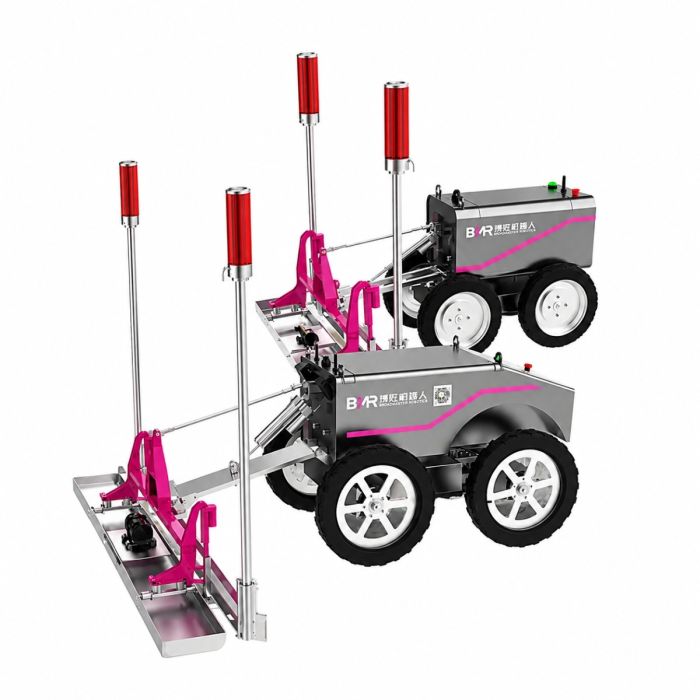
In stock
- BRAND:
- BMR
- MODEL:
- Concrete Leveling Robot 25SY / 25MY
- ORIGIN:
- China
- Warranty:
- 12 MONTHS
- AVAILABILITY:
- SUBJECT TO AVAILABILITY
- SKU:
- BMR-Concrete-Leveling-Robot
BMR 2.5 Meter Concrete Leveling Robot
Two and a half meters of leveling head, one operator with a remote control, and a battery that lasts a full shift: that is a different way to think about a concrete pour. The BMR 2.5 Meter Concrete Leveling Robot takes the hardest, most time-critical labor on a slab job and hands it to a machine that adjusts itself as it travels, so the crew can concentrate on the pour rather than on the screed.
The product is available through this page, by quotation.
Background
The company and its lineage
The robot is made by Shenzhen BrightMaster Robotics Co., Ltd., sold under the BMR brand. The company builds robots for construction floors, and its range reaches from concrete placing to finishing, grinding and coating. The leveling robot sits at the start of that chain, where fresh concrete first has to be brought to the right elevation.
The leveling robot comes in two working widths, 1.5 m and 2.5 m. The versions are named Concrete Leveling Robot 15SY, 15MY, 25SY and 25MY. This page covers the 2.5 m size, which is the 25SY and 25MY, and every figure below belongs to that size. If you are comparing it with other machines in the range, you will find them in the Concrete Robots category.
Positioning and key technology
The machine is also known in the industry as a robotic floor leveller or self leveling robot. It is designed to replace traditional manual screeding on large-scale concrete flooring projects. Instead of a crew working the surface by hand, the robot travels across the pour under remote control and performs slurry lifting, surface finishing and elevation control before the initial setting of the concrete.
Behind that work sits a set of technologies that the manufacturer developed in-house: a dual degree-of-freedom adaptive system, intelligent motion control algorithms, high-precision laser recognition measurement and real-time control. In practice, the robot automatically adjusts screed height, vibration frequency and travel speed in real time. This removes the inconsistencies and imperfections that come from manual operation, because the machine does not tire and does not drift as the hours pass.
Technical Specifications
| Specification | Value (25SY / 25MY, 2.5 m) |
|---|---|
| Leveling head size | 2500 mm |
| Dimensions (L x W x H) | 2500×2200×2100 mm |
| Weight | 350 kg |
| Tire size | 26x4-18 tubeless tires; optional AT26x9-14 all-terrain tires |
| Leveling thickness | 30~250 mm RH |
| Operational efficiency | ≥300 m²/h |
| Power supply | 48V 90AH |
| Operating endurance | ≥10 h |
| Battery charging time | 4 h |
| Operation mode | Semi-automatic, by remote control |
Specifications as published by the manufacturer; confirmed against the datasheet at quotation.
The manufacturer has not published the IP rating, the noise level, the leveling accuracy for this version, the remote control range, the compatible base station, a fully automatic navigation mode for this version or the contents of the box; they are confirmed at quotation.
What makes the 2.5 m robot different from the 1.5 m models?
The first difference is reach. The 2.5 m versions carry a 2500 mm leveling head and work at 300 m²/h or more, while the 1.5 m versions are the smaller machines in the same family. A wider head covers a big slab in fewer passes, which matters when the concrete is stiffening and the crew has a limited window.
The second difference is depth. The 2.5 m robot levels a thickness of 30~250 mm RH, a deeper range than the one published for the 1.5 m models. It also carries a larger battery, 48V 90AH, and is rated for an endurance of 10 hours or more, so a long working day does not depend on a mid-shift swap.
The trade-off is size and weight. At 2500×2200×2100 mm and 350 kg, this is a machine that needs open floor and a plan for how it is moved between pours. Where the job is a series of small rooms, the narrower models are the more natural fit. Where the job is a hall, a warehouse or a mall, the wider head earns its place.
How does it differ from manual screeding?
Manual screeding relies on people reading the level, holding the screed and keeping a steady pace. The robot replaces that judgment with measurement. High-precision laser recognition tells it where the surface is, and real-time control adjusts the screed height, the vibration frequency and the travel speed as it moves.
The result is consistency from the first meter to the last, and fewer people kneeling on wet concrete. The operator works with a remote control, in semi-automatic operation, and stays in charge of where the machine goes. The robot handles the repetitive work of keeping the surface at the right elevation before the concrete reaches its initial setting.
Who is the BMR 2.5 Meter Concrete Leveling Robot for?
Flooring contractors with large pours are the first group. Factories, airports, shopping malls and big basements all share the same problem: a wide slab, a limited working window and a demand for an even surface. A 2500 mm head and 300 m²/h or more suit that scale.
General contractors who want less dependence on scarce skilled screeding labor are a second group. A single operator with a remote control can run the machine, and the long battery endurance fits extended shifts.
Residential builders can use it too, particularly on large floors and basements. For projects made up mostly of small spaces, the 1.5 m models in the same family may be the better match; compare them through the Concrete Robots category. For the steps that follow leveling, see the BMR Concrete Finishing Robot and the BMR Floor Screeding Robot.
What is the BMR 2.5 Meter Concrete Leveling Robot used for?
- Large factory floors. Leveling wide industrial slabs where speed and a consistent surface both matter.
- Airport slabs. Covering big areas of concrete flooring within the working window of the pour.
- Shopping malls. Leveling extensive retail floors without a large manual screeding crew.
- Basements. Working across large basement slabs under remote control.
- Residential floors. Leveling housing slabs, especially large ones, to a consistent elevation.
- Slurry lifting and surface finishing. Lifting the slurry and controlling the elevation before the concrete's initial setting.
Pricing and Availability
We do not print prices on this page. Please request a quotation and we will answer with the details for your project. Delivery, customs and support are arranged together with the quotation, so there are no surprises later. The BMR 2.5 Meter Concrete Leveling Robot is available on this page.
Frequently Asked Questions
What leveling thickness does the 2.5 m robot handle?
The 25SY and 25MY levels a thickness of 30~250 mm RH.
How fast does it work?
Its operational efficiency is 300 m²/h or more.
How long does the battery last, and how long does it take to charge?
The 48V 90AH battery gives an operating endurance of 10 hours or more, and a charge takes 4 hours.
How is the robot operated?
It supports semi-automatic operation by remote control. The robot automatically adjusts screed height, vibration frequency and travel speed in real time.
What tires does it use?
It runs on 26x4-18 tubeless tires, with optional AT26x9-14 all-terrain tires.
Where can it be used?
Typical uses are residential floors, basements, factories, airports and shopping malls.
Where can I buy the BMR 2.5 Meter Concrete Leveling Robot and what does it cost?
You can buy it through this page, by quotation. The cost is confirmed in the quotation for your project, together with delivery, customs and support.
Summary
A concrete pour is won or lost in the window before the initial set, and this robot is built to use that window well. With a 2500 mm head, a leveling thickness of 30~250 mm RH, 300 m²/h or more and a battery that lasts 10 hours or more, it gives large projects a steady, repeatable way to level a slab. Laser measurement and real-time control do the adjusting; the operator steers by remote control. If your next floor is large, this page is the starting point.


