
BMR MQ200 Facade Cleaning Robot
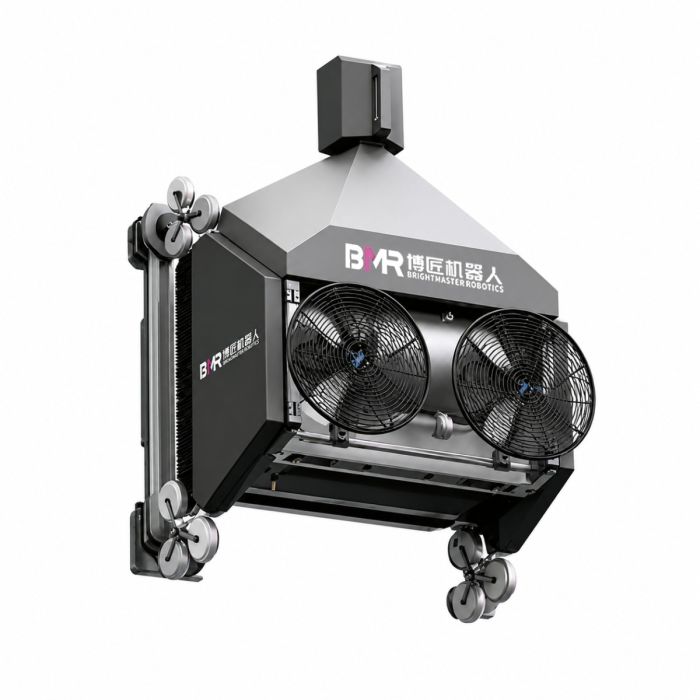
In stock
- BRAND:
- BMR
- MODEL:
- Facade Cleaning Robot MQ200
- ORIGIN:
- China
- Warranty:
- 12 MONTHS
- AVAILABILITY:
- ALLOW 8 TO 12 WEEKS FOR DELIVERY
- SKU:
- BMR-Facade-Cleaning-Robot
BMR MQ200 Facade Cleaning Robot
Every tall building has a skin that needs washing, and for decades the only way to reach it was to hang a person from a rope. The BMR MQ200 Facade Cleaning Robot offers a different bargain: keep the people on the ground, send the machine up the wall, and let it clean curtain walls on its own while an operator watches from below.
The product is available through this page, by quotation.
Background
The company behind the MQ200
The MQ200 is made by Shenzhen BrightMaster Robotics Co., Ltd. and sold under the BMR brand. The same brand also builds robots for construction work, such as indoor coating, concrete finishing and site measuring. Facade cleaning is a natural neighbor to those trades. Tall buildings are finished by machines and people working at height, and they must be kept clean the same way once they are occupied.
That shared background matters to a buyer. A robot built by a maker that works around construction sites is designed for real walls, real weather and real building managers, not for a demonstration hall. If you also look after other site work, the Construction Robots category shows what else the brand offers.
Positioning and key technology
The MQ200 is a fully automatic cleaning robot designed for high-rise and ultra-high-rise buildings. Its working model has three parts: ground-based manual control, autonomous high-altitude operation, and AI intelligent detection. The operator sets the job from the ground. The robot does the work at altitude. The AI checks the result. The aim is unmanned, intelligent and standardized curtain wall cleaning.
Three features carry that idea. The first is a redundant safety system, which is there to reduce the safety risks that come with high-altitude operation. The second is an AI vision system that plans the cleaning path intelligently and assesses how clean the surface is. The third is an integrated wastewater recovery unit, which can prevent secondary pollution to the surrounding environment. A modular obstacle-crossing mechanism lets the robot deal with projections on the wall. For a wider view of the field, see the Cleaning Robots category.
Technical Specifications
| Specification | MQ200 |
|---|---|
| Total weight | ≤ 80 kg |
| Operating slope | 0-90° |
| Working height | ≤200m |
| Cleaning efficiency | ≥350 m²/h |
| Cleaning width | 1000 mm |
| Moving speed | 0-0.2 m/s |
| Obstacle crossing height | ≤400 mm |
| Overall coverage rate | ≥80% |
| Protection level | IP 54 |
| Operating voltage | 220V |
| Water supply method | Surface water supply |
| Construction scenarios | Flat and large-curved glass, metal and stone curtain walls |
Specifications as published by the manufacturer; confirmed against the datasheet at quotation.
The manufacturer has not published the dimensions, the power consumption, the water consumption, the wastewater tank capacity, the cable or rope length, the contents of the box, the noise level or the control software and connectivity; they are confirmed at quotation.
What makes the MQ200 different from cleaning a facade by hand?
The first difference is where the people are. In traditional facade work, the cleaners are on the wall, and every hour of work carries the risks of working at height. With the MQ200, the operator controls the robot from the ground, and the robot works autonomously at altitude. The redundant safety system is built around the demands of that environment, so the safety question is part of the machine itself and not an afterthought.
The second difference is consistency. The robot has a cleaning width of 1000 mm and a cleaning efficiency of at least 350 m²/h, and its overall coverage rate is at least 80%. The AI vision system plans the path and assesses cleanliness, so the result is judged by a defined process and not by how tired a crew is at the end of a shift. For a property manager who has to report on maintenance, that is a useful change.
The third difference is what happens to the water. The integrated wastewater recovery unit can prevent secondary pollution to the surrounding environment. Anyone who has watched dirty run-off fall onto a pavement, a car park or a garden below a tower will see the point. The water supply method is surface water supply, which describes how the robot is fed while it works.
How does the MQ200 handle real building surfaces?
Buildings are not flat, uniform walls. They have frames, ledges, decorative elements and curves. The MQ200 is listed for flat and large-curved glass, metal and stone curtain walls, so it covers the main cladding types found on commercial towers. Its operating slope runs from 0 to 90°, and that range tells you it is meant for walls of different angles and not only for a perfectly vertical surface.
For projections, the obstacle crossing height is up to 400 mm, supported by the modular obstacle-crossing mechanism. The moving speed is 0-0.2 m/s, a slow and steady pace that suits careful cleaning at height. The working height is up to 200m, which puts the MQ200 in the territory of ultra-high-rise buildings. With a total weight of no more than 80 kg and an operating voltage of 220V, it is a machine a crew can plan around, and the IP 54 protection level is stated in the specification.
Who is the MQ200 for?
The first group is the owners and managers of high-rise commercial towers, hotels and office buildings. They have large glass areas to maintain on a regular cycle, and they want to reduce the number of people working on ropes and gondolas. For them the main attraction is the combination of autonomous operation, a safety system and repeatable results.
The second group is professional facade cleaning contractors. A company that already sells cleaning services to tall buildings can use a robot to widen its range, take on higher buildings and offer a safer method to clients who ask for it. The ground-based control model means a small team can supervise the work.
The third group is developers and facility operators who care about environmental rules around their sites. Because the wastewater recovery unit is integrated, the robot answers the question of what happens to the water. Finally, buyers who work in the wider construction field may be interested in the brand's other machines. The Construction Robots category is a good place to start. At present the fact sheet names only the MQ200 version, so there is no sibling model to steer you to for cleaning.
What is the MQ200 used for?
- Glass curtain wall cleaning. Routine cleaning of flat and large-curved glass on high-rise facades.
- Metal curtain wall cleaning. Washing of metal cladding panels on commercial and public buildings.
- Stone curtain wall cleaning. Maintenance of stone-clad exteriors where the surface is large and hard to reach.
- Ultra-high-rise maintenance. Work at heights up to 200m, where manual methods are slow and demanding.
- Cleanliness assessment. AI vision checks how clean the surface is after the pass.
- Environmentally careful cleaning. Wastewater recovery helps keep run-off from polluting the surroundings.
Pricing and Availability
This page carries no prices. Quotation is the way to buy: send us your request and we will answer with the terms for your project. Delivery, customs and support are arranged with the quotation, so you know the whole picture before you commit. The MQ200 Facade Cleaning Robot is available on this page.
Frequently Asked Questions
What kinds of walls can the MQ200 clean?
It is listed for flat and large-curved glass, metal and stone curtain walls. Those are the construction scenarios named in the specification.
How high can it work?
The working height is up to 200m, which makes it suitable for high-rise and ultra-high-rise buildings.
How fast does it clean?
The cleaning efficiency is at least 350 m²/h, with a cleaning width of 1000 mm and a moving speed of 0-0.2 m/s.
Can it cross obstacles on the wall?
Yes. The obstacle crossing height is up to 400 mm, and a modular obstacle-crossing mechanism handles projections.
How is safety handled?
The robot has a redundant safety system intended to reduce the safety risks of high-altitude operation. The operator controls it from the ground.
What happens to the dirty water?
An integrated wastewater recovery unit can prevent secondary pollution to the surrounding environment. The water supply method is surface water supply.
Where can I buy the MQ200 and what does it cost?
You can buy it through this page, by quotation. We do not list prices here; request a quotation and the terms, including delivery, customs and support, come with it.
Summary
The MQ200 takes a job that has always put people at risk and gives most of it to a machine. Operators stay on the ground, the robot cleans at altitude, AI plans the path and judges the result, and the wastewater is recovered instead of falling on the street. For owners and contractors who look after tall buildings with curtain walls, it is a serious option. If that describes your project, this page is the starting point.


