
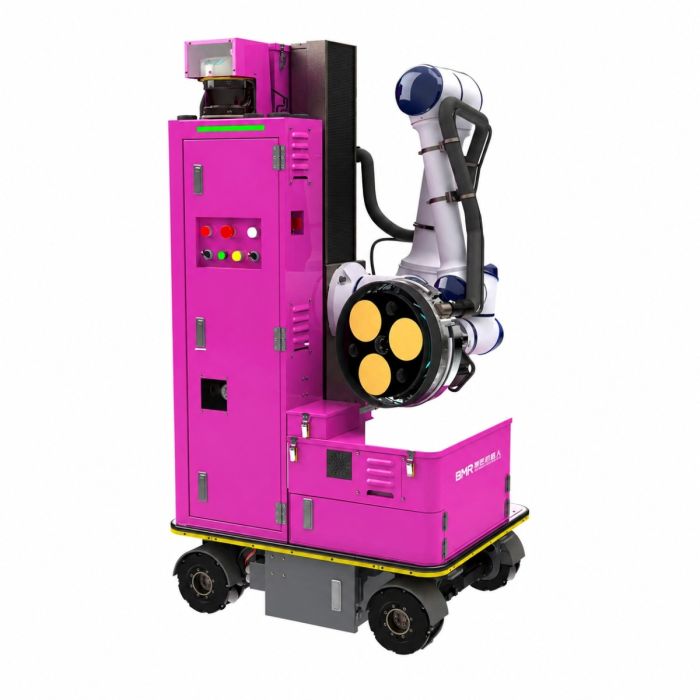
BMR Putty Grinding Robot
In stock
- BRAND:
- BMR
- ORIGIN:
- China
- Warranty:
- 12 MONTHS
- AVAILABILITY:
- SUBJECT TO AVAILABILITY
- SKU:
- BMR-Putty-Grinding-Robot
BMR Putty Grinding Robot
A ceiling more than three meters up, a fine layer of putty, and a crew that has to sand every inch of it by hand: that is the picture the BMR Putty Grinding Robot is built to change. It rolls through a finished room, grinds the walls and ceilings, and pulls the dust into its own collection box while the operator watches from an app.
The product is available through this page, by quotation.
Background
The company behind the robot
The BMR Putty Grinding Robot is made by Shenzhen BrightMaster Robotics Co., Ltd., a manufacturer of construction robots sold under the BMR name. Its range follows the order of work in a building: floors are leveled, finished and ground, and interior walls are coated and sanded. The putty grinding robot sits in the interior part of that range, where the surface is prepared before paint.
For buyers in the Caribbean, where contractors often work on apartments, office buildings and commercial premises, a machine from a family built around the whole finishing sequence is easier to plan around than a single stand-alone tool. You can see the wider family in our Construction Robots category, and the machines meant for indoor finishing in Interior Robots.
Positioning and key technology
The robot is used for putty grinding on interior walls and ceilings of buildings. Its function list is specific: intelligent constant force grinding, automatic navigation, automatic path planning, vacuuming and dust collection, automatic putty discharge, and APP remote operation. Together these cover the three things that make hand sanding difficult: keeping an even pressure, covering the surface in an orderly way, and dealing with the dust.
The grinding itself runs on a parameterized process setting. In practice that means the grinding is defined by settings rather than by the feel of the person holding the tool, and this is what gives stable and reliable grinding quality from one room to the next. Constant force grinding is the other half of the same idea: the robot works the putty with a steady force instead of a pressure that rises and falls with fatigue.
Technical Specifications
| Specification | Value |
|---|---|
| Total weight | 550kg |
| Overall dimensions | 942x752X1750mm |
| Moving speed | ≤0.5m/s |
| Positioning accuracy | ±2cm |
| Working height | ≤3200mm |
| Battery life | ≥4h |
| Charging time | ≤3h |
| Dust collection box volume | 100L |
| Height of surmountable obstacle | ≤20mm |
| Width of surmountable trench | ≤50mm |
| Climbing angle | ≤6° |
| Power supply requirements | AC220V/5kW |
Specifications as published by the manufacturer; confirmed against the datasheet at quotation.
The manufacturer has not published the box contents, the grinding head type, the noise level, the sensors and navigation hardware, the IP rating or the grinding productivity; they are confirmed at quotation.
What makes the BMR Putty Grinding Robot different from hand sanding?
Hand sanding depends on the person. Pressure changes through the shift, corners get more attention than open wall, and the ceiling is the part everyone dreads. The robot replaces that variation with a set process. Constant force grinding keeps the pressure steady, and path planning decides how the surface is covered, so the result in the last room matches the result in the first.
Dust is the second difference. Putty dust is fine, it travels through a building, and it settles on everything. The robot vacuums as it grinds and gathers the material in a 100L dust collection box, so far less of it is left to hang in the air or to sweep up afterward. Automatic putty discharge deals with the collected material, which saves the crew from constantly stopping work to empty a container by hand.
Third, the operator moves away from the work. With APP remote operation, the person in charge directs the robot from a distance instead of standing under a ceiling with a pole sander. The labor is not removed from the job; it is moved to supervision, setup and checking, which is a better use of a skilled worker.
How does the robot move around a building site?
A grinding robot is only useful if it can get across a real floor, and a finished-looking room is rarely perfectly flat. The robot is rated to surmount obstacles up to 20mm in height and trenches up to 50mm wide, and it can climb slopes up to 6°. These figures describe the kind of thresholds, cable runs and small level changes that appear between rooms.
It navigates automatically and plans its own paths, with a positioning accuracy of ±2cm and a moving speed of up to 0.5m/s. That is a deliberate pace: the machine is heavy at 550kg and its job is careful grinding, not travel. Its footprint of 942x752X1750mm means it needs to pass through doorways and corridors with this size in mind, and the working height of up to 3200mm sets the ceiling height it can reach.
Power is the practical point to plan for. The robot needs an AC220V/5kW supply. The battery life is at least 4h and charging takes up to 3h, so a crew can plan grinding sessions and charging breaks around the daily schedule. The manufacturer has not published the navigation hardware, so ask us for that detail when you request the quotation.
Who is the BMR Putty Grinding Robot for?
The manufacturer names fine decoration and industrial decoration scenarios: ordinary residences, western-style houses, commercial houses, apartments and office buildings. In plain terms, that means interior finishing contractors who prepare walls and ceilings before painting.
Developers who deliver many similar apartments will see the benefit of a repeatable process, because identical rooms can be ground to the same standard. Commercial fit-out firms working in offices have large wall and ceiling areas where consistent quality and dust control matter to the neighbors and the schedule. Finishing contractors who struggle to find enough skilled sanding labor can use the robot to carry the heavy, repetitive part of the work.
If your work is on the coating side rather than the grinding side, look at the BMR Intelligent Coating Robot, which belongs to the same interior sequence. If you are preparing floors instead of walls, the BMR Floor Grinding Robot 850M is the nearer match. This robot is for walls and ceilings.
What is the BMR Putty Grinding Robot used for?
- Grinding putty on interior walls. The robot works the putty layer with constant force to leave a smooth surface ready for paint.
- Grinding putty on ceilings. With a working height of up to 3200mm, it reaches overhead surfaces that are tiring to sand by hand.
- Finishing apartments and residences. Ordinary residences, western-style houses and apartments are named by the manufacturer as typical settings.
- Finishing commercial and office interiors. Commercial houses and office buildings benefit from steady quality over large areas.
- Collecting dust while grinding. Vacuuming and the 100L dust collection box keep most of the debris out of the room.
- Remote supervised operation. The operator starts, monitors and directs the work from the app instead of standing next to the machine.
Pricing and Availability
This robot is sold by quotation, so no price is printed on the page. Send us your project details, such as the type of building, the ceiling heights and the power supply on site, and we will prepare a quotation. Delivery, customs and support are arranged together with the quotation, so you receive one clear answer rather than separate arrangements. The BMR Putty Grinding Robot is available on this page.
Frequently Asked Questions
What surfaces does the robot work on?
It is made for putty grinding on interior walls and ceilings of buildings. It is not described as a floor or exterior machine.
How high can it reach?
The working height is up to 3200mm, which covers the ceiling height of many residential and commercial interiors.
What power does it need?
The power supply requirement is AC220V/5kW. Check that the site can provide it before you order.
How long does it run on one charge?
The battery life is at least 4h, and the charging time is up to 3h.
Can it cross small obstacles between rooms?
Yes, within limits: it surmounts obstacles up to 20mm in height and trenches up to 50mm wide, and climbs up to 6°.
How does it deal with dust?
It vacuums while grinding and collects the dust in a 100L box. Automatic putty discharge is also part of its function list.
Where can I buy the BMR Putty Grinding Robot and what does it cost?
You can request it through this page, and the cost is given in a written quotation based on your project. We do not print a price here; delivery, customs and support are arranged with the quotation.
Summary
The ceiling that costs a crew the most effort is also the one the robot is best placed to handle. The BMR Putty Grinding Robot combines constant force grinding, automatic navigation and path planning, dust collection and app control in a 550kg machine made for interior walls and ceilings. Its stated limits are clear: a working height of up to 3200mm, a positioning accuracy of ±2cm, and a 4h battery life. If you want to take the heaviest sanding work off your crew and keep the dust under control, this page is the starting point.


