
BMR Floor Grinding Robot 850M
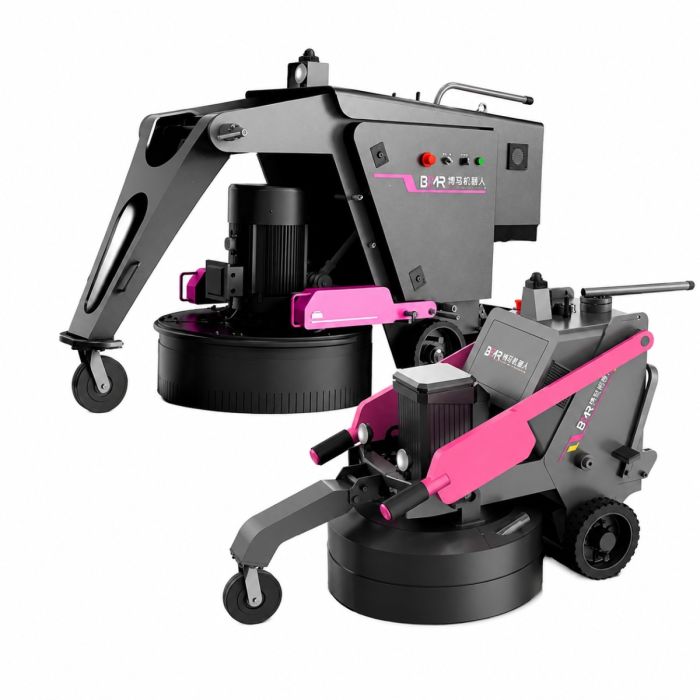
In stock
- BRAND:
- BMR
- MODEL:
- Floor Grinding Robot 850M
- ORIGIN:
- China
- Warranty:
- 12 MONTHS
- AVAILABILITY:
- SUBJECT TO AVAILABILITY
- SKU:
- BMR-Floor-Grinding-Robot-850M
BMR Floor Grinding Robot 850M
A concrete slab can look finished and still be far from ready for coating. The thin, weak skin of laitance on top has to come off first, and it has to come off evenly, across every square meter. The BMR Floor Grinding Robot 850M is built for that job: it maps the room, drives its own passes and grinds with dust collection on board, so the crew can supervise instead of pushing a machine all shift.
The product is available through this page, by quotation.
Background
The BMR brand and the 850 series
BMR builds robots for construction floors. Its range covers grinding, coating, screeding, leveling and finishing, so a contractor can follow a slab from the first pass to the final surface with machines from one family. The grinding robot comes in two versions, the 850M described here and the BMR Floor Grinding Robot 850S. The two share the same autonomous approach to floor preparation. The main difference is that the 850M carries automatic dust collection and the 850S is a lighter, more compact machine.
The robot is designed to remove surface laitance from concrete. Laitance is the weak, powdery layer that rises to the surface of fresh concrete. If it stays in place, coatings and toppings may not bond properly. Grinding is the usual way to take it off, and it has traditionally been slow, noisy and dusty work done by hand-guided machines.
Navigation and grinding technology
The 850M uses LiDAR scanning to identify the location of objects such as walls and columns. From that information it performs intelligent path planning, real-time positioning, autonomous navigation and fully automatic grinding. The positioning accuracy is 5cm. In practice this means the operator does not steer the machine across the slab; the robot works out its own route around fixed obstacles.
Beyond navigation, the robot offers safe stopping upon detecting obstacles, grinding disc protection, construction data statistics, fault alarm and FMS cloud data management. The grinding head is a planetary disc, with a working width of 850±50mm. The 850M series adds automatic dust collection, driven by a 2.4kW dust collection unit.
Technical Specifications
| Specification | BMR Floor Grinding Robot 850M |
|---|---|
| Voltage | 380 VAC |
| Power supply type | Three-phase five-wire system |
| Frequency | 50 HZ/60 HZ |
| Grinding power | 18.5kW |
| Dust collection power | 2.4kW |
| Working width | 850±50mm |
| Grinding disc | Planetary disc |
| Grinding speed | 400-2000rpm |
| Travel speed | 0.5m/s |
| Battery | 48V&30Ah |
| Operating range | 9km |
| Climbing | 15° |
| Positioning accuracy | 5cm |
| Dimensions (LxWxH) | 2030X915X1275mm |
| Weight | 754kg |
Specifications as published by the manufacturer; confirmed against the datasheet at quotation.
The manufacturer has not published the IP rating, the dust bin capacity, the charging time, the runtime per charge, the grinding efficiency, the package contents, the operating temperature range or the noise level; they are confirmed at quotation.
How does the 850M differ from the 850S?
The two versions are easiest to compare on a few points. The 850M weighs 754kg and measures 2030X915X1275mm. The 850S weighs 627kg and measures 1520X866X1204mm. The 850M has a grinding speed of 400-2000rpm, while the 850S has 0-2000rpm. Both climb 15°. The 850M carries automatic dust collection with a 2.4kW unit, and no dust collection power is given for the 850S.
For a buyer, the choice often comes down to the job site. If the work happens in an enclosed space where airborne dust is a concern, such as a workshop, a laboratory or an underground garage, the integrated collection of the 850M is the feature that matters. If access is tight and a smaller footprint counts for more, the 850S deserves a look.
Which floors can the 850M prepare?
The robot is widely applicable to the construction of several floor types: epoxy floors, sealed hardener floors, emery sealed hardener floors, epoxy terrazzo floors, inorganic terrazzo floors and terrazzo floors. Typical settings include underground parking garages, factory workshops and laboratories, among others.
What these systems have in common is the need for a clean, sound concrete surface underneath. Grinding delivers that surface, and an autonomous machine that follows planned passes helps keep the result consistent from one area of the slab to the next. For the next stage of work on the same floor, the Flooring Robots category shows the machines that follow grinding, and the wider Construction Robots category covers the rest of the site.
Who is the BMR Floor Grinding Robot 850M for?
Flooring contractors are the first group. Crews that prepare large slabs for coating or terrazzo can use the robot to take over the repetitive grinding passes, while people concentrate on supervision, edges and detail work. The data statistics and cloud management functions give managers a record of what was done.
Facility builders and general contractors are the second group. When a project includes an underground garage, a production hall or a laboratory floor, the grinding stage sits on the critical path, and a machine that works autonomously and collects its own dust fits well in an occupied or partly finished building.
Rental and equipment fleets are the third group. A machine with LiDAR navigation, three-phase power and a defined working width is a clear offer for customers who want robotic floor preparation without building the capability in-house.
Teams working in tighter spaces, or those that do not need integrated dust collection, may be better served by the BMR Floor Grinding Robot 850S.
What is the BMR Floor Grinding Robot 850M used for?
- Removing laitance: the robot takes the weak surface layer off new concrete so that later layers can bond.
- Preparing epoxy floors: grinding gives epoxy systems the clean concrete they are applied to.
- Sealed hardener and emery sealed hardener floors: the surface is ground as part of the construction of these hardened floors.
- Terrazzo work: epoxy terrazzo, inorganic terrazzo and terrazzo floors are all listed applications.
- Underground parking garages: large, open slabs where autonomous passes and on-board dust collection are an advantage.
- Factory workshops and laboratories: enclosed interiors where a mapped route around walls and columns keeps the work orderly.
Pricing and Availability
The price of the BMR Floor Grinding Robot 850M depends on the configuration and the destination, so it is handled through a quotation. Send us your project details and we will respond with the offer. Delivery, customs and support are arranged together with the quotation. The BMR Floor Grinding Robot 850M is available on this page.
Frequently Asked Questions
What power supply does the 850M need?
It runs on 380 VAC through a three-phase five-wire system, at 50 HZ/60 HZ.
How wide is the grinding path?
The working width is 850±50mm, with a planetary grinding disc.
How does the robot find its way around a room?
It uses LiDAR scanning to identify walls and columns, then plans its path, positions itself in real time and navigates on its own. The positioning accuracy is 5cm.
Does the 850M collect its own dust?
Yes. It features automatic dust collection, with a dust collection power of 2.4kW.
What battery does it use, and how far can it travel?
The battery is rated 48V&30Ah and the operating range is 9km. The travel speed is 0.5m/s.
Can it work on a slope?
The climbing ability is 15°.
Where can I buy the BMR Floor Grinding Robot 850M and what does it cost?
You can buy it through this page by requesting a quotation. We do not list a price here because the final offer depends on configuration, delivery and support.
Summary
Hand-guided grinding leaves the quality of a slab in the hands of whoever is holding the machine. The BMR Floor Grinding Robot 850M replaces that with a scanned room, a planned route and 18.5kW of grinding power over an 850±50mm width, with 2.4kW dust collection on board. It prepares epoxy, sealed hardener and terrazzo floors in garages, workshops and laboratories. For a lighter alternative, look at the 850S, and for a quotation on the 850M, this page is the starting point.