
Agilex HUNTER 2.0 (HUNTER 2.0)
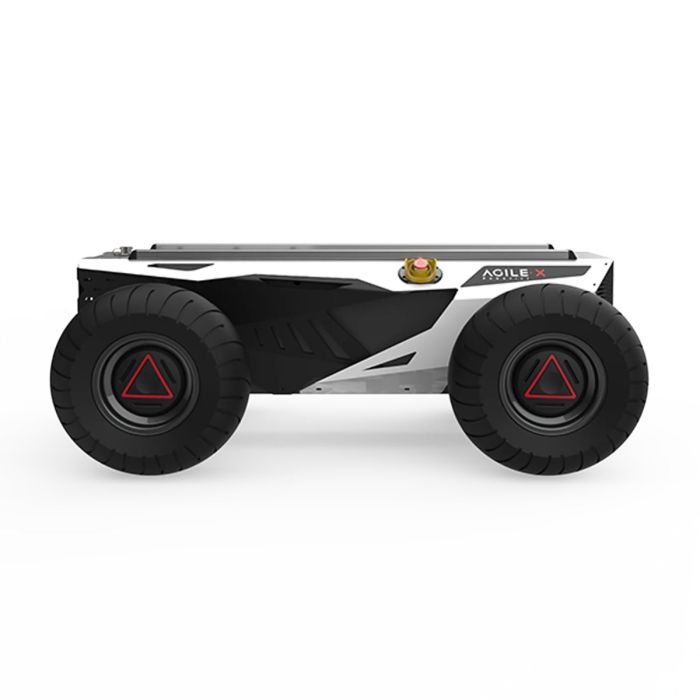
In stock
- BRAND:
- AGILEX
- PART #:
- HUNTER 2.0
- ORIGIN:
- China
- AVAILABILITY:
- SUBJECT TO AVAILABILITY
- SKU:
- AgileX-HUNTER-2.0
Agilex HUNTER 2.0 (HUNTER 2.0)
Many small research robots pivot on the spot like a shopping cart with a mind of its own. The Agilex HUNTER 2.0 (HUNTER 2.0) takes a different road: it steers with its front wheels the way a car does, and it is built for the slow, deliberate driving that autonomous-vehicle work calls for. For teams that want to test planning and control on a platform with car-like behavior, that choice shapes everything else about the chassis.
The product is available through this page, by quotation.
Background
The brand and its mobile platforms
AgileX is a robotics brand that supplies mobile chassis for research, development and prototyping. Its platforms are meant to be a starting point rather than a finished machine: a drivable base to which a team adds its own sensors, computing and software. The HUNTER 2.0 belongs to that family, and you can browse the wider range in the AgileX category.
That lineage matters because of how these chassis are used. A university lab, an integrator or a product team rarely wants a closed robot. It wants a dependable base with documented interfaces, and the HUNTER 2.0 follows that pattern with CAN bus connections, an open-source SDK and software resources, and a mounting system that accepts external hardware.
Positioning and key technology
The manufacturer developed the HUNTER 2.0 for low-speed autonomous driving scenarios. That is a specific niche. It is not a racing platform or a heavy-duty crawler. It is a ground vehicle on which engineers can study how a car-like machine behaves when software, not a driver, makes the decisions.
Two mechanical choices define it. The first is front-wheel Ackerman steering, the geometry used in road vehicles, in which the front wheels turn to follow a curved path. The second is a rocker suspension, which helps the chassis work through obstacles it meets along the way. Together they give the vehicle a driving character that planning and control researchers will recognize.
On top of that sits a practical layer. Aluminum T-slot rails let you mount external sensors or kits securely, and the communication stack is built on the CAN bus protocol. Instead of drilling and improvising, a team can bolt on what it needs and connect it through documented channels.
Technical Specifications
| Specification | Value |
|---|---|
| Intended use | Low-speed autonomous driving scenarios |
| Steering | Front-wheel Ackerman steering |
| Suspension | Rocker suspension |
| Maximum load | 150KG |
| Operating temperature | -10℃ to 45℃ |
| IP rating (standard) | IP22 only, unless separate custom IP protection is configured |
| Mounting | Aluminum T-slot rails for external sensors or kits |
| Communication standard | CAN2.0B, 500K baud rate, Motorola message format |
| Connectors | Two 4-pin aviation connectors and one DB9 (RS232) connector |
| Development resources | CAN bus protocol; open-source SDK and software resources |
| Charger | 10A charger by default |
| Remote control | FS RC transmitter provided (optional) |
| Obstacle sensing | No automatic obstacle avoidance sensor fitted |
Specifications as published by the manufacturer; confirmed against the datasheet at quotation.
The manufacturer has not published the exact dimensions, the weight, the motor power or the top speed; they are confirmed at quotation.
What makes the HUNTER 2.0 different from a skid-steer chassis?
A skid-steer or differential-drive base turns by driving its sides at different rates, which makes it agile in tight spaces. The HUNTER 2.0 turns by steering its front wheels. That sounds like a small distinction, but it changes what you can learn from the machine.
Software written for road vehicles assumes a minimum turning radius and a car-like relationship between steering angle and path. On an Ackerman platform, those assumptions hold. Teams working on lane following, path tracking, parking or low-speed urban navigation can test their algorithms on hardware whose motion model resembles the real thing, instead of adapting car-oriented code to a robot that behaves quite differently.
The rocker suspension adds to this. A chassis that has to leave a lab floor and cross uneven ground benefits from a suspension that lets it follow the surface and deal with obstacles in its path. The manufacturer states that the combination of front-wheel Ackerman steering and rocker suspension is what enables the HUNTER 2.0 to navigate the obstacles it encounters.
The trade-off is plain. A car-like platform cannot spin in place, so it needs room to maneuver. If your work depends on turning on the spot in narrow aisles, a different chassis may suit you better. If your work is about driving the way vehicles drive, this one is the more natural fit.
Does the HUNTER 2.0 avoid obstacles on its own?
No. The HUNTER 2.0 is not equipped with an automatic obstacle avoidance sensor. That is worth knowing before you plan a project, because it defines who is responsible for safe operation.
In practice, this is a platform for integrators. The T-slot rails and the connectors exist so that you can add the perception you need, whether that is cameras, ranging sensors or other equipment, and then write or install the software that acts on it. The CAN bus connection and the open-source SDK give you a route to command the vehicle from your own computer.
For early testing, the optional FS RC transmitter offers manual control. A human operator can drive the chassis while your autonomy stack is still being developed, which keeps the work safer and more predictable.
Who is the HUNTER 2.0 for?
The first group is university and institute labs working on autonomous driving at low speed. They need a vehicle-like base that a small team can handle, modify and instrument, and they value open interfaces over a closed product.
The second group is system integrators and prototyping teams. They build a payload, a sensor suite or a delivery concept and need a mobile base to carry it. With a stated maximum load of 150KG and aluminum T-slot rails, the chassis gives them a sturdy foundation for mounting equipment.
The third group is technical educators who want students to experience real vehicle kinematics. Ackerman steering, CAN messaging and a documented SDK make the HUNTER 2.0 a practical teaching platform.
Not every project fits. Because the standard rating is IP22 only and the operating range is -10℃ to 45℃, work in heavy rain or harsh dust needs a conversation about custom protection first. If you want a smaller research base, you might compare it with the Agilex SCOUT MINI R&D KIT. If your interest is converting a vehicle to drive-by-wire, the Agilex AUTO KIT is another page to read. For a tracked alternative, see the Agilex BUNKER PRO 2.0.
What is the HUNTER 2.0 used for?
- Autonomous driving research. Test path planning and vehicle control at low speed on a platform with car-like steering.
- Sensor integration. Mount external sensors or kits on the aluminum T-slot rails and connect them through the available ports.
- Custom software development. Use the CAN bus protocol, the open-source SDK and the software resources to build your own control layer.
- Payload carrying trials. Evaluate a mobile base that has a stated maximum load of 150KG for your own equipment.
- Teaching and training. Give students hands-on experience with Ackerman geometry, CAN communication and vehicle-level robotics.
- Prototype demonstrations. Build a working mobile concept for a client or a funding review on a ready-made chassis.
Pricing and Availability
We do not publish prices on this page. Quotation is the way to proceed: tell us how many units you need, which accessories such as the optional FS RC transmitter you want, and whether your site calls for custom IP protection. Delivery, customs and support are arranged together with the quotation, so you see the whole picture before you commit. The Agilex HUNTER 2.0 (HUNTER 2.0) is available on this page.
Frequently Asked Questions
What steering does the HUNTER 2.0 use?
It uses front-wheel Ackerman steering, the same basic geometry found in road vehicles. It is paired with a rocker suspension.
What is the maximum load?
The maximum load of the HUNTER 2.0 is 150KG.
How do I connect my own computer or controller?
The chassis supports the CAN bus protocol and uses the CAN2.0B standard at a 500K baud rate with the Motorola message format. It also provides two 4-pin aviation connectors and one DB9 (RS232) connector.
Can I mount sensors on it?
Yes. Aluminum T-slot rails allow secure mounting of external sensors or kits.
What water and dust protection does it have?
The standard protection is IP22 only. Separate custom IP protection can be configured if your project requires it.
Does it come with a charger and a remote control?
A 10A charger is included by default. The FS RC transmitter is provided as an option.
Where can I buy the HUNTER 2.0 and what does it cost?
You can request it through this page. The cost is given by quotation, together with delivery, customs and support arrangements, so no price is listed here.
Summary
The HUNTER 2.0 earns its place by driving the way a vehicle drives. Front-wheel Ackerman steering and a rocker suspension give researchers a familiar motion model, while T-slot rails, CAN bus, an open-source SDK and a 150KG maximum load make it a practical base for building something of your own. It does not sense obstacles by itself and its standard IP22 rating limits wet work, so it rewards teams that bring their own perception and plan their environment. If a car-like platform for low-speed autonomy is what your project needs, this page is the starting point.


