
Topsky Auxiliary reconnaissance quadruped robot dog
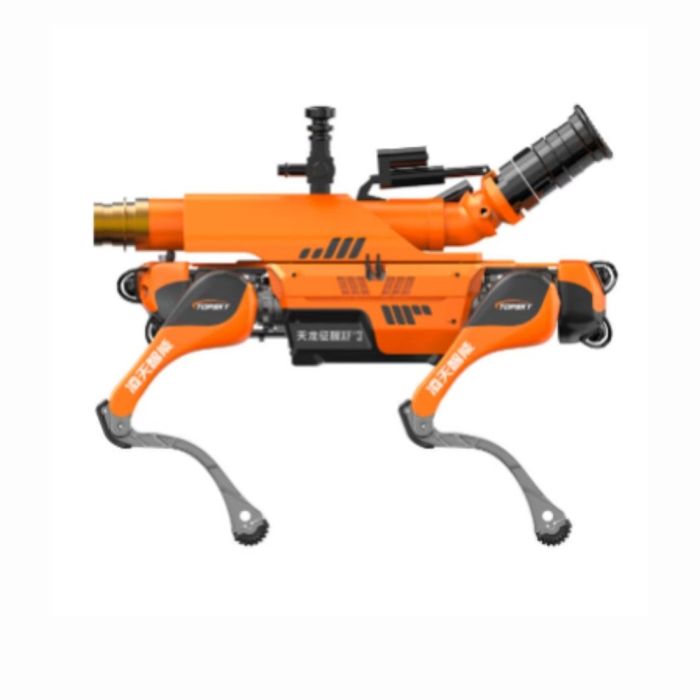
In stock
- BRAND:
- TOPSKY
- PART #:
- Auxiliary reconnaissance quadruped robot dog
- ORIGIN:
- China
- Warranty:
- 12 MONTHS
- AVAILABILITY:
- SUBJECT TO AVAILABILITY
- SKU:
- Topsky-Auxiliary-Reconnaissance-Quadruped-Robot-Dog
Topsky Auxiliary reconnaissance quadruped robot dog
Some rooms are too hot, too smoky or too unstable to send a person into first. The Topsky Auxiliary reconnaissance quadruped robot dog is made for that moment. It walks in ahead of the crew on four legs, looks around with visible-light and thermal sensors, and sends the picture back to a handheld terminal held at a safe distance.
This product is available through this page, by quotation.
Background
TOPSKY and the rescue-robot lineage
TOPSKY builds ground robots for demanding work, and its range on this site covers legged machines as well as wheeled chassis. The robot dog described here belongs to the rescue and fire-fighting side of that range. It is described by its maker as special rescue equipment that brings together bionics and intelligent technology, and it is aimed at complex, high-risk fire-fighting scenarios.
Close relatives sit beside it in the catalog. The Topsky Assistive firefighting quadruped robot dog and the Topsky High-speed fan firefighting quadruped robot dog serve fire work too, while the Topsky Auxiliary transportation quadruped robot dog is the one to look at when carrying is the main job. This model is the reconnaissance member of the family.
Positioning and key technology
The robot dog is positioned as a scout. Its job is to go first, gather information and help people decide what to do next. It carries a 360° panoramic camera and a dual-sensor gimbal that pairs visible light with thermal imaging. This lets it see through smoke to track heat sources and send back high-definition images together with temperature distribution data.
Underneath sits a sensing system that combines front and rear depth cameras with solid-state lidar, so the legs place their feet reliably on stairs. Lidar and 3D modeling technology also allow scene scanning and 3D map construction within 3 minutes, which supports path planning and the avoidance of collapse risks. A lithium battery with a quick-plug structure keeps the machine working between sorties. Mounted modules and expandable interfaces leave room for secondary development. You will find the wider family under Quadrupeds.
Technical Specifications
| Specification | Value |
|---|---|
| Protection rating | IP67 |
| Operating temperature | -20° to 55° |
| Chassis standing dimensions | 1083mm×525mm×720mm |
| Overall standing dimensions | 1083mm×525mm×955mm±100mm |
| Overall weight | Less than 95kg (including battery) |
| Charging time | Less than 2h |
| Quick battery replacement | 10s or less |
| Maximum movement speed | 6.5m/s |
| Maximum endurance time (no load) | More than 5.5h |
| Load endurance time (20kg load) | More than 4.5h |
| Maximum standing load | More than 135Kg |
| Continuous walking load | More than 40Kg |
| Maximum climbing capacity | 45° |
| Maximum step height | 20cm |
| Maximum crossing height | 40cm |
| Sensing system | Front and rear depth cameras with solid-state lidar |
| Remote control and audio-video range | 1110m in open areas |
| Power supply type | Lithium battery, quick-plug structure |
| Battery discharge port | DC46V (nominal) |
| Main communication port | Gigabit Ethernet |
| 24V power supply ports | 3 |
| 12V power supply ports | 3 |
| Gigabit Ethernet ports | 1 in, 4 out |
Specifications as published by the manufacturer; confirmed against the datasheet at quotation.
The manufacturer has not published the battery capacity, the degrees of freedom, the processor, the wireless standards, the camera resolution, the in-the-box contents or the noise level; they are confirmed at quotation.
How does the robot dog see a fire scene through smoke?
Smoke defeats ordinary cameras, and that is where this machine earns its place. The dual-sensor gimbal pairs a visible-light sensor with a thermal imaging sensor. The thermal channel follows heat rather than light, so the operator can track heat sources and read temperature distribution data even when the visible picture is poor. Alongside it, the 360° panoramic camera gives a wide view of the surroundings, so the operator is not looking at the scene through a keyhole.
Seeing is only half of reconnaissance. The lidar and 3D modeling technology can scan a scene and build a 3D map within 3 minutes. A commander looking at that map can plan a path and weigh collapse risks before anyone steps in. The handheld terminal pulls the pieces together: robot control, water cannon control, video feedback, intercom, and gas and other data collection, with video recording and screen projection on top. Because the terminal collects this data in one place, the team works from one picture instead of passing radio reports around.
What lets it move where wheels would struggle?
Legs suit broken ground. The manufacturer lists collapsed buildings, stairs, rubble piles and narrow spaces as the terrain this robot dog is adapted to. Its figures back that up: a maximum climbing capacity of 45°, a maximum step height of 20cm and a maximum crossing height of 40cm, with a top movement speed of 6.5m/s.
Stairs deserve a special mention. The front and rear depth cameras and the solid-state lidar work together so the feet land where they should on each step, which is the part of stair climbing that usually goes wrong. For flat, open ground where payload and simplicity matter more than stepping ability, a wheeled platform such as the Topsky 6X6 differential wheeled robot chassis is a different tool for a different job. The legged design belongs where the floor is uneven, partly collapsed or divided by stairs.
Endurance and load figures show how much work the machine can do. It is rated for more than 5.5h with no load and more than 4.5h with a 20kg load, with a continuous walking load of more than 40Kg and a maximum standing load of more than 135Kg. When the battery runs low, the quick-plug lithium pack can be swapped in 10s or less, or recharged in under 2h.
Who is the Topsky Auxiliary reconnaissance quadruped robot dog for?
Fire and rescue services are the obvious buyers, especially teams that cover large petroleum and chemical enterprises, tunnels, subways or other areas where collapse is a worry. For them, the robot dog replaces or supports a person during the first, riskiest look inside a hazard zone.
Industrial emergency teams and safety departments can use it the same way: a thermal, gas-aware scout that goes in before the response crew. Research groups and system integrators will care about the expandable interfaces and mounted modules, which support secondary development, and about the Gigabit Ethernet and the 24V and 12V supply ports. If your priority is extinguishing rather than scouting, compare the Topsky Assistive firefighting quadruped robot dog. If you mostly need to carry equipment, look at the Topsky Auxiliary transportation quadruped robot dog.
What is the Topsky Auxiliary reconnaissance quadruped robot dog used for?
- Fire-source location: thermal imaging through smoke helps find heat sources and track them.
- Search for trapped people: the dual-sensor gimbal and panoramic camera help locate trapped personnel.
- Scene mapping: lidar and 3D modeling build a 3D map of the scene within 3 minutes.
- Collapse-prone areas: tunnels, subways and collapsed buildings can be scouted before anyone enters.
- Petrochemical incidents: large-scale petroleum and chemical enterprises are a named fire-rescue setting.
- Data collection and development: the terminal gathers gas and other data, and the open interfaces support secondary development.
Pricing and Availability
We publish no prices on this page. A quotation is the way to proceed: tell us your use case and we will prepare an offer. Delivery, customs and support are arranged with the quotation. The Topsky Auxiliary reconnaissance quadruped robot dog is available on this page.
Frequently Asked Questions
Is the robot dog dust-proof and water-resistant?
It carries a protection rating of IP67. Its operating temperature range is -20° to 55°.
How long can it work on one battery?
Maximum endurance is more than 5.5h with no load and more than 4.5h with a 20kg load. The battery has a quick-plug structure and can be replaced in 10s or less.
How far can I control it?
Remote control and audio-video transmission reach 1110m in open areas. The handheld terminal handles robot control, video feedback and intercom.
Can it climb stairs?
Yes. Front and rear depth cameras and solid-state lidar work together to place the feet on stairs. The maximum step height is 20cm and the maximum climbing capacity is 45°.
What can it carry?
The continuous walking load is more than 40Kg and the maximum standing load is more than 135Kg. Overall weight is under 95kg including the battery.
Can I add my own equipment?
The robot dog offers mounted modules and expandable interfaces that support secondary development. Ports include 24V and 12V supplies and Gigabit Ethernet.
Where can I buy the Topsky Auxiliary reconnaissance quadruped robot dog and what does it cost?
It is available through this page, by quotation. Send us your request and we will prepare an offer; no price is listed here.
Summary
The idea behind this machine is simple: let the robot take the first look so people do not have to. Thermal and visible imaging through smoke, a 3D map in 3 minutes, legs that handle rubble and stairs, and a handheld terminal that keeps the operator at a distance all serve that one idea. The IP67 rating, the quick-swap battery and the expandable interfaces make it practical in the field. To see whether it fits your team, this page is the starting point.


