
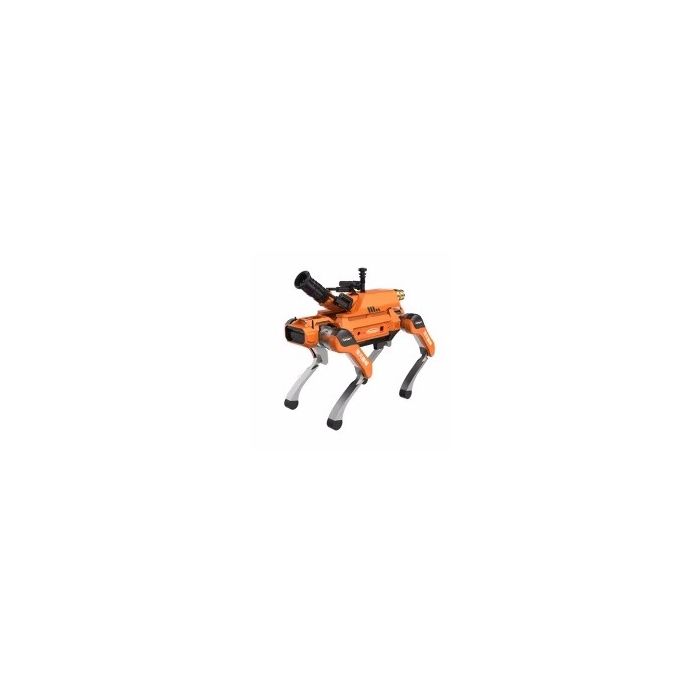
Topsky Assistive firefighting quadruped robot dog
In stock
- BRAND:
- TOPSKY
- PART #:
- Assistive firefighting quadruped robot dog
- ORIGIN:
- China
- Warranty:
- 12 MONTHS
- AVAILABILITY:
- SUBJECT TO AVAILABILITY
- SKU:
- Topsky-Firefighting-Quadruped-Robot-Dog
Topsky Assistive firefighting quadruped robot dog
A charged hose line is heavy, awkward and unforgiving, and the last stretch of it runs through the places people least want to be. The Topsky Assistive firefighting quadruped robot dog takes over that stretch on four legs. It carries a water cannon and gas sensing forward, sends video and voice back, and returns light once the hose is released.
The product is available through this page, by quotation.
Background
Topsky and the legged-robot lineage
TOPSKY builds quadruped robots for work that is too dangerous, too repetitive or too remote for people. Its range is organized by task: reconnaissance, transportation and firefighting. The firefighting line is the one that brings water, sensing and communication onto a single legged chassis.
Legged robots grew out of a simple observation. Wheels and tracks need a path, while legs need only places to put their feet. In rubble, on stairs, across thresholds and over pipes, a walking machine can keep going where a wheeled one stops. Emergency services have long wanted that ability, because the scenes they attend are rarely tidy.
Positioning and key technology
This model is advanced rescue equipment integrating bionics and intelligent technology, designed for complex and high-risk fire-fighting scenarios. It is a working platform rather than a demonstrator. The chassis is rated IP67 and operates from -20°~55°, and it accepts modules for toxic and harmful gas detection, environmental detection, two-way intercom, water cannon and ad hoc network.
Its sensing system combines front and rear depth cameras with solid-state lidar, which ensures the quadruped's foot placement on stairs. A handheld integrated terminal brings robot control, water cannon control, video, voice and data collection into one operator's hands. Status data can also travel over 4G/5G to a networked cloud platform.
Technical Specifications
| Specification | Value |
|---|---|
| Protection rating | IP67 |
| Operating temperature | -20°~55° |
| Chassis standing dimensions | 1083 mm×525mm×720mm |
| Overall standing dimensions | 1083 mm×525mm×955mm±100mm |
| Overall weight | <75kg (including battery) |
| Maximum movement speed | 6.5m/s |
| Maximum endurance (no load) | >5.5h |
| Load endurance time | >4.5h (20kg load) |
| Maximum standing load | >135Kg |
| Continuous walking load | >40Kg |
| Maximum climbing capacity | 45° |
| Maximum step height | 20cm |
| Maximum crossing height | 40cm |
| Charging time | <2h |
| Quick battery replacement | ≤10s |
| Power supply type | Lithium battery with quick-plug structure |
| Sensing system | Front and rear depth cameras with solid-state lidar |
| Battery discharge port | DC46V (nominal) |
| Main communication port | Gigabit Ethernet port |
| 24V power supply ports | 3 |
| 12V power supply ports | 3 |
| Gigabit Ethernet ports | 1 in, 4 out |
| Fire extinguishing spray distance | ≥62m |
| Maximum flow rate | ≥40L/s |
| Adjustable flow rate | 20L/30L/40L |
| Working pressure | ≤1.0MPa |
| Remote control and audio-video transmission range | 1110m in open areas |
Specifications as published by the manufacturer; confirmed against the datasheet at quotation.
The manufacturer has not published the payload capacity of the mounted modules, the battery capacity, the camera resolution, the thermal imaging specification, the contents of the box, the gas sensor detection ranges, the degrees of freedom of the legs or the noise level; they are confirmed at quotation.
What makes this robot different from a wheeled or tracked firefighting unit?
The first difference is the way it meets the ground. A legged platform places each foot deliberately, and here the front and rear depth cameras and the solid-state lidar work together to guide foot placement on stairs. The robot is rated for a maximum climbing capacity of 45°, a maximum step height of 20cm and a maximum crossing height of 40cm. Those figures describe the kind of obstacles that collapse-prone buildings, tunnels and industrial plants put in the way.
The second difference is endurance with a working load. The robot runs more than 5.5h with no load and more than 4.5h with a 20kg load. The battery is a lithium pack with a quick-plug structure, replaced in 10 seconds or less, and charging takes under 2 hours. A crew can therefore keep a robot in service by swapping packs rather than waiting at the charger.
The third difference is the pairing of water and information. Many machines can deliver water. This one also carries gas detection and environmental detection modules, a two-way intercom and an ad hoc network module, and it reports position, battery level, audio, video and gas environment data to the cloud over 4G/5G. Commanders can follow that data on a background PC terminal or a mobile terminal.
How does the water system work?
The fire extinguishing system is specified with a spray distance of at least 62m and a maximum flow rate of at least 40L/s. The flow rate can be set to 20L/30L/40L, so the operator can match the output to the scene. Working pressure is up to 1.0MPa.
The water inlet carries a quick water hose detachment system. With a remote control command the hose is detached automatically, which lets the robot dog return with a light load after completing its tasks. That matters in practice. A robot dragging a charged line behind it is slow to retreat, while one that can shed the hose can come back quickly for a new battery or a new assignment.
Control stays with the operator at a distance. Remote control and audio-video transmission reach 1110m in open areas. The handheld terminal handles water cannon control alongside walking control, so one person can steer the robot and aim the stream.
Who is the Topsky Assistive firefighting quadruped robot dog for?
Industrial fire brigades are the clearest fit, in particular at large petroleum and chemical enterprises where a close approach carries a high risk of casualties. Municipal fire and rescue services can use it for tunnels, subways and other collapse-prone spaces that need entry before anyone follows. Hazardous materials teams will value the gas and environmental modules in places where leaks and explosion risk are present.
Integrators and research teams form a second group. The platform has diversified mounted modules and expandable interfaces, and it supports secondary development. The power and data connections, including 24V and 12V supply ports and a Gigabit Ethernet port arrangement of 1 in and 4 out, give them room to add their own equipment.
Buyers whose priority is a different kind of fire attack may want to compare siblings. For a firefighting robot built around a high-speed fan, see the Topsky High-speed fan firefighting quadruped robot dog. Teams that mainly need to observe a scene before committing people can look at the Topsky Auxiliary reconnaissance quadruped robot dog. For moving equipment, there is the Topsky Auxiliary transportation quadruped robot dog. The wider range is listed under Quadrupeds.
What is the Topsky Assistive firefighting quadruped robot dog used for?
- Petroleum and chemical fire rescue. It works close to the fire in large plants where sending crews forward is dangerous.
- Tunnel and subway operations. It enters collapse-prone spaces ahead of personnel to extinguish fire and look around.
- Gas and liquid leak scenes. It carries toxic and harmful gas detection into places with flammable leaks and high explosion risk.
- Unmanned reconnaissance. It surveys toxic, oxygen-deficient, heavy-smoke and fire conditions and sends video and audio back to the operator.
- Voice contact at the scene. The two-way intercom lets commanders speak with people at the robot's position.
- Networked command support. Position, battery, audio, video and gas data go to the cloud platform for the control room to view.
Pricing and Availability
Prices are not published on this page. The call to action is a quotation: tell us your scenario, the modules you want and your location, and we will prepare it. Delivery, customs and support are arranged with the quotation. The Topsky Assistive firefighting quadruped robot dog is available on this page.
Frequently Asked Questions
How long does the robot run on one battery?
It runs more than 5.5h with no load and more than 4.5h with a 20kg load.
How quickly can the battery be changed?
The lithium battery uses a quick-plug structure, and replacement takes 10 seconds or less. Charging time is under 2h.
Can it work in water and dust?
Yes, it carries an IP67 protection rating. It operates at temperatures from -20°~55°.
How far can I control it?
Remote control and audio-video transmission reach 1110m in open areas. Describe your site when you ask for a quotation.
What can it climb and cross?
The maximum climbing capacity is 45°, the maximum step height is 20cm and the maximum crossing height is 40cm. Depth cameras and solid-state lidar guide its foot placement on stairs.
Can I add my own equipment?
The platform has diversified mounted modules and expandable interfaces, and it supports secondary development. Interfaces include 3 ports of 24V, 3 ports of 12V and Gigabit Ethernet.
Where can I buy the Topsky Assistive firefighting quadruped robot dog and what does it cost?
It is available through this page, by quotation, and no price is printed here. Send us your requirements and we will respond with a quotation covering delivery, customs and support.
Summary
The hardest part of a fire is often the approach, and this robot is built for it. It walks over steps and slopes, carries a water cannon with a spray distance of at least 62m, senses gas and its environment, and reports back over a link that reaches 1110m in open areas. It sheds its hose when the job is done and returns light for a quick battery swap. If your team needs to put a machine in front of the danger instead of a person, this page is the starting point.


