
Genisom M1 RoamerX Pro Quadruped Robot
In stock
- BRAND:
- GENISOM
- MODEL:
- M1 RoamerX Pro
- ORIGIN:
- China
- AVAILABILITY:
- SUBJECT TO AVAILABILITY
- SKU:
- Genisom-M1-RoamerX-Pro
Buy now, pay later
Genisom M1 RoamerX Pro Quadruped Robot
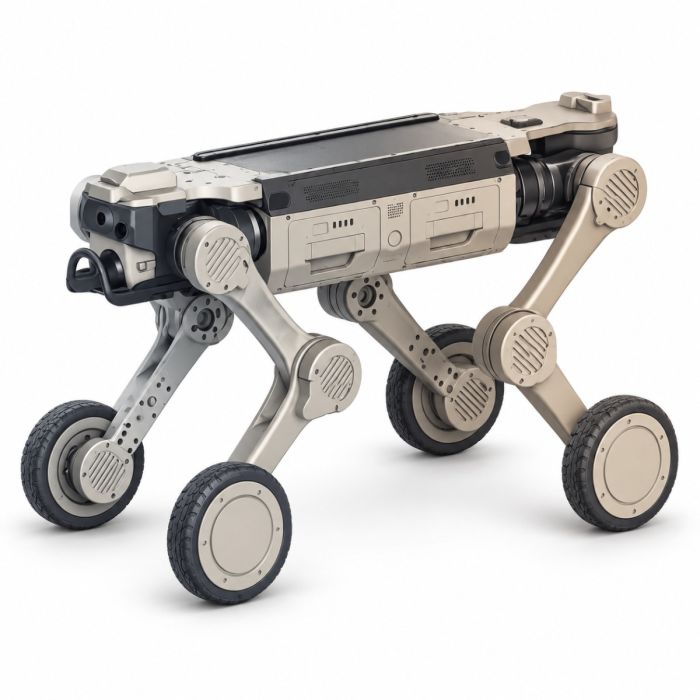
Most quadruped robots ask you to choose: either a machine light enough to carry and deploy, or one strong enough to do real work. The Genisom M1 RoamerX Pro Quadruped Robot is built around the idea that you should not have to choose. Its body weighs approximately 30kg, and it carries approximately 30kg continuously, a load-to-weight ratio of nearly 1:1.
The product is available through this page, by quotation.
Background
GENISOM AI and the M1 line
GENISOM AI is a Beijing-based company. It puts its emphasis on industry deployment: robotics hardware and software developed together, core technologies kept in-house, and a focus on how machines perform in real applications rather than on a demonstration stage. That outlook shows in the M1, which is designed for inspection routes, industrial yards and sites where a robot is expected to work a full shift.
The M1 family is offered in three versions named in the manufacturer's material: M1, M1 Pro and M1 Ultra. The RoamerX Pro edition described on this page belongs to that family. Buyers who want to compare the base machine or the Pro version can look at the Genisom M1 Light Weight High Payload Quadruped Robot Dog and the Genisom M1 Pro Quadruped Robot. The wider range sits in our Quadrupeds category.
Positioning and key technology
The manufacturer describes the M1 as the industry's first lightweight, high-load, fully protected quadruped robot. Each word in that phrase points to a design priority. Lightweight means a body of approximately 30kg, the lightest in its class. High-load means approximately 30kg of continuous operational load. Fully protected speaks to a machine meant for outdoor and industrial conditions rather than for a clean laboratory floor.
The legs are driven by GENISOM AI's in-house joint actuator modules. These include the P85MAX-S actuator, which reaches a peak torque of 180 N·m. Torque at the joint is what lets a light frame climb, step and recover while carrying a payload, and it is the reason the machine can clear an 80cm vertical obstacle and climb steps 25cm high in succession.
The M1 also treats expansion as a core feature. It offers 15 standard hardware interfaces, fully open, covering communication, power and control, so that integrators can mount different carriers and computing modules without redesigning the robot.
Technical Specifications
| Specification | Value |
|---|---|
| Total body weight | Approximately 30kg |
| Continuous operational load | Approximately 30kg |
| Load-to-weight ratio | Nearly 1:1 |
| Continuous climbing step height | 25cm |
| Vertical obstacle height | 80cm |
| Limit climbing angle | 45° |
| Operating temperature | -20°C ~ 55°C |
| Optional wide-temperature battery version | -40°C ~ 80°C |
| Battery system | Dual battery quick-swap design |
| Maximum no-load endurance | 5 hours / 29km |
| Automatic recharging | Optional smart charging station, low-battery automatic return |
| Hardware interfaces | 15 standard hardware interfaces, fully open |
| Joint actuator | P85MAX-S, peak torque 180 N·m |
| Voice and tracking (M1 Pro version) | Voice dialogue, voice recording and broadcasting, UWB and laser vision fusion tracking |
| Panoramic perception (M1 Ultra version) | 720° panoramic perception |
Specifications as published by the manufacturer; confirmed against the datasheet at quotation.
The manufacturer has not published the dimensions, the charging time, the battery capacity, the maximum speed, the sensor list, the onboard compute, the box contents or the exact weight of the Pro version; they are confirmed at quotation.
What makes the M1 different from other quadruped robots?
The first difference is the ratio of what the machine carries to what it weighs. Many quadrupeds of this size carry only a fraction of their own mass. The M1 carries approximately 30kg continuously at a body weight of approximately 30kg. For a team, this changes the logistics: one person can handle the robot, yet the robot can still bring a meaningful sensor package, a manipulator or a computing module to the site.
The second difference is how the machine handles terrain. A continuous step height of 25cm, a vertical obstacle height of 80cm and a limit climbing angle of 45° describe a robot meant for stairwells, equipment platforms, rubble and slopes, not only for flat corridors.
The third difference is endurance management. The dual battery quick-swap design lets an operator exchange batteries rather than wait for a charge, which reduces downtime. The maximum no-load endurance is 5 hours or 29km. An optional smart charging station lets the robot return on its own when the battery runs low, which supports long periods of unmanned operation.
What does the Pro version add?
According to the manufacturer, the M1 Pro supports voice dialogue, voice recording and broadcasting, and UWB and laser vision fusion tracking. In practice that means a robot that can speak to people on site, record and play back audio, and follow a target by combining ultra-wideband positioning with laser and vision data. These functions suit guided patrols, escort tasks and public-facing duties.
The M1 Ultra goes in another direction, with 720° panoramic perception that further improves depth perception and recognition of complex environments. Buyers whose priority is awareness of cluttered or irregular surroundings should ask about the Ultra version when requesting a quotation.
Who is the Genisom M1 RoamerX Pro for?
Industrial operators are the clearest segment. Plants, power facilities, and sites that swing from extreme cold to high heat need a robot rated for -20°C ~ 55°C, with an optional wide-temperature battery version for -40°C ~ 80°C. Inspection teams benefit from the payload capacity, which allows mounting of cameras, gas sensors or other instruments.
Integrators and research groups are the second segment. The 15 open hardware interfaces and compatibility with multiple carriers and computing modules give them a platform to build on rather than a closed product. Companies developing their own payloads or autonomy software can attach them through the communication, power and control interfaces.
Security and public-service users will find the voice and tracking functions of the M1 Pro version relevant. Buyers who need a smaller platform for teaching or lighter duties may prefer the Genisom L1 EDU RoamerX Pro Quadruped Robot. More options are listed under Standard Quadrupeds.
What is the Genisom M1 RoamerX Pro used for?
- Industrial inspection. Walks routine routes through plants and yards, carrying inspection instruments up stairs and over obstacles.
- Payload transport. Moves equipment of approximately 30kg continuously across ground where wheeled carts cannot go.
- Extreme-temperature sites. Works in cold and hot industrial environments within its stated temperature range, with the wide-temperature battery as an option.
- Unmanned patrols. Returns to the optional smart charging station when the battery is low, supporting long-term operation without an operator.
- Custom payload development. Hosts third-party carriers and computing modules through its 15 open hardware interfaces.
- Guided interaction and following. In the M1 Pro version, speaks, records, broadcasts and follows targets using UWB and laser vision fusion tracking.
Pricing and Availability
Every Genisom M1 RoamerX Pro Quadruped Robot is quoted to the buyer's configuration, including options such as the wide-temperature battery version and the smart charging station. Please send us your requirements and we will prepare a quotation. Delivery, customs and support are arranged together with the quotation. The robot is available on this page.
Frequently Asked Questions
How much can the robot carry?
The manufacturer states approximately 30kg of continuous operational load on a body weight of approximately 30kg, a load-to-weight ratio of nearly 1:1.
What obstacles can it climb?
It climbs continuous steps 25cm high, clears a vertical obstacle of 80cm and manages a limit climbing angle of 45°.
How long does the battery last?
The maximum no-load endurance is 5 hours or 29km. The dual battery quick-swap design lets you exchange batteries to reduce waiting time.
Can it work in very cold or hot conditions?
The operating temperature is -20°C ~ 55°C. An optional wide-temperature battery version extends this to -40°C ~ 80°C.
Can I add my own equipment?
Yes. The robot has 15 standard hardware interfaces, fully open, with communication, power and control connections for multiple carriers and computing modules.
Does it recharge by itself?
With the optional smart charging station, the robot returns automatically for recharging when the battery is low.
Where can I buy the Genisom M1 RoamerX Pro Quadruped Robot and what does it cost?
You can buy it through this page by requesting a quotation. The cost depends on the configuration and options, so we give it in the quotation rather than as a list figure.
Summary
The question at the start was whether a quadruped robot must trade weight for strength. The Genisom M1 RoamerX Pro answers with a body of approximately 30kg that carries approximately 30kg, climbs 25cm steps, clears 80cm obstacles and swaps batteries rather than waiting for a charge. Open interfaces make it a base for your own payloads, and the Pro and Ultra versions add voice, tracking and panoramic perception. For specifications confirmed against the datasheet, and for a quotation to match your site, this page is the starting point.