
FF Faber T Industrial EAI Mobile Manipulator
In stock
- BRAND:
- FARADAY FUTURE
- MODEL:
- FABER T
- ORIGIN:
- United States
- Warranty:
- 12 MONTHS
- AVAILABILITY:
- PRE-ORDER
- SKU:
- FF-Faber-T
FF Faber T Industrial EAI Mobile Manipulator
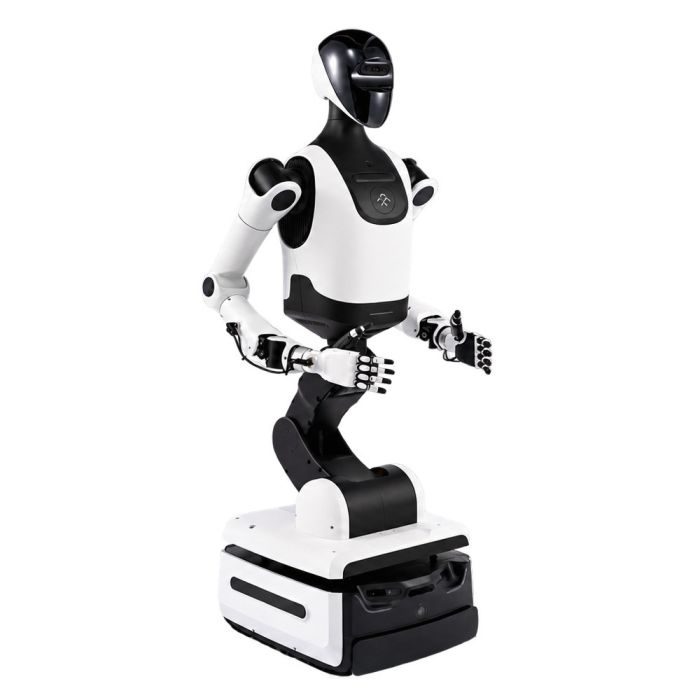
Some jobs are done best by someone who is not in the room: a heavy electrical switch that must be closed, a corridor of server racks, a substation where one mistake is costly. The FF Faber T Industrial EAI Mobile Manipulator is built for that kind of work, a wheeled machine with two arms that can step into a risky task so a person does not have to.
The product is available through this page, by quotation.
Background
Faraday Future and the meaning of Faber
Faraday Future (FF) was founded in 2014 and is a U.S.-based Physical AI ecosystem company. Its mission is reshaping the future of robotics and mobility solutions through AI innovation and technologies. The Faber series is part of that mission and sits in the company's wider robotics line, alongside the humanoids you can browse in our Humanoids category.
The name Faber comes from Latin and means "skilled craftsman." The choice fits the machine. This is not a showpiece built to wave at a crowd. It is a working tool meant to do careful, precise tasks with its hands.
Where Faber T sits in the series
The Faber series comprises three sub-models. Faber U is the most advanced, with Thor AI compute and multi-sensor fusion. Faber T has the potential to be deployed at scale for power inspection and data centers. Faber S offers the largest arm span with a full embodied-AI data collection toolchain.
Faber T is the sub-model aimed at repeatable, field-style deployments. It has already been deployed at scale for power inspection, energy infrastructure, and data centers. The whole series is an industrial-grade EAI operator, meaning an embodied-AI machine that works with its hands in real facilities. It combines autonomous navigation, omnidirectional mobility, dual-arm coordination, and precision operation.
Technical Specifications
| Specification | Value |
|---|---|
| Series | Faber (sub-model Faber T) |
| Arms | Dual 7-axis arms |
| Degrees of freedom (Faber series) | 26–35 DOF |
| Single-arm lift | Up to 11 pounds |
| Operating range | Ground level to about 6.6 feet high |
| Force-control precision | Better than 0.5 newtons |
| Mobility | Autonomous navigation and omnidirectional mobility |
| Software platform | Open Ubuntu/ROS platform |
| Customization | Exclusive customization fully supported |
Specifications as published by the manufacturer; confirmed against the datasheet at quotation.
The manufacturer has not published the dimensions, the weight, the battery capacity, the runtime, the compute platform, the sensors, the drive speed, the IP rating, the contents of the box, the connectivity or the total degrees of freedom for this version; they are confirmed at quotation.
What makes FF Faber T different from Faber U and Faber S?
The three sub-models share one platform, but each leans toward a different job. Faber U is the most advanced of the three. It is equipped with the Thor high-performance AI compute platform, dual LiDAR, and a multi-camera sensing system. A buyer who wants the strongest perception and compute in the series should start there.
Faber S offers the largest arm span and comes with a full embodied-AI data collection toolchain. It suits teams that want to gather training data and develop their own behaviors.
Faber T takes a different position. Its stated strength is the potential to be deployed at scale, and its record is in power inspection, energy infrastructure, and data centers. If your plan is to put the same capable machine into many similar sites, the Faber T is the sub-model built around that idea. The compute and sensor details quoted for Faber U belong to Faber U only and are not carried over to Faber T.
Why do the arms and the open platform matter?
Two arms change what a mobile robot can do. A single arm can lift up to 11 pounds, while both arms can work together to handle transport, assembly, and delicate operations that would be difficult for one arm alone. Each arm has seven axes, and the Faber series has 26–35 DOF overall. The result is a machine that can reach around obstacles and approach a task from more than one angle.
Reach matters just as much. The operating range runs from ground level to about 6.6 feet high, so one robot can work at a floor-level panel and at a shelf or switch well above waist height. Force-control precision better than 0.5 newtons means it can handle a task with a light touch instead of brute force. That is the difference between pressing a control and breaking it.
The software side is open. The series runs on an open Ubuntu/ROS platform, which is familiar to many robotics engineers. Teams that already write for ROS do not need to learn a closed system from scratch. Faber also fully supports exclusive customization, so the solution can be shaped to the work of a particular industry or site.
Who is FF Faber T for?
Utilities and energy operators are the clearest fit. Power inspection and energy infrastructure are named uses, and the ability to take over high-risk tasks from humans, such as closing electrical switches, speaks directly to safety managers.
Data center operators are the second segment. Repetitive walk-through and hands-on tasks in controlled halls are the kind of work the Faber T has been deployed for at scale.
Industrial and logistics teams form a third group. The series' primary focus today is industrial loading, unloading, and logistics transfer, and the dual arms are built for transport and assembly. Integrators and research groups that want a deeper sensing and compute stack should look at Faber U, and those who need the widest arm span and data collection tools should look at Faber S. Universities and labs exploring embodied AI can also browse our Research Robots category.
What is FF Faber T used for?
- Closing electrical switches. The robot can take over this high-risk task from humans.
- Power inspection. Faber T has already been deployed at scale for this work.
- Energy infrastructure. Sites that carry the load of the grid are a named deployment area.
- Data center operations. Rolling, reaching and handling work inside server environments is part of the deployment record.
- Industrial loading and unloading. The Faber series lists this as its primary focus today.
- Logistics transfer. Two arms working together can handle transport, assembly, and delicate operations.
Pricing and Availability
We do not print prices on this page. Quotation is the way to buy: send us your site, your task and your quantity, and we will answer with a quote. Delivery, customs and support are arranged with the quotation. The FF Faber T Industrial EAI Mobile Manipulator is available on this page.
Frequently Asked Questions
What is the FF Faber T?
It is an industrial-grade embodied-AI mobile manipulator from Faraday Future. It is one of three sub-models in the Faber series, with dual arms and an omnidirectional base.
How much can it lift?
A single arm can lift up to 11 pounds. Both arms can work together on transport, assembly, and delicate operations that would be difficult for one arm alone.
How high and how precisely can it work?
Its operating range extends from ground level to about 6.6 feet high. Force-control precision is better than 0.5 newtons.
What software does it run?
The series is built on an open Ubuntu/ROS platform. That lets engineers who already know ROS work with it in a familiar environment.
Can it be customized?
Yes. Faber fully supports exclusive customization, providing customers with the best industry solutions.
What does the name Faber mean?
Faber comes from Latin and means "skilled craftsman." It reflects the series' focus on careful, precise work.
Where can I buy the FF Faber T and what does it cost?
You can request it through this page, by quotation. We do not list a price here; the quotation covers your configuration, with delivery, customs and support arranged alongside it.
Summary
The FF Faber T is a machine meant to go where a person would rather not: the live switch, the substation, the long rows of a data center. It brings two 7-axis arms, a reach from the floor to about 6.6 feet, a light touch measured to better than 0.5 newtons, and an open Ubuntu/ROS platform. Within the Faber series it is the sub-model with a deployment record at scale. If you want to put it to work, this page is the starting point.