
FF Master Ultra Humanoid Robot
In stock
- BRAND:
- FARADAY FUTURE
- ORIGIN:
- United States
- Warranty:
- 12 MONTHS
- AVAILABILITY:
- SUBJECT TO AVAILABILITY
- SKU:
- FF-Master-Ultra
FF Master Ultra Humanoid Robot
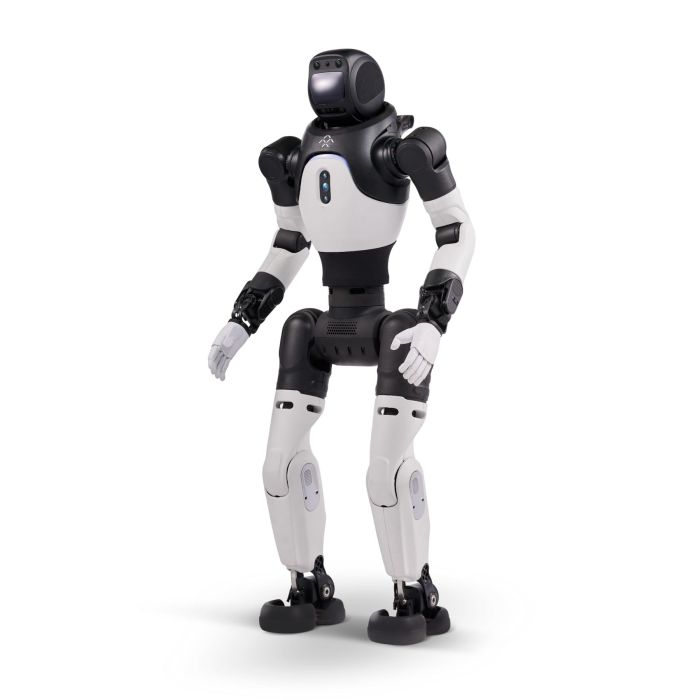
Some robots are built to be admired from behind a rope; the FF Master Ultra Humanoid Robot is built to be put to work, and even to be steered by a person wearing a VR headset in another place entirely. It is a compact humanoid with a serious computing core, a full set of cameras and LiDAR, and a cellular link, which makes it a tool for teams who want to test what embodied AI can do in a real room.
The product is available through this page, by quotation.
Background
Faraday Future and the FF Master line
FARADAY FUTURE is best known for its work in advanced mobility, and its humanoid and mobile manipulator robots extend that engineering into embodied AI. The catalog on this site shows a family with a clear ladder of sizes and purposes: the compact FF Master line, the FF Master Mini, the full-size FF Futurist, and the industrial Faber series of mobile manipulators. Each is aimed at a different kind of buyer.
Within the FF Master line the sources name three versions: FF Master, Master Edu and Master Ultra. The Ultra is the top of the compact family, and everything in this article describes the Ultra only. For the teaching-oriented sibling, see the FF Master Edu Humanoid Robot.
Positioning and key technology
The Master Ultra is a compact humanoid robot that stands 1.31 m tall and weighs 39 kg. That size matters. A machine at this scale can work in classrooms, labs, exhibition halls and offices without the clearances, transport arrangements and safety zones that a full-size humanoid demands. Where a project needs an adult-scale body, the FF Futurist Full-Size Humanoid Robot is the place to look instead.
The technology that sets the Ultra apart is its computing and sensing. It is powered by an NVIDIA Orin NX 16GB module rated at 157 TOPS, which gives developers on-board capacity for perception, planning and learning workloads. Around that core sits a set of sensors: 3D LiDAR, an interactive RGB camera, dual front RGB cameras, a rear RGB camera and an RGB-D camera. The body offers 30 degrees of freedom, so the robot has enough joints for expressive and varied movement.
Connectivity completes the picture. The robot supports 4G/5G connectivity and VR remote manipulation, so an operator does not have to be in the same room as the machine.
Technical Specifications
| Specification | Value |
|---|---|
| Version | Master Ultra |
| Height | 1.31 m |
| Weight | 39 kg |
| Degrees of freedom | 30 DOF |
| Peak torque | 120 N·m |
| Max speed | 1.8 m/s |
| AI compute | NVIDIA Orin NX 16GB (157 TOPS) |
| Connectivity | 4G/5G; VR remote manipulation supported |
| Cameras and LiDAR | 3D LiDAR, interactive RGB camera, dual front RGB cameras, rear RGB camera, RGB-D camera |
Specifications as published by the manufacturer; confirmed against the datasheet at quotation.
The manufacturer has not published the payload, the battery capacity, the runtime, the IP rating, the dimensions, the operating temperature, the charging time, the Wi-Fi and Bluetooth details for the Ultra or the box contents; they are confirmed at quotation.
What makes the FF Master Ultra different from a typical compact humanoid?
The first difference is how much the robot can perceive and process. Many small humanoids are sold mainly as motion platforms: they walk, wave and perform. The Master Ultra pairs its 30 degrees of freedom with an NVIDIA Orin NX 16GB rated at 157 TOPS and a sensor set that includes 3D LiDAR, an RGB-D camera and several RGB cameras. That combination points to a machine meant to sense its surroundings and run AI models, not only to replay motions.
The camera layout is worth a closer look. Dual front RGB cameras face the direction of travel, an interactive RGB camera supports engagement with people, and a rear RGB camera covers what is behind the robot. Together with the 3D LiDAR and the RGB-D camera, the robot has views from several angles and in several modes, which gives developers a rich stream of data to work with.
The second difference is reach. With 4G/5G connectivity and VR remote manipulation, the Ultra can be operated from a distance. A research group can collect demonstrations through a headset, and a trainer can show the robot a task while standing elsewhere. That is a different way of working from a robot that must always be supervised on site.
The third difference is physical capability. A peak torque of 120 N·m and a maximum speed of 1.8 m/s describe a robot with real drive in its joints, not a desktop figure.
How does the Ultra compare with the other robots in the range?
The range is organized by scale and by purpose. The FF Master Mini Humanoid Robot sits at the small end of the line, while the full-size Futurist covers adult-scale work. The Ultra occupies the middle: small enough for ordinary rooms, yet equipped with a computing and sensing package suited to serious development work.
Within the FF Master family, the Edu version is the one to compare first. The Ultra is the version this page describes, with the Orin NX computing, the full camera set and LiDAR listed above. When you request a quotation, ask for the Edu and Ultra side by side so that the differences in hardware and in scope are laid out for your own project. You can also browse the full Humanoids category to see every option in one place.
Who is the FF Master Ultra for?
Universities and research institutes are the clearest fit. A humanoid with 157 TOPS of on-board AI compute, LiDAR and depth sensing can host work in perception, navigation, manipulation and human-robot interaction, and VR remote manipulation helps with collecting demonstration data.
Developers and robotics companies form the second group. They need a compact platform on which to build and test software before moving to larger machines, and the Ultra's size keeps the cost of space and logistics low.
Training centers and technical schools can use it to show students how a modern humanoid is built and programmed. Teams whose main goal is teaching may prefer to compare it with the Edu version first.
Exhibition organizers, innovation labs and public-facing venues are a further group. A robot of this size can stand close to visitors, and its interactive RGB camera supports engagement with them. Buyers who need an industrial mobile manipulator instead should look at the FF Faber U Industrial EAI Mobile Manipulator.
What is the FF Master Ultra used for?
- Embodied AI research. Teams run perception and decision models on the Orin NX 16GB and test them on a body with 30 degrees of freedom.
- Remote operation trials. Operators use VR remote manipulation over 4G/5G to guide the robot from another location.
- Navigation and mapping work. The 3D LiDAR and RGB-D camera give developers the data needed to study how a humanoid understands space.
- Teaching and training. Instructors show students real humanoid hardware, from joints and sensors to on-board computing.
- Human-robot interaction studies. The interactive RGB camera and the compact build make close contact with people practical.
- Demonstrations and exhibitions. A walking, seeing humanoid draws attention at shows, labs and customer visits.
Pricing and Availability
No price is listed on this page, because every deployment differs in quantity, configuration and destination. Request a quotation and we will answer your questions about the configuration you need. Delivery, customs and support are arranged together with the quotation. The FF Master Ultra Humanoid Robot is available on this page.
Frequently Asked Questions
How tall is the FF Master Ultra and how much does it weigh?
The Master Ultra stands 1.31 m tall and weighs 39 kg.
What computing hardware does it use?
It is powered by an NVIDIA Orin NX 16GB rated at 157 TOPS. This gives developers on-board capacity for AI workloads.
Which sensors does the robot carry?
It carries 3D LiDAR, an interactive RGB camera, dual front RGB cameras, a rear RGB camera and an RGB-D camera. Together they give a wide view of the robot's surroundings.
Can the robot be controlled remotely?
Yes. It supports 4G/5G connectivity and VR remote manipulation, so an operator can guide it from another location.
How fast can it move and how strong are its joints?
The maximum speed is 1.8 m/s and the peak torque is 120 N·m. The robot has 30 degrees of freedom.
Which version of the FF Master line does this page cover?
This page covers the Master Ultra, the top version of the compact FF Master family. The FF Master and the Master Edu are separate versions with their own pages or quotations.
Where can I buy the FF Master Ultra Humanoid Robot and what does it cost?
You can request it through this page, and the cost is given in a quotation that depends on quantity, configuration and destination. No price is shown here.
Summary
The FF Master Ultra Humanoid Robot is less about showing off a humanoid shape than about giving a team a machine that notices, computes and can be steered from far away. Its compact 1.31 m, 39 kg body fits ordinary rooms, while the NVIDIA Orin NX 16GB at 157 TOPS, the LiDAR and camera set, the 30 degrees of freedom and the 4G/5G link give it the depth that research and training work calls for. If it matches your project, this page is the starting point.