
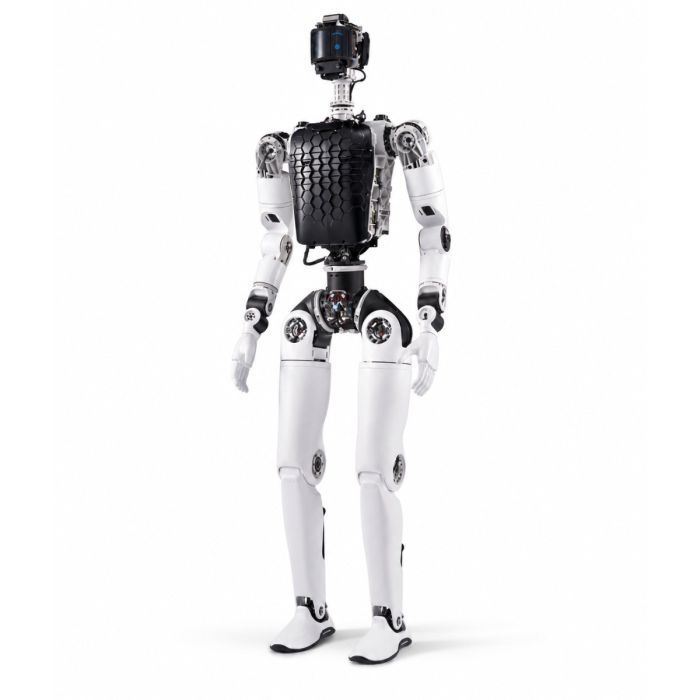
FF Futurist Full-Size Humanoid Robot
In stock
- BRAND:
- FARADAY FUTURE
- MODEL:
- FUTURIST
- ORIGIN:
- United States
- AVAILABILITY:
- PRE-ORDER
- SKU:
- FF-Futurist
FF Futurist Full-Size Humanoid Robot
A humanoid robot that only looks good on a stage is a costly ornament. A humanoid that can be put to work in a laboratory, a showroom or a field trial is a tool. The FF Futurist Full-Size Humanoid Robot from Faraday Future is built to be the second kind: a full-size professional EAI humanoid that moves its whole body under NVIDIA SONIC full-body motion control, the U.S.'s first of its kind.
The product is available through this page, by quotation.
Background
Faraday Future and its move into Physical AI
Faraday Future, known as FF, was founded in 2014 and is a U.S.-based Physical AI ecosystem company. Its mission is reshaping the future of robotics and mobility solutions through AI innovation and technologies. That dual focus matters for buyers. A company that works on both vehicles and robots is used to treating actuators, power systems and software as one engineering problem, and the Futurist is the humanoid expression of that approach.
The Futurist has a lineage. The current model is called the All-New Futurist because it replaces a previous generation of the same robot, and it is around 14% lighter than that earlier Futurist. For anyone who has followed the first generation, this is a redesign with a clear direction: less mass to carry, move and keep upright.
Positioning and key technology
The All-New Futurist is a full-size professional EAI humanoid robot. EAI stands for embodied AI, the idea that artificial intelligence is most useful when it has a body and acts in the physical world. The robot is designed for academic research, commercial applications and real-world deployment, so it is aimed at professionals rather than hobbyists.
The key technology is NVIDIA SONIC full-body motion control. In a humanoid, the hard problem is not moving one arm or one leg. It is coordinating dozens of joints at once so that the machine stays balanced while it reaches, steps or turns. Full-body motion control addresses this as a single task instead of a set of separate ones. A second version, the Ultra, is scheduled for release later this year and will be powered by the Jetson Thor high-performance AI compute platform. It will also support autonomous charging.
Technical Specifications
| Specification | Value |
|---|---|
| Product type | Full-size professional EAI humanoid robot (All-New Futurist) |
| Motion control | NVIDIA SONIC full-body motion control (All-New Futurist) |
| Height | Approximately 5 feet 8 inches (All-New Futurist) |
| Weight | About 121 pounds, around 14% lighter than the previous generation (All-New Futurist) |
| Degrees of freedom | 31 across the body, excluding the hands (All-New Futurist) |
| Peak knee-joint torque | 320 newton meters (All-New Futurist) |
| AI compute | Jetson Thor high-performance AI compute platform (Ultra version, scheduled for release later this year) |
| Charging | Autonomous charging supported (Ultra version, scheduled for release later this year) |
Specifications as published by the manufacturer; confirmed against the datasheet at quotation.
The manufacturer has not published the payload, the IP rating, the maximum walking speed, the degrees of freedom of the hands, the sensor suite, the connectivity, the operating system, the charging time, what is in the box or the full dimensions; they are confirmed at quotation.
What makes the All-New Futurist different from the previous generation?
The clearest difference is mass. The All-New Futurist weighs about 121 pounds, around 14% lighter than the previous generation. In a legged machine, weight affects almost everything: how much torque the joints must produce, how much energy each step consumes, how safe the robot is to handle in a lab and how easy it is to transport. A lighter body is a practical gain, not just a headline.
The second difference is the way the body is controlled. The All-New Futurist is built around coordinated movement of the whole body through NVIDIA SONIC. Combined with 31 degrees of freedom across the body, excluding the hands, this gives a research team a platform with a rich range of joints to work with. Teams planning manipulation work should ask about the hands when they request a quotation, because the figure of 31 does not include them.
The third point is leg strength. A peak knee-joint torque of 320 newton meters speaks to how the robot carries its own body through demanding movements. Knees do much of the work in standing, stepping and recovering balance, so the torque of these joints is a useful indicator of the platform's physical capability.
What does the Ultra version add?
The Ultra version is the planned step up. It is scheduled for release later this year, will be powered by the Jetson Thor high-performance AI compute platform, and will support autonomous charging. These two additions point in a direction that matters to operators. More onboard compute gives developers more room for perception and decision-making software, and autonomous charging lets a robot return to power without a person plugging it in.
It is worth being plain about timing. The Ultra is not yet released, and the figures in the table above belong to the All-New Futurist. Where an item is tied to the Ultra, the table says so. If your project depends on the extra compute or on autonomous charging, mention it in your quotation request so that the right version and its release status can be discussed.
Who is the FF Futurist for?
Universities and research institutes are the most natural buyers. A full-size humanoid with full-body motion control and 31 degrees of freedom across the body is a platform on which students and researchers can study locomotion, balance, whole-body control and the way AI models translate into physical action. Academic research is a design purpose of the robot, so this is a core segment and not a side use.
Commercial developers and system integrators form the second group. Companies exploring humanoids for demonstrations, customer-facing roles or pilot programs need a robot with a credible, professional build, and the Futurist suits commercial applications and real-world deployment. Technology centers, innovation labs and corporate R&D teams in the Caribbean and elsewhere can use it to test ideas before committing to larger programs.
Teams that need a smaller or more education-oriented machine may prefer to look at the other humanoids in the Humanoids category, where different sizes and purposes are listed. Those who want the Jetson Thor compute platform and autonomous charging should ask about the Ultra version once its release is confirmed.
What is the FF Futurist used for?
- Academic research. Study whole-body control, balance and embodied AI on a full-size humanoid with a wide range of body joints.
- Commercial pilots. Test humanoid roles in business settings before a wider rollout.
- Real-world deployment trials. Place the robot in practical environments to see how it behaves outside the laboratory.
- Software and AI development. Build and refine motion and behavior software on a platform that uses NVIDIA SONIC full-body motion control.
- Teaching and training. Give engineering and robotics students hands-on access to a professional humanoid.
- Demonstrations and exhibitions. Show visitors, clients and investors what a full-size EAI humanoid can do.
Pricing and Availability
We do not list prices for this robot. A humanoid of this class is configured to a project, so quotation is the way to buy it. Tell us your application, your preferred version and any questions about the specifications that remain open, and we will respond with a quotation. Delivery, customs and support are arranged with the quotation, so you see the whole arrangement in one place. The FF Futurist Full-Size Humanoid Robot is available on this page.
Frequently Asked Questions
How tall and heavy is the All-New Futurist?
The robot stands approximately 5 feet 8 inches tall and weighs about 121 pounds. That is around 14% lighter than the previous generation.
How many degrees of freedom does it have?
It has 31 degrees of freedom across the body, excluding the hands. The degrees of freedom of the hands are confirmed at quotation.
What control system does it use?
It uses NVIDIA SONIC full-body motion control, the U.S.'s first of its kind in a full-size professional EAI humanoid.
What is the Ultra version?
The Ultra is a version scheduled for release later this year. It will be powered by the Jetson Thor high-performance AI compute platform and will support autonomous charging.
Is the robot suitable for research?
Yes. The All-New Futurist is designed for academic research, commercial applications and real-world deployment.
What about payload, IP rating and charging time?
These details are settled when you request a quotation, so please include them in your questions.
Where can I buy the FF Futurist and what does it cost?
You can buy it through this page, by quotation. We do not print prices, so send us your request and we will prepare a quotation that covers delivery, customs and support.
Summary
A humanoid earns its place when it works, not when it merely stands on a stage. The FF Futurist Full-Size Humanoid Robot is built around that idea: a full-size professional EAI humanoid, around 14% lighter than its predecessor, with 31 degrees of freedom across the body, 320 newton meters of peak knee-joint torque and NVIDIA SONIC full-body motion control. The Ultra version, with Jetson Thor compute and autonomous charging, is planned for later this year. For research labs, developers and commercial teams that want to take humanoids from demonstration to deployment, this page is the starting point.