
Xynova PRM10-20-34-150-F Linear Actuator
In stock
- BRAND:
- XYNOVA
- MODEL:
- PRM10-20-34-150-F
- ORIGIN:
- China
- Warranty:
- 12 MONTHS
- AVAILABILITY:
- SUBJECT TO AVAILABILITY
- SKU:
- Xynova-PRM10-20-34-150-F
Xynova PRM10-20-34-150-F Linear Actuator
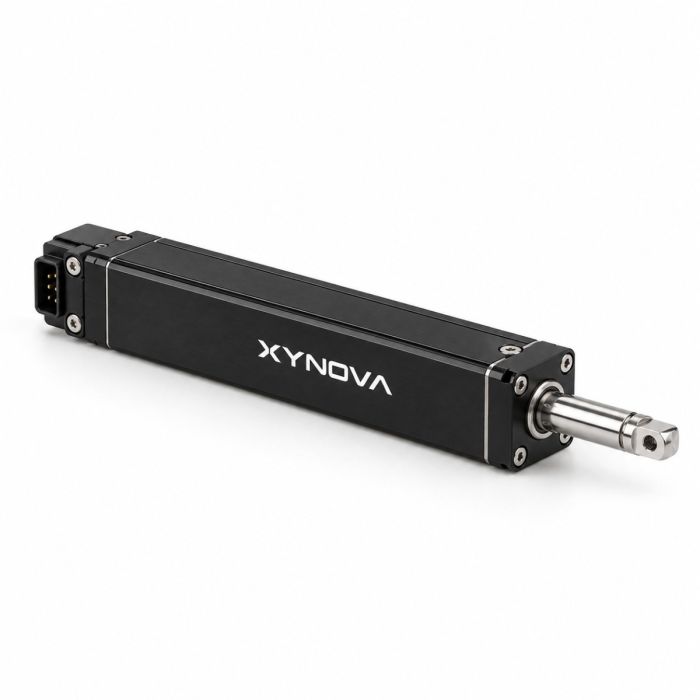
A humanoid hand has very little room for a muscle, yet it still has to push, hold and let go with confidence. The Xynova PRM10-20-34-150-F Linear Actuator is built for that tight space: a micro electric cylinder only 10 by 13.5 by 81 mm in size, weighing no more than 34 g, and rated for a maximum thrust of at least 150 N.
The product is available through this page, by quotation.
Background
Xynova and its place in humanoid robotics
Xynova Technology Co., Ltd. is a core component supplier in the field of humanoid robots. It does not sell finished robots. It makes the parts that go inside them, and that focus shows in how the catalog is arranged. Rotary actuators, micro linear cylinders and dexterous hand series are designed to work as one family, so an engineer can draw several joints from a single supplier and expect them to fit together.
The PRM10 series is the micro cylinder line. Within it you will find several versions, including PRM10-20-34-150-F, PRM10-20-47-100-F, PRM10-25-47-100-F, PRM10-20-64-75-F, PRM10-25-64-75-F and PRM10-20-18-200-F. Each version has its own figures, and the figures on this page belong only to PRM10-20-34-150-F.
Key technology: roller screw, hollow cup motor and software
Three in-house developments define this actuator. The first is a 7mm micro planetary roller screw, which greatly improves transmission efficiency and suits a wide range of industrial and everyday applications. The second is a frameless torque motor, a brushless hollow cup motor, which provides higher torque, longer lifespan and quieter operation. The third is upper-level software with a rich set of API interfaces, which makes it easy to coordinate and control several modules together.
Easy joint self-locking completes the picture. There is no risk from a power failure, because the joint holds its position, which adds to safety during operation. For a limb that carries a load, that matters as much as speed does.
Technical Specifications
| Specification | Value |
|---|---|
| Model | PRM10-20-34-150-F |
| Product type | Micro electric cylinder for humanoid robots |
| Effective stroke | 19+1% mm |
| Size (L×W×H) | 10*13.5*81 mm |
| No-load max speed | ≥34 mm/s |
| Full-load speed | ≥9 mm/s |
| Max thrust | ≥150 N |
| Weight | ≤34 g |
| Operating voltage | DC12±10% V |
| Repeatability | ±0.04 mm |
| Operating temperature | -15~60℃ |
| Static current | 0.05 A |
| No-load current | 0.4 A |
| Transmission | In-house developed 7mm micro planetary roller screw |
| Motor | In-house developed frameless torque motor / brushless hollow cup motor |
Specifications as published by the manufacturer; confirmed against the datasheet at quotation.
The manufacturer has not published the IP rating, the communication interface, the feedback sensor type, the package contents, the stall current, the service life, the noise level or the mounting method; they are confirmed at quotation.
What makes this actuator different from a conventional linear actuator?
Most linear actuators are chosen for stroke and force, and they are allowed to be bulky. A humanoid limb is not so forgiving. The forearm, the finger and the wrist all have a fixed volume, and every gram added at the end of a limb costs the whole machine in energy and balance. This cylinder answers with a body of 10 by 13.5 by 81 mm and a weight of no more than 34 g, while still delivering a maximum thrust of at least 150 N.
The speed figures show how it behaves in use. With no load it moves at 34 mm/s or faster, and at full load it holds 9 mm/s or faster. That gap is normal for a screw-driven cylinder, and it tells a designer what to expect when the joint takes real weight. The repeatability of ±0.04 mm means the cylinder returns to a commanded position closely, which is what a gripping or pointing motion needs.
The electrical figures are modest. The supply is DC12±10% V, the static current is 0.05 A and the no-load current is 0.4 A. A designer sizing a power rail for many joints can start from those numbers.
How does it compare with the other PRM10 versions?
The PRM10 series comes in several versions, and the model code carries the differences. PRM10-20-47-100-F, PRM10-25-47-100-F, PRM10-20-64-75-F, PRM10-25-64-75-F and PRM10-20-18-200-F sit alongside this one. This page gives figures only for PRM10-20-34-150-F, so none of them is attributed to a sibling. For a side-by-side comparison, ask for the datasheets when you request a quotation.
One sibling is listed in the store: the Xynova PRM10-20-18-200-F Linear Actuator. If your design needs a different balance of speed, force and stroke than the one described here, that page is the place to begin.
Who is the Xynova PRM10-20-34-150-F for?
The first group is humanoid robot developers who work on hands, wrists and forearms. The cylinder is designed for humanoid robots, and its small size suits joints where a rotary motor would not fit.
The second group is research laboratories and universities building manipulation platforms. A compact cylinder with stated repeatability and a software interface with rich APIs lets a small team test a joint design without writing the control layer from scratch.
The third group is integrators of custom robotic systems. The cylinder is paired with rotary actuators and dexterous hand series to offer fully customized electric drive solutions. Buyers who need a rotating joint next to a linear one can look at the Robot Actuators category, which includes rotary models such as the Xynova PR20-102-130-HS Rotary Actuator.
The fourth group is educators and prototype builders working in advanced mechatronics, who value a part that is small and self-locking. Buyers who need a different size or stroke should consider the sibling versions named above.
What is the Xynova PRM10-20-34-150-F used for?
- Finger and hand joints: the compact body fits inside the limited space of a dexterous hand, pushing a finger linkage with controlled force.
- Wrist and forearm drives: a light cylinder moves a joint without adding much weight to the end of the limb.
- Research manipulation platforms: a repeatability of ±0.04 mm supports repeated, comparable experiments.
- Multi-module coordination: the upper-level software and its APIs allow several modules to be controlled together.
- Load-holding joints: easy joint self-locking keeps a position when power is lost, which adds safety.
- Prototypes and teaching rigs: a small electric cylinder suits automation prototypes, laboratory setups and education platforms.
Pricing and Availability
The Xynova PRM10-20-34-150-F Linear Actuator is a quotation product, and no price is shown here. Send us your quantity and project details, and we will reply with a quotation. Delivery, customs and support are arranged with the quotation. The actuator is available on this page.
Frequently Asked Questions
What is the stroke of the PRM10-20-34-150-F?
The effective stroke is 19+1% mm. This figure belongs to the PRM10-20-34-150-F version only.
How fast does it move?
The no-load maximum speed is at least 34 mm/s, and the full-load speed is at least 9 mm/s.
What supply voltage does it need?
The operating voltage is DC12±10% V. The static current is 0.05 A and the no-load current is 0.4 A.
Will it hold its position if power is lost?
Yes. The cylinder has easy joint self-locking, so there is no risk from a power failure, and this adds safety during operation.
What temperature range does it work in?
The operating temperature is -15~60℃.
What about the IP rating and the communication interface?
Neither is listed on this page. Ask for both, along with the feedback sensor type and the mounting method, when you send your quotation request.
Where can I buy the Xynova PRM10-20-34-150-F and what does it cost?
It is available through this page, by quotation. No price is listed, because the cost depends on your quantity and project, so send us a request and we will respond with a quotation.
Summary
A humanoid joint asks for force from a part that has almost no room to give it. The Xynova PRM10-20-34-150-F answers with a 34 g body, a thrust of at least 150 N, a repeatability of ±0.04 mm, a roller screw and hollow cup motor developed in-house, and self-locking that holds the joint when power is lost. For a project that needs a micro cylinder of this kind, this page is the starting point.


