
Unitree R1 Edu Pro H AI Humanoid Robot for Advanced Robotics Research
In stock
- BRAND:
- UNITREE ROBOTICS
- MODEL:
- R1 EDU-U10
- PART #:
- R1 EDU-U10
- ORIGIN:
- China
- Warranty:
- 12 MONTHS
- AVAILABILITY:
- SUBJECT TO AVAILABILITY
- SKU:
- Unitree-R1-EDU-U10
Unitree R1 Edu Pro H AI Humanoid Robot for Advanced Robotics Research
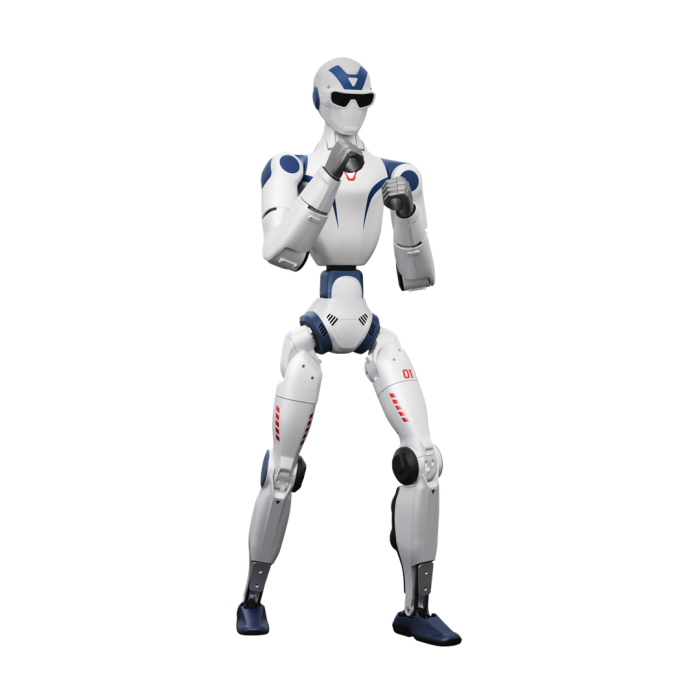
A humanoid that can open a hand is a different tool from one that can only walk past a bench. The Unitree R1 Edu Pro H AI Humanoid Robot for Advanced Robotics Research is built around that difference: a full-body research platform whose two tendon-driven five-finger hands let a team study grasping, handover and manipulation on a body that stays compact enough to carry in a hard case.
The product is available through this page, by quotation.
Background
Unitree Robotics and the R1 line
Unitree Robotics is a maker of legged and humanoid robots, and the R1 family is its compact humanoid range. The range includes eleven versions: R1 Basic, R1 EDU Standard, R1 EDU Smart and the lettered R1 EDU Pro A through Pro H. The Pro H carries the model code R1-EDU-U10 on this page, and every figure below stays with the version or component it belongs to.
Unitree also offers a software development kit, unitree_sdk2, an SDK package used to develop Go2, B2, H1, G1, H2, R1 and A2 robots in real environments. For a lab, that means the R1 belongs to a family with a common programming route rather than standing alone.
Where the Pro H sits in the range
The Pro H is a 30-DOF full-body humanoid fitted with two Unitree tendon-driven five-finger dexterous hands, with 2 DOF per hand (10 joints). That hand configuration is what sets it apart in a family where other lettered versions are named for different hand options. The Pro C and the Pro D, for example, come with BrainCo Revo 2 dexterous hands, so the Pro H is the version to look at when the Unitree hand is the one you want.
The Unitree Dex2/5 hand weighs 365g, measures 151mm x 70mm x 63mm and uses an RS485 communication interface. It is compatible with G1/R1 models, and its hidden internal wiring keeps the cabling beneath the surface of the hand.
Technical Specifications
| Specification | Value |
|---|---|
| Degrees of freedom (R1 EDU Pro H, U10) | 30-DOF full-body humanoid |
| Hands (R1 EDU Pro H, U10) | Two Unitree tendon-driven five-finger dexterous hands, 2 DOF per hand (10 joints) |
| Dimensions (R1 series) | 1230 x 357 x 190 mm |
| Weight (R1 series) | 29 kg |
| Arm payload (R1 series) | 2 kg |
| Head DOF (R1 series) | 2 |
| Camera (R1 series) | Humanoid binocular camera |
| Microphones (R1 series) | 4-mic array |
| Connectivity (R1 series) | WiFi 6, Bluetooth 5.2 |
| Battery (R1 series) | Smart, quick release |
| Cooling (R1 series) | Local air cooling |
| Transport (R1 series) | Hard case |
| Unitree Dex2/5 hand weight | 365g |
| Unitree Dex2/5 hand size | 151mm x 70mm x 63mm |
| Unitree Dex2/5 hand interface | RS485 |
| Unitree Dex2/5 hand compatibility | G1/R1 models |
Specifications as published by the manufacturer; confirmed against the datasheet at quotation.
The manufacturer has not published the Pro H weight with hands, the Pro H dimensions, the battery capacity, the charging time, the walking speed, the IP rating, the operating temperature range, the full contents of the box or the camera resolution; they are confirmed at quotation.
What makes the Pro H different from the other R1 EDU versions?
The clearest difference is the hands. The Pro H carries two Unitree tendon-driven five-finger hands, where the Pro C and the Pro D are named for BrainCo Revo 2 hands. For a team that already works with Unitree hardware, choosing the Pro H keeps the hands, the body and the software under one maker, which usually means one set of documentation and one route for support questions.
The body is shared across the R1 series. It measures 1230 x 357 x 190 mm, weighs 29 kg and has an arm payload of 2 kg. A two-degree-of-freedom head carries a humanoid binocular camera and a 4-mic array, so the robot can look and listen as well as move. Ask for the Pro H weight and dimensions with hands fitted when you plan a lab bench or a carry case.
Connectivity is WiFi 6 and Bluetooth 5.2, the battery is smart and quick release, and cooling is local air cooling. A quick-release battery matters in a teaching or testing setting, where a session should not end because one pack is flat and the robot has to sit idle on a charger.
What does the dexterous hand add to a research humanoid?
Many compact humanoids are used for locomotion and gesture work. Hands change the research question. With ten hand joints in total, the Pro H can be used to study how a controller, a learned policy or a teleoperation scheme handles objects rather than only how the body moves through a room.
The Unitree Dex2/5 hand is a small unit, 365g in weight and 151mm x 70mm x 63mm in size. It communicates over RS485, a widely used serial interface, which makes it familiar to engineers who have wired actuators and sensors before. The hidden internal wiring keeps cables out of the way of the fingers, which helps when a hand is working close to objects and fixtures.
Because the hand is compatible with G1/R1 models, groups that use more than one Unitree humanoid can reuse the same hand knowledge across platforms. If you want to compare hand options inside the R1 range, the Unitree R1 Edu Pro C and the Unitree R1 Edu Pro D are the versions to read next.
Who is the Unitree R1 Edu Pro H for?
University and institute labs that want a full-body humanoid with working hands for manipulation, control and learning research will find the Pro H a natural fit. The hard case makes it practical to move between a lab, a classroom and a demonstration hall.
Teaching programs can use the robot to show students what a humanoid body, a perception system and an SDK look like when they work together. The unitree_sdk2 package gives instructors a clear route into programming.
Industrial and applied R&D teams evaluating humanoids for handling tasks can use the Pro H to test ideas before committing to a larger program. With a 2 kg arm payload, it suits light objects and bench-scale tasks.
If your work does not need the Unitree hand, the other lettered versions are worth a look. The Unitree R1 Edu Pro A and the Unitree R1 Edu Pro B are on this site, and the full group is gathered in the Unitree R1 EDU category.
What is the Unitree R1 Edu Pro H used for?
- Manipulation research: test grasping, holding and handover strategies with five-finger hands on a full-body humanoid.
- Teleoperation studies: drive the hands and arms from an operator interface and record how the robot responds.
- Perception and interaction: use the binocular camera and the 4-mic array for vision and voice experiments.
- Control and learning development: build and test whole-body controllers and learned policies through unitree_sdk2.
- Classroom teaching: give students hands-on contact with a real humanoid rather than a simulation alone.
- Demonstrations and trials: carry the robot in its hard case to events, partner sites and early evaluations.
Pricing and Availability
No price is shown on this page. A quotation is the way to buy: tell us your configuration, your site and your timeline, and we respond with a written offer. Delivery, customs and support are arranged together with the quotation, so you see the whole picture before you decide. The Unitree R1 Edu Pro H AI Humanoid Robot for Advanced Robotics Research is available on this page.
Frequently Asked Questions
How many degrees of freedom does the Pro H have?
It is a 30-DOF full-body humanoid. The two hands have 2 DOF each, which makes 10 joints.
Which hands does the Pro H use?
It uses two Unitree tendon-driven five-finger dexterous hands. The Unitree Dex2/5 hand weighs 365g, measures 151mm x 70mm x 63mm and has an RS485 interface.
How much does the robot weigh?
The R1 series weighs 29 kg. Ask for the Pro H weight with hands fitted when you request your quotation.
What software can I use to program it?
Unitree offers unitree_sdk2, an SDK package for developing Go2, B2, H1, G1, H2, R1 and A2 robots in real environments.
How is the robot connected and powered?
The R1 series has WiFi 6 and Bluetooth 5.2 for connectivity. The battery is smart and quick release, and cooling is local air cooling.
Can I transport it easily?
Yes, the R1 series travels in a hard case, which suits moves between a lab and other sites.
Where can I buy the Unitree R1 Edu Pro H and what does it cost?
You can buy it through this page, by quotation. We do not show a price here; send us your requirements and we reply with a written offer that includes delivery, customs and support.
Summary
The Pro H answers a simple question: what if a compact humanoid could also use its hands? With a 30-DOF body, two tendon-driven five-finger hands, a binocular camera, a 4-mic array and a common SDK, it gives research and teaching teams a practical platform for manipulation work. To request an offer for the Unitree R1 Edu Pro H, this page is the starting point.


