
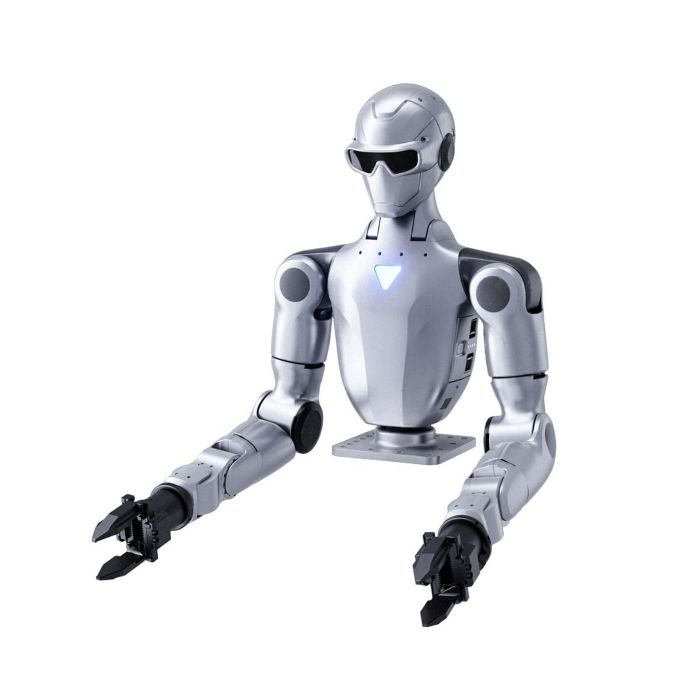
Unitree R1-A7 Smart G Humanoid Robot
In stock
- BRAND:
- UNITREE ROBOTICS
- MODEL:
- R1-A7-Smart-G
- PART #:
- R1-A7-Smart-G
- ORIGIN:
- China
- Warranty:
- 12 MONTHS
- AVAILABILITY:
- SUBJECT TO AVAILABILITY
- SKU:
- Unitree-R1-A7-Smart-G
Unitree R1-A7 Smart G Humanoid Robot
A robot can look at a cup for as long as you like and still not know how hard it is holding it. The Unitree R1-A7 Smart G Humanoid Robot is built to close that gap: a dual-arm torso that ends in LinkerBot O6 hands with tactile sensing, so contact is something the system can measure rather than guess.
The product is available through this page, by quotation.
Background
Unitree and the R1-A7 lineage
Unitree Robotics is known for compact, developer-friendly robots, and the R1-A7 belongs to its dual-arm manipulation platform. The R1-A7 is the 7-DoF-per-arm version of that platform: two 7-DoF arms with 555 mm (21.9 in) of reach, a rotating waist and a 2-DoF sensor head. The desk-mount R1-A7 has 19 total degrees of freedom, and the R1-A7-D, which rides on a wheeled chassis, has 22.
The family is not a single product but a ladder of configurations. The desk-mount R1-A7 and the mobile-base R1-A7-D are the two bodies. On top of them sit the Smart A to H and Ultimate A to H configurations, and the R1-A5 appears in the same family. The letter at the end of a Smart name tells you which hands come with the robot, and this page covers the G configuration.
What the Smart G configuration adds
The Smart configuration is rated at 40 TOPS and carries built-in Orin Nano compute, plus your choice of hands. In Smart G, that choice is LinkerBot O6 six-DoF hands with tactile sensing. Tactile versions add fingertip sensing, which is the feature that sets this configuration apart from versions fitted with other hands.
One point is worth stating plainly: this is a torso, not a humanoid that walks. It stays where you mount it, and that is exactly why the engineering effort goes into the arms, the waist, the head and the hands.
Technical Specifications
| Specification | Value |
|---|---|
| Configuration | R1-A7 Smart G, LinkerBot O6 Tactile Hands |
| Arms | Two 7-DoF arms |
| Arm reach (forearm plus upper arm) | 555 mm (21.9 in) |
| Total degrees of freedom (desk-mount R1-A7) | 19 |
| Dimensions (desk-mount) | 835 x 357 x 190 mm (32.9 x 14.1 x 7.5 in) |
| Weight (desk-mount) | About 13 kg (29 lb) |
| Arm payload | 2 to 4 kg (4.4 to 8.8 lb) per arm, varying with arm extension |
| Maximum shoulder torque | 60 Nm (44 lb-ft) |
| End-clamp repeatability | ±0.1 mm (±0.004 in) |
| Waist yaw (desk-mount) | ±150° |
| Head range | Yaw ±115°, pitch ±36° |
| Joint motor | Low-Inertia High-Speed Inner Rotor PMSM |
| Joint design | Crossed-roller and deep-groove ball bearings, hollow internal wiring, dual encoders on the arm joints, local air cooling |
| Head camera | Binocular; RGB 1280 x 720 at 30 Hz, depth 544 x 448 at 10 Hz |
| Binocular field of view | 146° horizontal by 124° vertical, eye spacing 60 mm (2.4 in) |
| Standard compute | 8-core CPU in the body; 8-core CPU with 10 TOPS in the head |
| Smart configuration compute | 40 TOPS, built-in Orin Nano |
| Hands | LinkerBot O6 six-DoF hands with tactile sensing |
| Audio | 4-array microphone and dual 3 W speakers |
| Wireless | Wi-Fi 6 and Bluetooth 5.2 |
| Power supply | External power or Li-ion battery |
| Battery life (battery-powered) | Approx. 1.5 h |
Specifications as published by the manufacturer; confirmed against the datasheet at quotation.
The manufacturer has not published the IP rating, the operating temperature range, the joint motion range of the arms, the included accessories, the power consumption or the battery capacity; they are confirmed at quotation.
What makes the Smart G different from the other R1-A7 versions?
The body, the arms and the head are shared across the family. What changes is the end of the arm. Smart G carries LinkerBot O6 hands with six degrees of freedom each and tactile sensing, so fingertip contact becomes data. A vision-only hand tells you where an object is; a tactile hand also tells you whether the object has been touched, held or is slipping.
For work such as learning from demonstration, delicate grasping or testing how a policy copes with unseen objects, that contact signal is often what separates a demo from a repeatable result. If your work depends mainly on vision and arm motion, the Unitree R1-A7 Fixed Base Dual-Arm Humanoid Robot or one of the other Smart configurations, such as the Unitree R1-A7 Smart A Humanoid Robot, may be the more direct fit.
The Smart tier also brings the 40 TOPS Orin Nano compute, which sits in addition to the standard 8-core body CPU and the 8-core head CPU with 10 TOPS. That gives you room to run perception and control on the robot itself instead of tethering everything to a separate workstation.
How does the R1-A7 arm compare with the numbers buyers usually ask about?
Buyers usually ask first about reach, payload and precision. Reach is 555 mm per arm, forearm plus upper arm. Maximum shoulder torque is 60 Nm, and end-clamp repeatability is ±0.1 mm. Payload is stated as 2 to 4 kg per arm, and Unitree is explicit that the figure moves a long way with arm extension: the closer to the body, the more the arm can carry, and the further it reaches, the less.
The joints use crossed-roller and deep-groove ball bearings, hollow internal wiring, dual encoders on the arm joints and local air cooling. The motor is a low-inertia, high-speed inner-rotor PMSM, chosen for responsiveness and heat dissipation. For a lab that runs long data-collection sessions, those details matter more than a headline number.
Perception is handled by a binocular head camera with RGB at 1280 x 720 and 30 Hz and depth at 544 x 448 and 10 Hz. The field of view is 146° horizontal by 124° vertical. The waist turns ±150° on the desk-mount, and the head moves ±115° in yaw and ±36° in pitch, so the robot can look across a whole workspace without being repositioned.
Who is the Unitree R1-A7 Smart G Humanoid Robot for?
Manipulation research groups are the most natural buyers. If your questions are about grasp stability, slip detection or contact-rich skills, the tactile hands give you the signal, the Orin Nano compute gives you somewhere to run models, and the open interfaces for the underlying system, arms, audio, lighting and vision, with full secondary development support, let you wire in your own software.
Universities and teaching labs can use it as a shared platform for courses in robot learning and human-robot interaction, since it combines voice, vision and touch in one desk-sized body. Integrators evaluating dual-arm automation for light assembly or sorting tasks can use it to test an idea before committing to a production cell.
It is less suited to anyone who needs a robot that walks, or one that moves around a site on its own. For mobility, look at the R1-A7-D, which adds a wheeled chassis and a chassis LiDAR. If you are still comparing options, the Unitree R1-A7 category and the wider Unitree R1 category show the other versions side by side.
What is the Unitree R1-A7 Smart G Humanoid Robot used for?
- Tactile grasping research. Study how fingertip contact data improves grip force control and slip handling.
- Imitation learning and data collection. Record two-arm demonstrations with synchronized vision and touch for training manipulation policies.
- Teaching and lab courses. Give students a compact dual-arm platform with open interfaces they can program.
- Human-robot interaction trials. Combine the 4-array microphone, dual 3 W speakers and head motion for voice-driven demonstrations.
- Assembly and sorting prototypes. Test small-part handling ideas with a 555 mm reach and ±0.1 mm repeatability before building a full cell.
- Software and perception development. Build and test vision, planning and control stacks on 40 TOPS of onboard compute.
Pricing and Availability
We do not print prices on this page. Pricing is provided by quotation, and the quotation is where the configuration, the hands and your intended use are confirmed. Delivery, customs and support are arranged with the quotation, so you know the full picture before you commit. The Unitree R1-A7 Smart G Humanoid Robot is available on this page.
Frequently Asked Questions
Does the Smart G walk?
No. The R1-A7 is a torso and does not walk. It is mounted on a desk in this version, and the wheeled R1-A7-D is the family member with a mobile base.
What hands does the Smart G use?
It uses LinkerBot O6 six-DoF hands with tactile sensing. The tactile versions add fingertip sensing.
How much can each arm carry?
The published payload is 2 to 4 kg per arm, and it varies with arm extension. The figure falls as the arm reaches further from the body.
What compute does it have?
The standard platform has an 8-core CPU in the body and an 8-core CPU with 10 TOPS in the head. The Smart configuration adds built-in Orin Nano compute at 40 TOPS.
Can I develop my own software for it?
Yes. Open interfaces cover the underlying system, the arms, audio, lighting and vision, with full secondary development support.
How long does the battery last?
Battery life is approximately 1.5 h when battery-powered. The robot can also run from external power, and the battery capacity is confirmed at quotation.
Where can I buy the Unitree R1-A7 Smart G Humanoid Robot and what does it cost?
You can request it through this page, by quotation. The cost depends on the configuration and the terms of delivery, and it is given in the quotation, not printed here.
Summary
Most arms can be told where to go; fewer can feel what they have reached. The Unitree R1-A7 Smart G Humanoid Robot pairs a dual 7-DoF-arm torso, 555 mm of reach and ±0.1 mm repeatability with LinkerBot O6 tactile hands and 40 TOPS of onboard compute. It does not walk, and it does not pretend to; it is a focused tool for contact-aware manipulation work. If that is what your project needs, this page is the starting point.