
Unitree R1-A5 Smart H Humanoid Robot
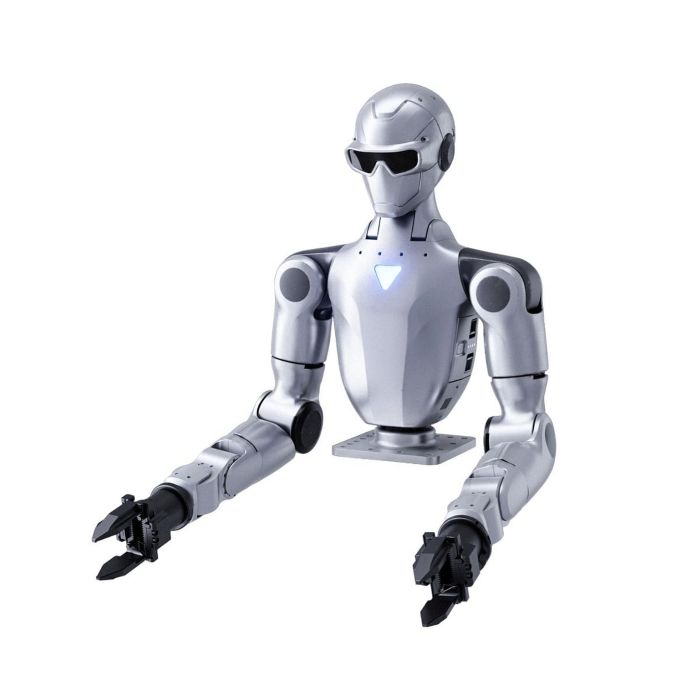
In stock
- BRAND:
- UNITREE ROBOTICS
- MODEL:
- R1-A5-Smart-H
- PART #:
- R1-A5-Smart-H
- ORIGIN:
- China
- Warranty:
- 12 MONTHS
- AVAILABILITY:
- SUBJECT TO AVAILABILITY
- SKU:
- Unitree-R1-A5-Smart-H
Unitree R1-A5 Smart H Humanoid Robot
Most humanoid platforms ask a buyer to choose between a clever head and a capable hand. The Unitree R1-A5 Smart H Humanoid Robot puts both into one configuration: a head with its own 8-core processor, a body with another, and a tendon-driven dexterous hand with Orin Nano 40 Tops built in. It is a dual-arm machine meant for people who want to build behavior, not just watch a demonstration.
The product is available through this page, by quotation.
Background
Unitree and the R1-A5 lineage
UNITREE ROBOTICS is known for compact, motor-driven robots that universities, laboratories and integrators use as working platforms. The R1 family continues that approach with dual-arm humanoid designs, described as the Unitree Dual-Arm Humanoid Robot. Within it, the sources name the versions R1-A5, R1-A7, R1-A5-D, R1-A7-D and R1-A5 Smart H.
The R1-A5 Smart H is the version of the R1-A5 that carries a tendon-driven dexterous hand and built-in Orin Nano compute. If you want to see the plain version first, the Unitree R1-A5 Fixed Base Dual-Arm Humanoid Robot is the natural reference point, and the wider range is gathered in the Unitree R1 category.
Positioning and key technology
The joints of this robot use a low-inertia, high-speed inner rotor PMSM, chosen for superior responsiveness and heat dissipation. For an arm that has to start, stop and change direction repeatedly, those two qualities matter more than a headline number.
Perception and computing are split across the body. The body carries an 8-core high-performance CPU. The head carries an 8-core high-performance CPU plus 10 TOPS. A binocular camera gives the robot its view of the world, and a 4-array microphone with dual speakers lets it listen and speak. On the Smart H, the built-in compute is Orin Nano 40 Tops.
Full-process secondary development at the underlying level is supported through a mature robot development framework. That is the feature that turns the robot from a demonstrator into a platform for your own software.
Technical Specifications
| Specification | R1-A5 | R1-A5 Smart H |
|---|---|---|
| Product type | Unitree Dual-Arm Humanoid Robot | Unitree Dual-Arm Humanoid Robot |
| Dimensions | 700x357x190mm | Not stated separately |
| Weight | Approx. 11kg (with external power supply) | Not stated separately |
| Joint motor | Low-Inertia High-Speed Inner Rotor PMSM | Low-Inertia High-Speed Inner Rotor PMSM |
| Base computing power | Body: 8-core high-performance CPU; Head: 8-core high-performance CPU + 10 TOPS | Body: 8-core high-performance CPU; Head: 8-core high-performance CPU + 10 TOPS |
| Built-in compute | Not stated | Orin Nano 40 Tops build in |
| Camera module | Binocular Camera + Optional Wrist Camera | Not stated separately |
| Binocular field of view | Horizontal 146°, Vertical 124° | Horizontal 146°, Vertical 124° |
| Binocular eye spacing | 60mm | 60mm |
| Audio | 4-array microphone + dual speakers | 4-array microphone + dual speakers |
| End effector | Optional two-finger gripper / three-finger dexterous hand / five-finger dexterous hand | Tendon-driven dexterous hand |
| Power supply | External Power or Li-ion Battery | External Power or Li-ion Battery |
| Secondary development | Full-process, at the underlying level | Full-process, at the underlying level |
| Charger | Included | Included |
Specifications as published by the manufacturer; confirmed against the datasheet at quotation. The manufacturer has not published the Wi-Fi range, the operating temperature, the IP rating, the hand payload, the contents of the software and SDK package, or the box contents beyond the charger; they are confirmed at quotation.
One note deserves attention: the maximum load of the arm varies greatly under different arm extension postures. A single payload figure would therefore say little, and the right way to size a task is to describe the posture it needs.
What makes the R1-A5 Smart H different from the standard R1-A5?
The difference is in the hand and the compute. The standard R1-A5 lists a choice of optional end effectors: a two-finger gripper, a three-finger dexterous hand or a five-finger dexterous hand. The Smart H comes with a tendon-driven dexterous hand. For a team that already knows it needs fingers rather than a simple gripper, that removes a decision from the purchase.
The second difference is the compute. The Smart H lists Orin Nano 40 Tops built in, in addition to the CPUs in the body and the head. This gives a developer a dedicated place to run perception or learning workloads on the robot itself, instead of depending on an external computer for everything.
What does not change is the shared foundation: the same family of joint motors, the same binocular camera geometry, the same audio set and the same development framework. Choosing the Smart H is therefore a choice about the end of the arm and the processing, not a change of platform.
Why does the camera geometry matter for manipulation?
The binocular camera has a horizontal field of view of 146° and a vertical field of view of 124°, with an eye spacing of 60mm. A wide view means the robot can see both its hand and the workpiece without turning its head far, and two eyes at a fixed spacing give a basis for judging depth. The R1-A5 lists an optional wrist camera as well, which you can add to your request if close-up viewing is part of the task.
Who is the R1-A5 Smart H for?
University and research laboratories are the most obvious group. A dual-arm robot with a tendon-driven hand, onboard compute and a development framework that reaches the underlying level lets graduate students work on grasping, bimanual coordination and learning-based control without first designing hardware.
Teaching programs form a second group. A robot that listens, speaks, sees and uses its hands gives one classroom platform for several courses, from perception to human-robot interaction.
Integration teams and companies evaluating humanoid automation are a third. They can use the Smart H to test whether a human-shaped pair of arms and a dexterous hand suit a given process before committing to a larger program.
If your work needs a simpler end effector or you prefer to choose the hand yourself, look at the Unitree R1-A5 Fixed Base Dual-Arm Humanoid Robot or the Unitree R1-A5 Smart A Humanoid Robot, and compare them with this version.
What is the R1-A5 Smart H used for?
- Dexterous manipulation research. Study grasping and in-hand handling with a tendon-driven hand on a dual-arm body.
- Bimanual task development. Program two arms to work together on one object.
- Vision-guided behavior. Use the binocular camera and onboard compute to build perception pipelines.
- Voice and interaction projects. Use the 4-array microphone and dual speakers for spoken interaction experiments.
- Teaching robotics and AI. Give students a physical platform for control, vision and software courses.
- Evaluating humanoid automation. Test a candidate process with human-like arms and hands before planning a deployment.
Pricing and Availability
No price is printed on this page. The Unitree R1-A5 Smart H Humanoid Robot is supplied by quotation, so you can describe your application, your choice of power supply and any questions about options, and receive an offer built around them. Delivery, customs and support are arranged with the quotation. Everything you need to begin that conversation is available on this page.
Frequently Asked Questions
What hand does the R1-A5 Smart H have?
It has a tendon-driven dexterous hand. The standard R1-A5 instead lists optional end effectors: a two-finger gripper, a three-finger dexterous hand or a five-finger dexterous hand.
What computing does it carry?
The body has an 8-core high-performance CPU, and the head has an 8-core high-performance CPU plus 10 TOPS. The Smart H also lists Orin Nano 40 Tops built in.
How is it powered?
It runs from external power or a Li-ion battery. A charger is included.
Can I write my own software for it?
Yes. Full-process secondary development at the underlying level is supported through the robot development framework.
What can it see and hear?
The binocular camera covers 146° horizontally and 124° vertically, with a 60mm eye spacing. Audio comes from a 4-array microphone and dual speakers.
How much can the arm lift?
The maximum load of the arm varies greatly with arm extension posture, and no hand payload has been published. Describe your task and posture when you request a quotation.
Where can I buy the Unitree R1-A5 Smart H Humanoid Robot and what does it cost?
You can request it through this page, by quotation. The cost depends on your configuration and is given in the quotation, not printed here.
Summary
The Unitree R1-A5 Smart H Humanoid Robot pairs two things that are usually bought separately: a tendon-driven dexterous hand and substantial onboard computing, on top of a dual-arm body with a wide binocular view, a microphone array and an open development framework. It suits teams who want to spend their time on behavior and software. For related versions, browse the Unitree R1 category; to take the next step with this one, this page is the starting point.


