
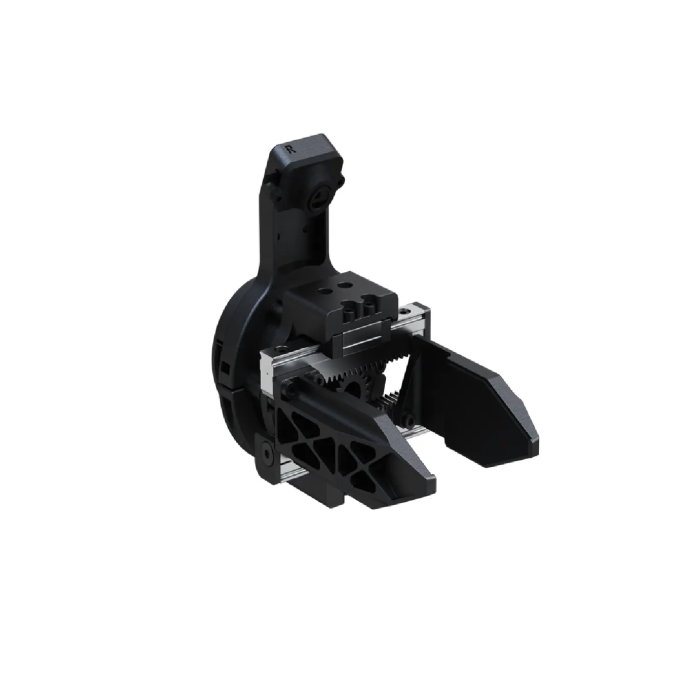
Unitree H2 Dedicated Dex1-1 Gripper Advanced Edition — Single Unit
In stock
- BRAND:
- UNITREE ROBOTICS
- MODEL:
- H2-Dex1-1-V2
- PART #:
- H2-Dex1-1-V2
- ORIGIN:
- China
- Warranty:
- 12 MONTHS
- AVAILABILITY:
- SUBJECT TO AVAILABILITY
- SKU:
- Unitree-H2-Dex1-1-V2
Unitree H2 Dedicated Dex1-1 Gripper Advanced Edition — Single Unit
Most of a humanoid robot's engineering goes into getting it to the table; the work only counts once something is picked up. The Unitree H2 Dedicated Dex1-1 Gripper Advanced Edition — Single Unit is the part of the H2 that does that job: a compact two-jaw gripper with a built-in 1080P camera, made for teams that want a simple, fast end effector with vision at the point of contact instead of a complex multi-finger hand.
This product is available through this page, by quotation.
Background
Unitree and the H2 platform
Unitree Robotics is a Chinese maker of legged and humanoid robots, known in labs and universities for quadrupeds and for humanoids that research groups can actually buy and program. The H2 is part of that humanoid line, and Unitree offers a range of H2-dedicated accessories around it: batteries, a charger and several different hands. The Dex1-1 gripper belongs to that accessory family and is made specifically for the H2.
Unitree treats the hand as a swappable part of the robot. A team can choose a simple parallel gripper, a three-finger dexterous hand or a tactile hand, depending on what the project needs to prove. The Dex1-1 sits at the simple end of that range, where robustness, speed and ease of control matter more than finger-level dexterity.
Where the Dex1-1 Advanced Edition fits
The Dex1-1 comes in three versions named by the sources: Standard Version, Advanced Version (with Camera) and Ultimate Edition. The mechanical figures for the Dex1-1 apply to the whole series. What sets the Advanced Version apart in the sources is its camera, specified at 1080P with a frame rate of 30 or 60 frames per second and a field of view of 118° horizontal, 87° vertical and 140° diagonal.
That camera is the reason to choose this version. A gripper that can see the object between its jaws gives a teleoperator a clear view for demonstrations, and gives a learning pipeline a close-up image stream that matches what the hand is doing.
Technical Specifications
| Specification | Value |
|---|---|
| Camera (Advanced Version) | 1080P, 30/60 FPS, FOV H:118° V:87° D:140° |
| Dimensions | 143mm x 78mm x 67mm |
| Weight | 550g |
| Stroke | 90mm |
| Jaw length | 80mm |
| Gripping force (adjustable) | 5~120N |
| Speed (adjustable) | 50~375 mm/s |
| Fingertip position resolution | 0.1mm |
| Grasp load (form-fitting) | 20kg |
| Grasp load (friction) | 5kg |
| Full-stroke shortest closing time | 0.24s |
| Communication protocol | High-speed 485 |
| Communication baud rate | 6Mbps |
| Control frequency | 1000Hz |
| Operating voltage | 24V~64V (24/48VDC recommended) |
| Peak line current | 3.5A |
| Motor peak torque | 5N.m |
| Recommended operating environment | -20℃ ~ 60℃ |
Specifications as published by the manufacturer; confirmed against the datasheet at quotation.
The manufacturer has not published the camera sensor model, the IP rating, the cable length, the software SDK details, the dimensions of the camera module or the total weight with the camera; they are confirmed at quotation.
What does the camera add to the Dex1-1 gripper?
A parallel gripper is mechanically simple: two jaws, one axis of motion, a force limit. What it lacks is awareness. Without a camera on the hand, an operator or a vision model has to judge the grasp from the robot's head, where the arm, the jaws or the table often block the view. The Advanced Version puts a 1080P camera on the gripper itself, so the picture comes from the point where the work happens.
The field of view is wide: 118° horizontal, 87° vertical and 140° diagonal. A wide view helps with close-range work, because the object and its surroundings stay in frame as the hand approaches. The choice of 30 or 60 frames per second lets a team trade smoother motion for a lighter data load, depending on whether the footage is for live teleoperation or for recording training data.
A team with a strict optical requirement should raise its sensor and camera module questions when requesting a quotation.
How does the Dex1-1 compare with the Dex3-1 hands?
The two families answer different questions. The Dex1-1 closes along a single axis over a stroke of 90mm, with grip force adjustable from 5 to 120N and a shortest full-stroke closing time of 0.24s. It is quick and easy to command, and it carries 20kg in a form-fitting grasp, or 5kg by friction alone. That makes it suited to boxes, containers, handles, tools and other objects with graspable geometry.
A three-finger hand such as the Unitree H2-Dedicated Dex3-1 Force-Controlled Three-Finger Dexterous Hand — Single Unit or the Unitree H2-Dedicated Dex3-1 Tactile Three-Finger Dexterous Hand — Single Unit is the better route when the research is about in-hand manipulation or touch feedback. Teams that want a different bionic hand can also look at the Unitree H2-Dedicated BrainCo Revo 2 Basic Dexterous Hand — Single Unit (Left or Right). For pick-and-place, logistics-style tasks and vision-guided teleoperation, the Dex1-1 is the more direct choice.
Who is the Unitree H2 Dedicated Dex1-1 Gripper Advanced Edition for?
University and corporate research labs are the first group. Teams studying imitation learning or teleoperation need synchronized images from the hand, and the Advanced Version provides them without a separate camera mount. The 1000Hz control frequency and 6Mbps communication rate are written for people who care about tight control loops.
System integrators and pilot-line engineers are the second group. They often need a gripper that is robust, quick and simple to reason about, and they value a defined operating range of -20℃ to 60℃ and a wide supply range of 24V to 64V, with 24 or 48VDC recommended.
Educators and demonstration teams are the third. A gripper with a camera makes it easy to show an audience what the robot sees and what it is about to do. Buyers who do not need vision may find the Standard Version, named in the sources, a closer match to their needs, and those wanting touch sensing should consider the tactile hands linked above. Power accessories and other add-ons are collected under H2 Accessories.
What is the Unitree H2 Dedicated Dex1-1 Gripper Advanced Edition used for?
- Teleoperated manipulation. An operator sees the grasp through the hand camera and closes the jaws with a controlled force.
- Imitation-learning data capture. Close-up image streams are recorded alongside gripper position and force for training manipulation policies.
- Pick-and-place of boxes and containers. The 90mm stroke and form-fitting grasp load suit objects with clear grasp points.
- Tool and handle grasping. Adjustable force lets a team grip firmly or gently depending on the object.
- Vision-guided alignment tasks. The wide field of view keeps the target visible during the approach.
- Teaching and demonstration. A visible camera feed shows students and visitors how a humanoid hand perceives its task.
Pricing and Availability
Pricing for the Unitree H2 Dedicated Dex1-1 Gripper Advanced Edition — Single Unit is provided by quotation. Send us your intended use, the version you need and the quantity, and we will respond with a quotation. Delivery, customs and support are arranged together with the quotation. The product and its quotation process are available on this page.
Frequently Asked Questions
Is this gripper made for the Unitree H2?
Yes. The product is listed as an H2-dedicated Dex1-1 gripper, sold as a single unit.
What does the Advanced Edition add over the other versions?
The sources name a camera for the Advanced Version (with Camera): 1080P, 30 or 60 frames per second, with a field of view of 118° horizontal, 87° vertical and 140° diagonal. The mechanical figures apply to the whole Dex1-1 series.
How much can the gripper hold?
The grasp load is 20kg in a form-fitting grasp and 5kg by friction. Gripping force is adjustable from 5 to 120N.
How fast does it close?
The shortest full-stroke closing time is 0.24s, and speed is adjustable from 50 to 375 mm/s over a stroke of 90mm.
What power and communication does it use?
It operates from 24V to 64V, with 24 or 48VDC recommended, and has a peak line current of 3.5A. Communication is high-speed 485 at 6Mbps, with a control frequency of 1000Hz.
Can I ask about the IP rating or SDK information?
Yes. Please include those questions in your quotation request and we will answer them together with the rest of your order details.
Where can I buy the Unitree H2 Dedicated Dex1-1 Gripper Advanced Edition and what does it cost?
You can request it through this page. The cost is given by quotation, together with delivery, customs and support arrangements.
Summary
The Dex1-1 Advanced Edition is built for the moment a humanoid hand has to close on something. It combines a quick, adjustable two-jaw mechanism with a camera that shows exactly what the jaws are doing, which is why labs, integrators and educators choose it for vision-guided grasping. Where finger dexterity or touch sensing is needed, the Dex3-1 hands are the alternative, and where a camera is not needed another Dex1-1 version may fit. For a quotation on the Unitree H2 Dedicated Dex1-1 Gripper Advanced Edition — Single Unit, this page is the starting point.


