
Unitree H2-Dedicated Dex3-1 Tactile Three-Finger Dexterous Hand — Single Unit
In stock
- BRAND:
- UNITREE ROBOTICS
- MODEL:
- H2-Dex3-1-TACTILE
- PART #:
- H2-Dex3-1-TACTILE
- ORIGIN:
- China
- Warranty:
- 12 MONTHS
- AVAILABILITY:
- SUBJECT TO AVAILABILITY
- SKU:
- Unitree-H2-Dex3-1-TACTILE
Unitree H2-Dedicated Dex3-1 Tactile Three-Finger Dexterous Hand — Single Unit
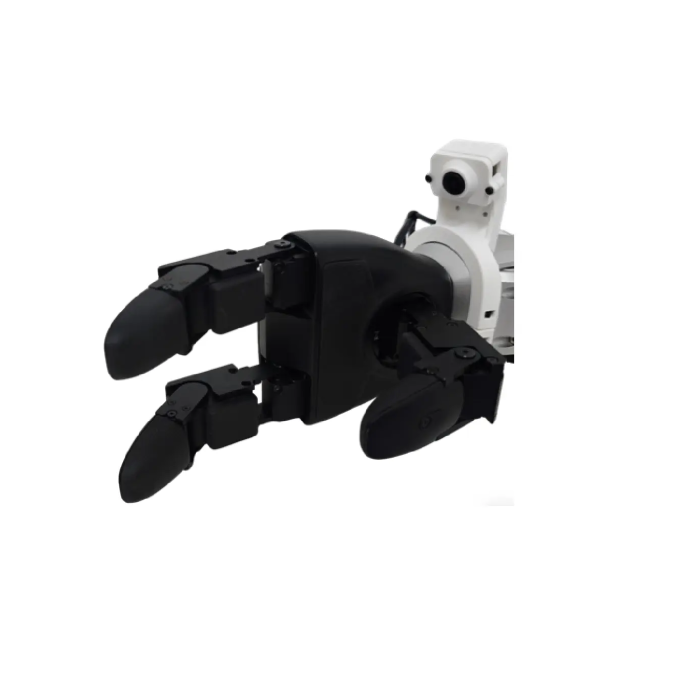
Most people assume a more capable robot hand simply needs more fingers. The Unitree H2-Dedicated Dex3-1 Tactile Three-Finger Dexterous Hand — Single Unit makes the opposite argument: three well-driven fingers that can feel what they hold may do more useful work than five that cannot. It is a hand designed around touch and force rather than around imitating the human silhouette.
The product is available through this page, by quotation.
Background
Unitree Robotics and its hand lineage
Unitree Robotics is known for legged and humanoid robots, and its dexterous hands follow the same engineering habit seen across the range: compact brushless motors with force control built into the joints. The Dex3-1 series is the company's three-finger hand family. Its structure combines direct-drive and gear-drive micro brushless joints in one small hand.
The sources name two main variants of the series: a Dex3-1 with tactile sensing and a Dex3-1 without it. This page covers the tactile version, supplied as a single unit for the Unitree H2. The non-tactile sibling is listed separately as the Unitree H2-Dedicated Dex3-1 Force-Controlled Three-Finger Dexterous Hand — Single Unit.
Positioning and key technology
The Dex3-1 is a three-finger hand with 7 degrees of freedom. Six of its joints are micro brushless force-control joints that drive directly, and one is a micro brushless force-control joint that drives through gears. A direct-drive joint has no reduction stage between the motor and the finger.
The hand is controlled with a combined force and position hybrid scheme. In practice this means the controller can command where a finger should go and how hard it should press, and balance the two. For grasping soft, fragile or irregular objects, that combination matters more than raw finger count.
The tactile version adds 33 tactile sensors on one hand. The pressure sensing range runs from 10g to 2500g. That span covers a light touch up to a firm grip, and it gives the control layer real contact information instead of motor feedback alone.
Technical Specifications
| Specification | Value |
|---|---|
| Product | Unitree H2-Dedicated Dex3-1 Tactile Three-Finger Dexterous Hand — Single Unit |
| Degrees of freedom | 7 |
| Thumb | 3 degrees of freedom |
| Index finger | 2 degrees of freedom |
| Middle finger | 2 degrees of freedom |
| Joint motors | 6 micro brushless force-control direct-drive joints; 1 micro brushless force-control gear-drive joint |
| Transmission mechanism | 6 motors drive directly, 1 motor drives with gears |
| Control | Force and position hybrid control |
| Tactile sensors | 33 per hand |
| Pressure sensing range | 10g-2500g |
| Fingertip repeat positioning accuracy | ±2mm |
| Weight | 710g |
Specifications as published by the manufacturer; confirmed against the datasheet at quotation.
The manufacturer has not published the IP rating, the included accessories and cables, or the part number; they are confirmed at quotation.
What makes the tactile Dex3-1 different from the non-tactile version?
The difference is sensing. Both versions share the same three-finger concept, the same joint philosophy and the same force and position hybrid control. The tactile version adds 33 tactile sensors on one hand, with a pressure range from 10g to 2500g, so the hand can report contact rather than infer it.
That matters when the task depends on knowing whether an object is held, how firmly, and whether it is starting to slip. A team that only needs to open, close and position the fingers may be well served by the force-controlled version without tactile sensing. A team that wants to study or use contact data in grasping, teleoperation or learning experiments will want the tactile unit.
Why three fingers instead of five?
A three-finger hand gives up some of the human-like shape. In return it keeps the mechanism compact and simpler to control. The thumb has 3 degrees of freedom, and the index and middle fingers have 2 each. That is enough to pinch, to wrap and to hold many everyday shapes between the thumb and two opposing fingers.
The hand weighs 710g, and its fingertip repeat positioning accuracy is ±2mm. For buyers whose work does call for a full human-like hand, the Unitree H2-Dedicated Dex5-1P Tactile Five-Finger Dexterous Hand with RGB is the nearer fit. For manipulation research where touch matters more than finger count, the three-finger design is a deliberate and practical choice.
Who is the Dex3-1 Tactile Hand for?
Research laboratories are the most obvious group. Manipulation, imitation learning and tactile perception studies all benefit from a hand that returns contact data and accepts force commands. A compact hand with sensing built in shortens the path from idea to first experiment.
Universities and training programs can use the hand to teach grasp control, sensor reading and the difference between position control and force control. Because the hand is a single unit, a department can start with one hand and expand later.
Integrators and developers working on humanoid applications will value the hybrid control and the repeat positioning accuracy when planning tasks such as handling light objects or tools. Buyers who do not need touch data should look at the non-tactile Dex3-1, and those planning a wider hand setup can browse the H2 Accessories category.
What is the Dex3-1 Tactile Hand used for?
- Grasp research: study how contact pressure changes as fingers close on different objects.
- Teleoperation: let an operator drive the hand while contact data is recorded alongside motion.
- Learning experiments: collect touch and position data for training manipulation policies.
- Gentle handling: use force control to hold light or fragile items without crushing them.
- Teaching: demonstrate force and position hybrid control in robotics courses.
- Integration trials: evaluate a three-finger tactile hand on an H2 platform before committing to a larger program.
Pricing and Availability
Pricing is arranged by quotation, so you can describe your application and receive an offer that fits it. Delivery, customs and support are arranged together with the quotation. The Unitree H2-Dedicated Dex3-1 Tactile Three-Finger Dexterous Hand — Single Unit is available on this page.
Frequently Asked Questions
How many degrees of freedom does the Dex3-1 Tactile Hand have?
It has 7 degrees of freedom: 3 in the thumb, 2 in the index finger and 2 in the middle finger.
How is the hand driven?
Six micro brushless force-control joints drive directly, and one micro brushless force-control joint drives through gears.
How many tactile sensors does it carry?
One hand carries 33 tactile sensors. The pressure sensing range is 10g-2500g.
How accurate is the fingertip positioning?
The fingertip repeat positioning accuracy is ±2mm.
How much does the hand weigh?
The weight is 710g.
Is an IP rating given?
No IP rating is stated for this hand. The same goes for the included accessories, cables and part number.
Where can I buy the Unitree H2-Dedicated Dex3-1 Tactile Three-Finger Dexterous Hand and what does it cost?
It is available through this page by quotation. The cost depends on your requirements and is given in the quotation itself, with delivery, customs and support arranged alongside it.
Summary
The case for this hand is that feeling matters more than counting fingers. Three fingers with 7 degrees of freedom, direct-drive force-control joints, hybrid force and position control and 33 tactile sensors make a compact hand that can sense what it holds. Its figures, including ±2mm fingertip repeat positioning accuracy and a 10g-2500g sensing range, give a clear starting point for evaluation. If that matches your work, this page is the starting point.


