
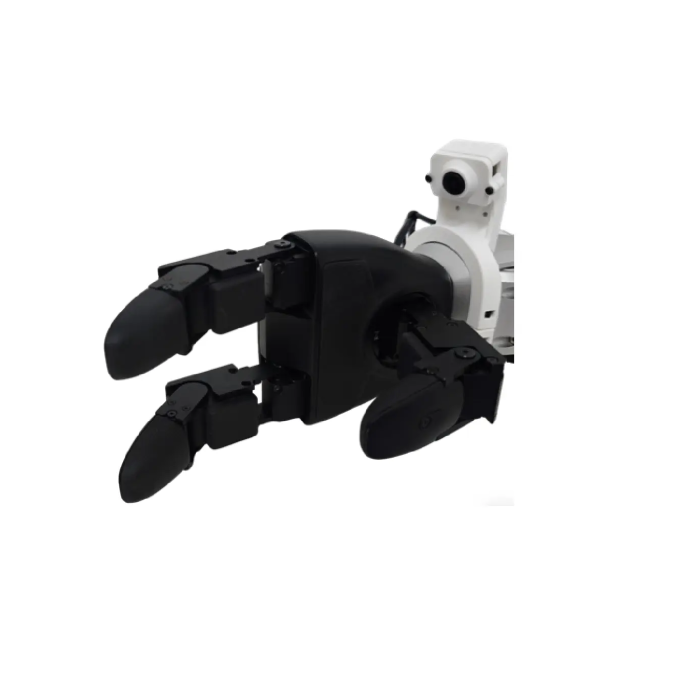
Unitree H2-Dedicated Dex3-1 Force-Controlled Three-Finger Dexterous Hand — Single Unit
In stock
- BRAND:
- UNITREE ROBOTICS
- MODEL:
- H2-Dex3-1
- PART #:
- H2-Dex3-1
- ORIGIN:
- China
- Warranty:
- 12 MONTHS
- AVAILABILITY:
- SUBJECT TO AVAILABILITY
- SKU:
- Unitree-H2-Dex3-1
Unitree H2-Dedicated Dex3-1 Force-Controlled Three-Finger Dexterous Hand — Single Unit
Three fingers are fewer than a human hand has, and for many robot tasks that is exactly enough. The Unitree H2-Dedicated Dex3-1 Force-Controlled Three-Finger Dexterous Hand — Single Unit is built on that idea: fewer joints to control, each one driven with force in mind, and a sensing layer that tells the robot how hard it is touching something.
The product is available through this page, by quotation.
Background
Unitree and the humanoid hand question
Unitree Robotics builds legged and humanoid robots, and it also makes the end effectors those robots need to do useful work. A humanoid body can walk, balance and reach, but until a hand is fitted it cannot handle objects with any care. That is why the H2 accessories range includes several hand options, from simple grippers to multi-finger designs with tactile sensing.
The Dex3-1 is Unitree's own three-finger design. Keeping the hand in-house means it sits naturally beside Unitree's other robot hardware, and the same Dex3-1 family also appears for the G1 humanoid. This page covers the H2-dedicated single unit, which is the version for buyers who equip an H2 one hand at a time.
Force control as the core idea
The Dex3-1 combines force and position hybrid control, which makes it sensitive and reliable. In plain terms, the hand does not just move a finger to a place; it can also regulate how much force the finger applies when it arrives. That matters when the object is a paper cup, a tool handle or a sensor housing, where too little force drops the item and too much damages it.
The mechanical layout supports this. The hand has 7 degrees of freedom: 6 micro brushless force-control joints with direct drive, and 1 micro brushless force-control joint with gear drive. Direct drive keeps the path between motor and finger short, which is the usual route to responsive force behavior.
Technical Specifications
The figures below are for the Dex3-1 as shown on the Unitree G1 page. The H2-dedicated versions are separate items (Left, Right, Pair, and a Tactile variant).
| Specification | Dex3-1 (Unitree G1 page) |
|---|---|
| Degrees of freedom | 7 (6 direct-drive micro brushless force-control joints, 1 gear-drive micro brushless force-control joint) |
| Control concept | Force and position hybrid control |
| Weight | 710g |
| Size | 175mm x 88mm x 77mm |
| Fingertip repeat positioning accuracy | ±2mm |
| Working voltage | 12~58V |
| Maximum current | 10A |
| Communication interface | USB2.0 |
| Communication rate | 1000Hz |
| Working temperature range | -20℃ ~ 60℃ |
| Pressure sensors | 9 (total of 33 pressure sensors) |
| Range of perception | 10g-2500g |
| Joint module encoder | Rotor absolute value encoder |
Specifications as published by the manufacturer; confirmed against the datasheet at quotation.
The manufacturer has not published the IP rating of the hand or what is in the box; both are confirmed at quotation.
What makes the Dex3-1 different from a simple gripper?
A two-jaw gripper opens and closes. It is robust and easy to program, but it grips every object in roughly the same way. The Dex3-1 has three fingers and 7 degrees of freedom, so it can change its posture around the object, which is the difference between pinching a handle and cradling a rounded part.
Sensing is the second difference. The hand carries 9 pressure sensors, for a total of 33 pressure sensors, with a range of perception of 10g-2500g. A controller can use that signal to detect contact, judge how firmly an item is held and react before a slip becomes a drop. Together with the 1000Hz communication rate, the hand is built for a fast feedback loop rather than for blind open-loop motion.
Fingertip repeat positioning accuracy is ±2mm, and each joint module uses a rotor absolute value encoder. For a team recording demonstrations or training policies, repeatable fingertip placement makes results easier to compare from one run to the next.
How does the Dex3-1 compare with the Dex3-1 Tactile and five-finger hands?
There is a separate Dex3-1 Tactile hand for the H2. If your work depends on rich touch data, the Unitree H2-Dedicated Dex3-1 Tactile Three-Finger Dexterous Hand — Single Unit is the page to read next. The figures in this article belong to the Dex3-1 as shown on the G1 page, and we do not carry them over to the Tactile version.
If you need more fingers for human-like grasps, the Unitree H2-Dedicated Dex5-1P Tactile Five-Finger Dexterous Hand with RGB— Single Unit (Left or Right) is a five-finger option on the same accessory range. Three fingers trade some anthropomorphic reach for a simpler hand to control and to model, which many research and integration teams prefer.
Who is the Dex3-1 for?
Research laboratories are the clearest fit. A three-finger hand with force control and pressure sensing gives a manipulation group something concrete to work with: contact data, a defined communication interface and repeatable positioning. Universities teaching robotics can use it to show students what force-aware grasping looks like on real hardware.
Integrators building demonstrations or pilot applications for a humanoid will also find it useful. The hand's USB2.0 interface and electrical range of 12~58V help an engineer plan the wiring and power for the arm and hand together. Teams that want a hand for evaluation before committing to a larger program can begin with a single unit.
If your main need is rich tactile feedback, look at the Tactile version linked above. If your tasks need five fingers, look at the five-finger hand. For many other manipulation tasks, the Dex3-1 is a sensible middle point. You can browse the wider range in H2 Accessories or in Humanoid Accessories.
What is the Dex3-1 used for?
- Force-aware grasping research. Studying how a robot adjusts its grip using contact and pressure feedback.
- Teleoperation and demonstration capture. Recording operator motions so that grasping behaviors can be learned or replayed.
- Tool and object handling trials. Testing whether a humanoid can pick up, hold and pass everyday items.
- Teaching and lab exercises. Giving students a real multi-joint hand to program, measure and compare.
- Integration prototypes. Building and refining a pilot cell where an H2 must interact with parts or fixtures.
- Operational evaluation. Judging, before a wider purchase, whether a three-finger hand meets the needs of a given task.
Pricing and Availability
We do not print prices on this page. The way to buy is a quotation: tell us whether you need the Left or Right hand, a pair, or the Tactile version, and we respond with the details for your configuration. Delivery, customs and support are arranged with the quotation. Everything you need to start a request is available on this page.
Frequently Asked Questions
How many degrees of freedom does the Dex3-1 have?
The hand has 7 degrees of freedom: 6 micro brushless force-control joints with direct drive and 1 with gear drive.
What does the hand weigh and how large is it?
On the Unitree G1 page the Dex3-1 weighs 710g and measures 175mm x 88mm x 77mm.
What sensing does the hand have?
It has 9 pressure sensors, for a total of 33, with a range of perception of 10g-2500g.
How does the hand connect to the robot?
The communication interface is USB2.0, with a communication rate of 1000Hz. The working voltage is 12~58V and the maximum current is 10A.
In what temperatures can it work?
The working temperature range is -20℃ ~ 60℃.
Is a Tactile version available?
Yes, there is a Dex3-1 Tactile hand for the H2. You can read about it on the Dex3-1 Tactile page.
Where can I buy the Unitree H2-Dedicated Dex3-1 and what does it cost?
You can request it through this page. The cost depends on the configuration you choose, so it is given in a quotation rather than printed here.
Summary
The Dex3-1 shows that a hand does not need five fingers to be capable. Seven degrees of freedom, force and position hybrid control, pressure sensing and a 1000Hz communication rate give a humanoid a hand that can feel what it holds. If you are equipping an H2 for manipulation work, this page is the starting point.


