
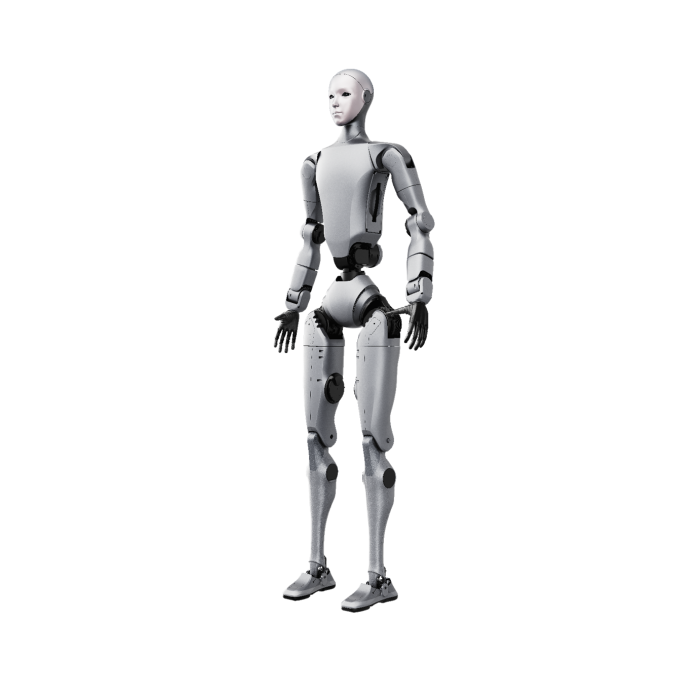
Unitree H2 Basic Humanoid Robot
In stock
- BRAND:
- UNITREE ROBOTICS
- MODEL:
- H2-BASIC
- PART #:
- H2-BASIC
- ORIGIN:
- China
- Warranty:
- 12 MONTHS
- AVAILABILITY:
- SUBJECT TO AVAILABILITY
- SKU:
- Unitree-H2-BASIC
Unitree H2 Basic Humanoid Robot
Some robots are sold as a blank canvas, and some are sold as a finished performer. The Unitree H2 Basic Humanoid Robot is the second kind: a full-size bipedal platform that arrives with its own computing, its own senses and a bionic face, and is meant to be put in front of people rather than hidden behind a development bench. If your question is how quickly you can get a capable humanoid into a demonstration, a lab walkthrough or an evaluation, this is the model to look at first.
The Unitree H2 Basic Humanoid Robot is available through this page, by quotation.
Background
Unitree Robotics and the H2 family
Unitree Robotics is a manufacturer known for legged and humanoid machines, and the H2 line sits in its humanoid range. The sources for this page name four versions: H2 Basic, H2, H2 EDU and H2 Plus. They share a family name, but they are not interchangeable, and every figure in this article belongs to the H2 Basic alone. Where another version matters to a buyer, we say so and point to it instead of lending it a number.
For buyers around the Caribbean, the family structure matters because a humanoid is rarely bought on a single day. A university may start with one unit for evaluation and later look at a version with more development capability. A hotel group or an exhibition company may want a robot that simply works on arrival. Knowing where the Basic sits in the family makes that conversation shorter.
Positioning of the H2 Basic
The defining choice in the H2 Basic is on the computing side. It carries an Intel Core i5 module for the platform functions, while the second computer reserved for user development is not supported. In plain terms, this version is built to run the platform functions rather than to host your own code on a dedicated board. That is a clear and honest position: it suits people who want to use a humanoid more than they want to reprogram one.
The rest of the machine is anything but basic. It has 31 joint motors, a wide-field-of-view humanoid binocular camera, a microphone array with high-power speakers for voice interaction, and a bionic face. Its algorithms are updated over the air, so the robot is not frozen at the capability it had when it left the factory.
Technical Specifications
| Specification | Value |
|---|---|
| Standing dimensions (H × W × D) | 1820 × 456 × 218 mm |
| Weight with battery | Approx. 70 kg |
| Degrees of freedom, total (joint motors) | 31 |
| Arms | 7 per arm (14 total) |
| Legs | 6 per leg (12 total) |
| Waist | 3 |
| Head | 2 |
| Peak torque, arm joints | 120 N·m |
| Peak torque, leg joints | 360 N·m |
| Arm payload | Rated approx. 7 kg; peak approx. 15 kg |
| Frame materials | Aerospace-Grade Aluminum; Titanium Alloy; High-Strength Engineering Plastics |
| Cooling | Air-cooled |
| Battery capacity | 15 Ah (0.972 kWh) |
| Battery voltage | 75.6 V |
| Maximum runtime | Approx. 3 hours |
| PC1 (platform function) | Intel Core i5 |
| PC2 (user development) | Not supported |
| Perception sensor | Wide-Field-of-View Humanoid Binocular Camera |
| Audio | Microphone array and high-power speakers for voice interaction |
| Wireless | Wi-Fi 6 and Bluetooth 5.2 |
| Head | Bionic face |
| Software updates | Algorithms evolve continuously via OTA |
Specifications as published by the manufacturer; confirmed against the datasheet at quotation.
The manufacturer has not published the maximum walking speed, the IP rating, the camera resolution, the robot-only noise level, the operating temperature range or the charging time; they are confirmed at quotation.
What does the H2 Basic offer without a user development computer?
It is fair to ask what a humanoid is worth if you cannot load your own software onto a dedicated second computer. The answer is that the value sits elsewhere. The H2 Basic gives you the body, the senses and the platform functions already integrated: 31 joint motors, a binocular camera, a microphone array, speakers, wireless links and a bionic face. Someone else has done the hard work of making these parts behave as one machine, and the OTA updates mean that work continues after delivery.
For many uses, that is exactly what is wanted. A venue that needs a humanoid to greet visitors, a training center that needs students to see a full-scale bipedal robot move, or a company that wants to judge how a humanoid fits its premises does not necessarily need a second computer open to user code. Paying for development capability that nobody will use is a poor trade, and the Basic version avoids it.
If your plan does include writing and running your own software on the robot, treat this as a point to settle before ordering. Tell us your plans and we can advise whether the Unitree H2 EDU SMART K Humanoid Robot or the Unitree H2 Plus ULTIMATE-E Humanoid Robot is the better fit. We do not quote figures for those versions here, because they are not part of this fact sheet.
How is the H2 Basic built to move and carry?
Movement starts with joint count and joint strength. The legs have 6 degrees of freedom each, the arms 7 each, the waist 3 and the head 2. The seven-joint arm is worth noting: it gives the shoulder, elbow and wrist more ways to approach an object than a simpler arm would, which matters when a robot is expected to work at human height among human furniture.
Peak torque is 360 N·m in the leg joints and 120 N·m in the arm joints. The larger leg figure reflects the job of the legs, which carry the body and its battery of approximately 70 kg in total weight. The arms have a rated payload of approximately 7 kg, with a peak of approximately 15 kg. Those are two separate figures, and they should be read as such: the rated value describes what the arm is meant to carry in normal work, and the peak value describes a short-term limit.
The frame combines aerospace-grade aluminum, titanium alloy and high-strength engineering plastics, and the robot is air-cooled. The battery is 15 Ah at 75.6 V, which is 0.972 kWh, and the maximum runtime is approximately 3 hours. Planning around that runtime is the sensible way to schedule a day of demonstrations.
Who is the Unitree H2 Basic Humanoid Robot for?
Exhibition and demonstration teams are the clearest fit. A humanoid with a bionic face, a speaker system and a microphone array can speak with an audience, and a standing height of 1820 mm lets people meet it at eye level. Because the platform functions are already integrated, the setup effort is aimed at the event, not at the robot.
Universities, technical colleges and training centers can use it to teach what a full humanoid is, how many joints it takes to walk and reach, and what a battery-powered machine of this size demands from a room. Research groups that mainly want to observe, evaluate or benchmark a humanoid body, rather than write onboard software, will also find the Basic version practical.
Companies exploring automation can use it as an evaluation unit: place it in a real corridor, beside a real workbench, and learn whether a humanoid form suits the work before committing to a larger program. Buyers whose first requirement is a user development computer should look instead at the Unitree H2 EDU SMART K Humanoid Robot or the Unitree H2 Plus ULTIMATE-E Humanoid Robot, and talk to us about them.
What is the Unitree H2 Basic Humanoid Robot used for?
- Public demonstrations. A full-size humanoid with voice interaction and a bionic face draws attention at trade shows, showrooms and open days.
- Teaching robotics. Students can study joint layout, balance, power systems and human-scale design on a real machine.
- Voice interaction trials. The microphone array and high-power speakers allow teams to test how people respond to a robot that speaks.
- Perception evaluation. The wide-field-of-view binocular camera lets evaluators see how a humanoid views its surroundings.
- Light manipulation tests. The arms, with a rated payload of approximately 7 kg, allow trials of reaching and carrying at human working height.
- Feasibility studies. Operators can place a humanoid in a real facility to judge access, space, battery planning and staff reaction before a larger commitment.
Pricing and Availability
We do not publish prices on this page. Quotation is how a purchase starts: tell us your application, your location and how many units you need, and we prepare an offer built around them. Delivery, customs and support are arranged together with the quotation, so you are not left to sort them out alone. The Unitree H2 Basic Humanoid Robot is available on this page.
Frequently Asked Questions
How tall is the Unitree H2 Basic Humanoid Robot?
Its standing dimensions are 1820 mm high, 456 mm wide and 218 mm deep. It weighs approximately 70 kg with the battery fitted.
How many joints does it have?
It has 31 joint motors in total: 7 in each arm, 6 in each leg, 3 in the waist and 2 in the head.
How long does the battery last?
The maximum runtime is approximately 3 hours from a 15 Ah, 75.6 V battery of 0.972 kWh.
Can I run my own software on it?
The Intel Core i5 computer, PC1, runs the platform functions. The user development computer, PC2, is not supported on this version. If you need one, ask us about other versions.
What can it hear, see and say?
It has a wide-field-of-view humanoid binocular camera, a microphone array and high-power speakers for voice interaction. It also has a bionic face, plus Wi-Fi 6 and Bluetooth 5.2 for wireless links.
Does the software improve after delivery?
Yes. Its algorithms evolve continuously via OTA updates.
Where can I buy the Unitree H2 Basic Humanoid Robot and what does it cost?
You can request it through this page. The cost is given in a written quotation based on your requirements, and delivery, customs and support are arranged with it.
Summary
The Unitree H2 Basic Humanoid Robot is a finished performer rather than a blank canvas. It brings a human-scale body with 31 joint motors, strong leg and arm torque, a binocular camera, voice hardware, a bionic face and OTA-updated algorithms, and it does so without a user development computer. For demonstration, teaching, evaluation and feasibility work, that focus is a strength. For buyers whose plans include their own onboard software, the family offers other versions to discuss. Whichever you need, this page is the starting point.


