
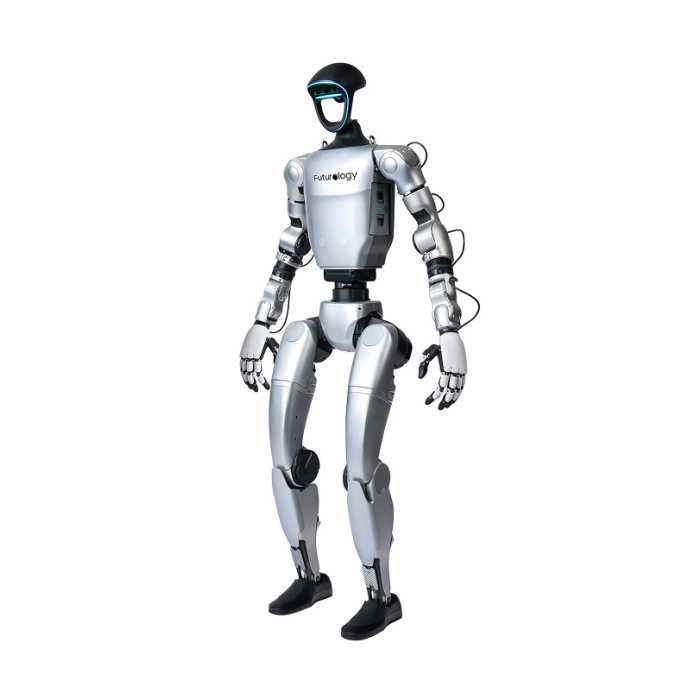
Unitree G1 EDU Pro G (U14) Humanoid Robot
In stock
- BRAND:
- UNITREE ROBOTICS
- MODEL:
- G1edu-U14
- PART #:
- G1edu-U14
- ORIGIN:
- China
- Warranty:
- 12 MONTHS
- AVAILABILITY:
- SUBJECT TO AVAILABILITY
- SKU:
- Unitree-G1edu-U14
Unitree G1 EDU Pro G (U14) Humanoid Robot
Before a humanoid ever walks across your lab, the folded transport case already tells you something: this is a machine designed to be packed away, moved and set up again. The Unitree G1 EDU Pro G (U14) Humanoid Robot folds to 690x450x300mm, and it brings 27 degrees of freedom, two Dex2/5 hands and an NVIDIA Jetson computing module into a compact bipedal frame meant for research, teaching and content work.
The product is available through this page, by quotation.
Background
Unitree and the G1 lineage
Unitree Robotics is a company best known for legged machines, and the G1 is its compact humanoid. The Unitree G1 is a compact bipedal humanoid built for research, education and content work. Every G1 in the range is the same core platform, so the differences between versions come from what is fitted to that platform: the hands, the compute and the development features.
The range is named in several steps: G1 Basic, G1 PRO, G1 Edu Standard, a series of Edu Professional configurations lettered A, B, E, F, G, H and I, G1 Edu Ultimate G, G1 Edu Boxing and G1-Comp. The Pro G, catalogued here as U14, is the Edu Professional G configuration. Reading the letter correctly is the first step in buying the right unit.
Where the Pro G sits in the family
The Pro G is an EDU version, and that matters for compute. On EDU versions the G1 pairs its high-performance 8-core CPU with a Jetson Orin NX 16GB rated at 100 TOPS. That gives teams an on-board platform for perception, planning and learning-based control work, rather than a machine that depends entirely on an external computer.
What sets the Professional G configuration apart is its hardware at the end of the arm. It is equipped with 2 Dex2/5 hands and offers 27 degrees of freedom. The tactile sensor is not included, which is worth knowing at the planning stage if your experiments depend on touch feedback.
Technical Specifications
| Specification | Value |
|---|---|
| Version | G1 Edu Professional G (U14) |
| Hands fitted | 2 Dex2/5 hands |
| Degrees of freedom | 27 |
| Degrees of freedom per leg | 6 |
| Tactile sensing | Tactile sensor not included |
| On-board computing | 8-core CPU and Jetson Orin NX 16GB, 100 TOPS (EDU versions) |
| Connectivity | Wi-Fi 6 / Bluetooth 5.2 |
| Battery | Smart battery, 9000 mAh, quick release |
| Microphone array | 4 microphones |
| Height, width and thickness (folded) | 690x450x300mm |
Specifications as published by the manufacturer; confirmed against the datasheet at quotation.
The manufacturer has not published the weight, the standing dimensions, the knee torque, the arm payload, the battery runtime, the in-the-box contents or the IP rating of this version; they are confirmed at quotation.
What makes the Pro G different from the other G1 versions?
Because all G1 versions share one core platform, the honest answer is found in the configuration, not in a different robot. The Pro G is defined by its two Dex2/5 hands and its 27 degrees of freedom. A buyer who wants a research humanoid that can work with objects, not only walk and gesture, will find that the hand option is the central reason to choose a Professional configuration.
Other Professional letters carry other combinations. Our page for the Unitree G1 Edu Pro A U9 lets you set one of them beside this version. Every figure on this page belongs to the Pro G, or to the EDU series where the table says so, and should not be read across to a sibling.
Does the missing tactile sensor limit the Pro G?
It depends on the experiment. The tactile sensor is not included with this version, so work that relies on touch feedback from the fingertips needs to be discussed with us before an order is placed. For many teaching, motion-control, vision and interaction projects, the microphone side of the platform, the on-board Jetson and the hands themselves already offer a great deal to work with.
If touch sensing is central to your programme, raise it when you request the quotation so that the configuration can be checked against your plan.
Who is the Unitree G1 EDU Pro G (U14) for?
University laboratories are the most natural buyers. A group that needs a humanoid with hands for manipulation research, and a Jetson-class module for running its own models on board, will find the Pro G well matched to that work. Teaching departments can use the same machine to give students direct experience with a bipedal platform.
Integrators and development teams who want to build and test software on a humanoid will value the EDU computing, the Wi-Fi 6 and Bluetooth 5.2 connectivity and the quick-release battery. Content and demonstration teams may find the folded format convenient for moving the robot between venues.
Buyers whose work is about combat demonstration should look at the Unitree G1 EDU Combat Boxing Humanoid Robot instead, and those who do not need functioning hands may prefer the Unitree G1 Edu Plus Humanoid Robot with Fake Hands (G1EDU-U2). The wider Unitree G1 and Research Robots categories give the full picture.
What is the Unitree G1 EDU Pro G (U14) used for?
- Manipulation research. The two Dex2/5 hands and 27 degrees of freedom support experiments in grasping and handling objects.
- Locomotion studies. With 6 degrees of freedom in each leg, the bipedal platform serves gait and balance work.
- On-board AI development. The Jetson Orin NX 16GB at 100 TOPS lets teams run perception and learning workloads on the robot.
- Teaching and student projects. A compact humanoid gives classes a physical platform for robotics coursework.
- Voice and interaction work. The array of 4 microphones supports speech and human-robot interaction trials.
- Demonstrations and content. The folded format and the humanoid form suit exhibitions, filming and showcase events.
Pricing and Availability
We do not print prices on this page. A quotation is the way to proceed: tell us your configuration needs, your location and how you plan to use the robot, and we will respond with a quotation for the Unitree G1 EDU Pro G (U14). Delivery, customs and support are arranged together with the quotation, so that nothing is left to chance once the robot is on its way to you. The Unitree G1 EDU Pro G (U14) Humanoid Robot is available on this page.
Frequently Asked Questions
Which hands does the Pro G have?
The Professional G configuration is equipped with 2 Dex2/5 hands. The tactile sensor is not included with this version.
How many degrees of freedom does it offer?
The version has 27 degrees of freedom, and each leg has 6 degrees of freedom.
What computing does it carry?
EDU versions pair an 8-core CPU with a Jetson Orin NX 16GB rated at 100 TOPS.
How does it connect?
Connectivity is Wi-Fi 6 and Bluetooth 5.2.
What are its folded dimensions?
The folded height, width and thickness are 690x450x300mm.
What battery does it use?
It uses a 9000 mAh smart battery with quick release, so a spare pack can be swapped in without tools being the focus of your session.
Where can I buy the Unitree G1 EDU Pro G (U14) and what does it cost?
It is available through this page, by quotation. Send us your requirements and we will return a quotation; no price is printed here.
Summary
The Unitree G1 EDU Pro G (U14) is a compact humanoid that earns its place through what it can do once unfolded: 27 degrees of freedom, two Dex2/5 hands and a Jetson Orin NX 16GB for on-board computing. Its limits are stated plainly, with no tactile sensor included. For research, education and demonstration teams that want a capable humanoid with hands, this page is the starting point.


