
SIASUN GCR3-618 (GCR3-618)
In stock
- BRAND:
- SIASUN
- PART #:
- GCR3-618
- ORIGIN:
- China
- AVAILABILITY:
- SUBJECT TO AVAILABILITY
- SKU:
- SIASUN-GCR3-618
SIASUN GCR3-618 (GCR3-618)
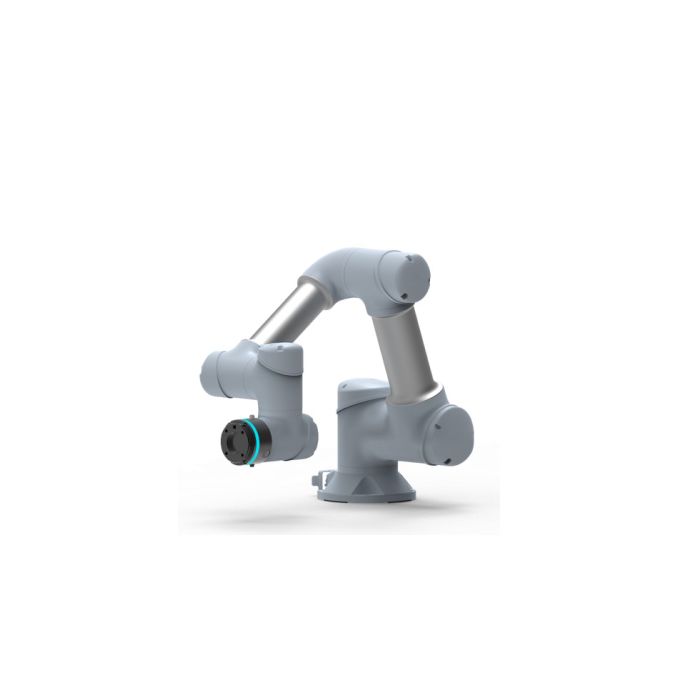
A robot that has to be fenced off is a robot that takes up the floor space of a small room. The SIASUN GCR3-618 (GCR3-618) takes the opposite approach: a compact six-axis arm meant to work at the same bench as the people who run it, with 16 TUV-certified safety features built for human-machine collaboration.
The product is available through this page, by quotation.
Background
SIASUN DUCO and the GCR series
SIASUN DUCO is a sub-brand of SIASUN focused on intelligent robotics. The manufacturer states that it has broken foreign technology monopolies in multiple fields and that all of its core components are independently developed. For a buyer, that matters in a practical way: a maker that develops its own core components controls the design of the whole arm, and that tends to make long-term support a simpler conversation.
The GCR3-618 belongs to the GCR series, which the manufacturer describes as high-end, general-purpose collaborative robots. The series name is a family label, and the numbers in each model name point to the individual arm. Other models in the family include the GCR5-910 and the GCR7-910, and a GCR3-618-W version is also named by the manufacturer. Every figure in this article belongs to the GCR3-618 alone, and no figure from a sibling model has been borrowed.
Positioning and key technology
The GCR3-618 is positioned as a general-purpose arm, not a machine built for one single task. Its design combines three ideas. The first is safety: 16 TUV-certified safety features are provided for human-machine collaboration. The second is perception: the arm integrates 2D/3D vision depth fusion with high-sensitivity force perception, and the two are brought together in its control. The third is ease of use: drag-and-drop teach programming is offered to lower the usage threshold and make operation easier.
Beyond the arm itself, the manufacturer describes a variety of scenario-specific software packages and support for multiple external interfaces. It also describes cloud-based robot data monitoring and remote OTA upgrades. Taken together, the GCR3-618 is presented as a light, approachable arm that can be programmed by hand, fitted with sensing and kept up to date remotely.
Technical Specifications
| Specification | Value |
|---|---|
| Product type | High-end, general-purpose collaborative robot (GCR series) |
| Degrees of freedom | 6 |
| Max payload | 3kg |
| Reach | 618mm |
| Repeatability | ±0.02mm |
| Max TCP speed | 1.0m/s |
| Max straight-line speed | 0.8m/s |
| IP class | IP54/IP65 |
| Safety features | 16 TUV-certified safety features for human-machine collaboration |
| Programming | Drag-and-drop teach programming |
Specifications as published by the manufacturer; confirmed against the datasheet at quotation.
The manufacturer has not published the net weight, the power supply and consumption, the communication interfaces, the package contents or the controller and teach pendant model; they are confirmed at quotation.
What makes the GCR3-618 different from a conventional industrial robot?
A conventional industrial arm is usually chosen for raw speed and strength, and it works behind guarding. A collaborative arm is chosen for a different reason: it can be deployed close to people, and it can be moved from one task to another without rebuilding the cell around it. The GCR3-618 follows that second philosophy. Its 16 TUV-certified safety features are provided specifically for human-machine collaboration, and the manufacturer places a focus on safety in the way the arm is described.
The second difference is how the arm learns a task. With drag-and-drop teach programming, an operator can set up a job without writing a long program, which lowers the threshold for people who are not robotics specialists. Small workshops in particular often have good process knowledge but little programming time, and this approach suits them.
The third difference is sensing. The integration of 2D/3D vision depth fusion and high-sensitivity force perception means the arm is not limited to blind repetition of a fixed path. Vision can help it find a part, and force perception can help it handle contact with that part. The figures behind that precision are modest and clear: ±0.02mm repeatability, a 618mm reach and a 3kg maximum payload.
How does the GCR3-618 compare with larger models in the GCR series?
The model number tells most of the story. The GCR3-618 is the light-payload member of the family, with a 3kg maximum payload and a 618mm reach. It suits tasks where the tool and the workpiece are both small, and where a compact arm fits easily on a bench or a small stand. If your application needs more payload or more reach, the larger arms in the series are the better place to start, for example the SIASUN Collaborative Robot Arm (GCR5-910) or, for much bigger jobs, the SIASUN Collaborative Robot Arm (GCR10-1300).
Choosing the smaller arm is not a compromise on safety or software features in itself; those features are described for the GCR3-618 in their own right. The question is simply whether the task fits within 3kg and 618mm. When it does, a smaller arm is usually easier to place, and it is the natural choice. You can see the whole family on the Cobots page.
Who is the SIASUN GCR3-618 for?
Small and medium manufacturers are the first segment. They often have repetitive bench tasks that tie up skilled people, and they need a robot that can be taught quickly and that does not demand a fenced cell. Drag-and-drop teach programming speaks directly to this buyer.
Integrators are the second segment. A general-purpose arm with multiple external interfaces and scenario-specific software packages gives them a platform they can adapt from one customer project to the next. The vision and force sensing integration adds options for more demanding applications.
Laboratories, training centers and technical schools form the third segment. A six-axis collaborative arm with built-in safety features is a sensible tool for teaching automation, because students can work near it. Finally, companies planning a fleet of arms will find cloud-based data monitoring and remote OTA upgrades useful for managing equipment over time. Buyers who know their parts will exceed 3kg should look at a larger model in the series instead.
What is the SIASUN GCR3-618 used for?
- Assembly: placing, inserting and fastening small parts at a workstation shared with an operator.
- Quality inspection: presenting parts to a camera or checking them with vision, using the 2D/3D vision depth fusion capability.
- Machine tending: loading and unloading small workpieces for a nearby machine, so that people can attend to other duties.
- Contact tasks: work such as polishing or finishing, where high-sensitivity force perception helps the arm handle contact.
- Pick and place: moving light items between stations along a repeatable path.
- Training and development: teaching automation and testing process ideas with drag-and-drop teach programming before a larger rollout.
Pricing and Availability
Prices are not listed on this page. A quotation is the way to proceed: tell us your application, your environment and your quantity, and we will answer with a proposal. Delivery, customs and support are arranged with the quotation, so you do not need to work them out alone. The SIASUN GCR3-618 (GCR3-618) is available on this page.
Frequently Asked Questions
What payload and reach does the GCR3-618 offer?
The GCR3-618 has a maximum payload of 3kg and a reach of 618mm. It has six degrees of freedom.
How precise is the arm?
Repeatability is ±0.02mm. The maximum TCP speed is 1.0m/s and the maximum straight-line speed is 0.8m/s.
What safety features does it have?
The manufacturer lists 16 TUV-certified safety features for human-machine collaboration. They are the basis for working next to people without a conventional guarded cell, subject to your own risk assessment.
How is the robot programmed?
It uses drag-and-drop teach programming, which is intended to lower the usage threshold and make operation easier. Scenario-specific software packages are also available.
What is its IP class?
The IP class is listed as IP54/IP65. Please ask at quotation how this applies to your working environment.
Can the robot be monitored and updated remotely?
Yes. The manufacturer describes cloud-based robot data monitoring and remote OTA upgrades, together with support for multiple external interfaces.
Where can I buy the GCR3-618 and what does it cost?
It is available through this page, by quotation. We do not print prices here; send us your requirements and we will prepare a proposal that covers delivery, customs and support.
Summary
The idea behind the SIASUN GCR3-618 is that a robot should not have to be set apart from the people it helps. With a 3kg maximum payload, 618mm reach, ±0.02mm repeatability, 16 TUV-certified safety features and drag-and-drop teaching, it is a compact arm for shared workspaces. Vision and force sensing, scenario-specific software and cloud monitoring extend what it can do. If it fits your task, this page is the starting point.


