
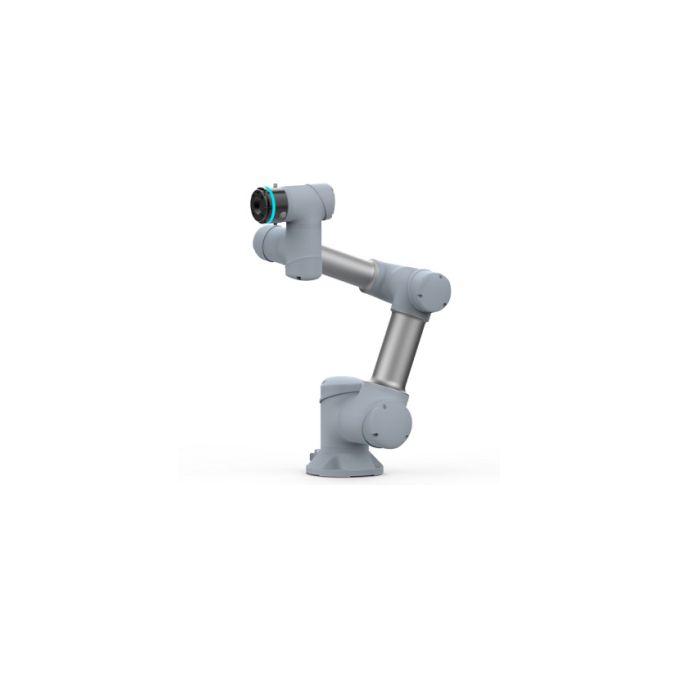
SIASUN Collaborative Robot Arm with 917mm Reach, 5kg Max Payload, 6 DOFs (GCR5-910)
In stock
- BRAND:
- SIASUN
- PART #:
- GCR5-910
- ORIGIN:
- China
- AVAILABILITY:
- SUBJECT TO AVAILABILITY
- SKU:
- SIASUN-GCR5-910
SIASUN Collaborative Robot Arm with 917mm Reach, 5kg Max Payload, 6 DOFs (GCR5-910)
A cobot has to be two things at once: gentle enough to work beside a person and exact enough to earn its place on the line. The SIASUN Collaborative Robot Arm with 917mm Reach, 5kg Max Payload, 6 DOFs (GCR5-910) is built around that balance, pairing a repeatability of ±0.02mm with safety features certified by TUV for work next to people.
The product is available through this page, by quotation.
Background
SIASUN and the GCR series
SIASUN is a robotics manufacturer whose range runs from industrial robot arms to collaborative models. The GCR series is its line of collaborative arms, and the GCR5-910 is a high-end, general-purpose collaborative robot within that series. The sources name three further versions in the family: the GCR5-910-W, the GCR3-618 and the GCR3-618-W. This article gives figures only for the GCR5-910, and none of them should be read across to the other versions.
For buyers who are still deciding between collaborative and conventional arms, our Robot Arms category shows the wider range, and the Factory Robots category groups the equipment used on production floors.
Positioning and key technology
The GCR5-910 is aimed at general-purpose work rather than a single task. Three ideas run through its design. The first is safety: the arm carries 16 TUV-certified safety features for human-machine collaboration. The second is perception: it integrates 2D/3D vision depth fusion with high-sensitivity force perception and control, so it can respond to what it sees and what it feels. The third is ease of use: drag-and-drop teach programming lowers the usage threshold and makes operation easier for people who are not robot specialists.
On the software side, SIASUN supplies a variety of scenario-specific software packages and supports multiple external interfaces. Cloud-based robot data monitoring and remote OTA upgrades are part of the offer too. In practice, that means the arm can be watched and updated without sending a technician to the cell every time.
Technical Specifications
| Specification | Value |
|---|---|
| Model | GCR5-910 |
| Product type | High-end, general-purpose collaborative robot (GCR series) |
| Degrees of freedom | 6 |
| Max payload | 5kg |
| Reach | 917mm |
| Repeatability | ±0.02mm |
| Max TCP speed | 3.6m/s |
| Max straight-line speed | 1.5m/s |
| IP class | IP54/IP65 |
| Safety | 16 TUV-certified safety features for human-machine collaboration |
| Programming | Drag-and-drop teach programming |
Specifications as published by the manufacturer; confirmed against the datasheet at quotation.
The manufacturer has not published the communication interfaces, the contents of the box, the operating noise, the robot cable length or a joint-by-joint speed table; they are confirmed at quotation.
What makes the GCR5-910 different from a traditional industrial arm?
A traditional industrial arm is usually chosen for raw speed and strength, and it normally works behind a fence. The GCR5-910 takes a different route. Its 16 TUV-certified safety features exist so that a person and the robot can share a workspace, and that changes how a station can be laid out. Instead of building a cage and a separate loading point, a team can plan a cell where the operator stays close to the work.
This does not mean giving up capability. A repeatability of ±0.02mm is a precision figure that suits assembly, screw fastening and inspection, and a maximum TCP speed of 3.6m/s shows the arm is not built only for slow, cautious motion. The maximum straight-line speed is 1.5m/s. Those two numbers measure different things, so read them separately when you plan cycle times.
The other difference is how the arm is taught. With drag-and-drop teach programming, a technician can show the robot what to do rather than writing code from scratch. For a plant that changes products often, or one that has no dedicated robot programmer, that matters as much as any speed figure.
How do vision and force sensing change what the arm can do?
An arm that only follows fixed coordinates needs the part to be in exactly the same place every time. The GCR5-910 integrates 2D/3D vision depth fusion with high-sensitivity force perception and control, which lets it work with parts that vary a little in position and contact them with controlled force.
That combination is what makes tasks such as intelligent picking, polishing and grinding, and gluing and oiling realistic for a cobot. Picking needs the arm to find the part. Polishing and grinding need it to hold a steady contact. Screw fastening needs it to feel when the screw is seated. These all belong to the application areas of this model, together with welding, loading and unloading, assembly and quality inspection.
The IP class is IP54/IP65. For a workshop where dust or splashes are part of daily life, that is a useful line on the datasheet.
Who is the GCR5-910 for?
The first group is the small and medium manufacturer that wants to automate a manual station without rebuilding the shop floor. A collaborative arm that can sit beside an operator, be taught by hand and be redeployed later suits a plant with mixed production runs.
The second group is the integrator or engineering team that needs a general-purpose arm for several customer projects. Scenario-specific software packages and multiple external interfaces help here, because the same arm can be adapted to different tasks. The cloud-based data monitoring and remote OTA upgrades also help an integrator who supports equipment after it has been installed.
The third group is the quality or finishing department. Vision, force control and a repeatability of ±0.02mm point to inspection, polishing, grinding and gluing work, where consistency matters more than brute force.
Buyers whose parts or tools fall outside a 5kg payload and 917mm reach can compare the SIASUN Collaborative Robot Arm (GCR10-1300) with us during the quotation. The GCR5-910 is the right starting point when 5kg and 917mm cover the task.
What is the GCR5-910 used for?
- Intelligent picking. Vision depth fusion helps the arm locate parts and pick them from varied positions.
- Welding. The arm carries out welding tasks within its general-purpose range.
- Loading and unloading. It moves parts into and out of machines and fixtures, freeing operators for other work.
- Assembly and screw fastening. Precise positioning and force perception suit fitting parts together and driving screws.
- Polishing and grinding. High-sensitivity force control supports surface finishing with steady contact.
- Quality inspection, gluing and oiling. The arm presents parts to vision systems and applies glue or oil in a repeatable way.
Pricing and Availability
We do not publish prices for this arm. The way forward is a quotation, which we prepare against your application, your site and the version you need. Delivery, customs and support are arranged together with the quotation, so you receive one plan rather than separate pieces. The SIASUN GCR5-910 collaborative robot arm is available on this page.
Frequently Asked Questions
What payload and reach does the GCR5-910 have?
The maximum payload is 5kg and the reach is 917mm. Both figures apply to the GCR5-910 only, not to other versions in the family.
How accurate is the arm?
Repeatability is ±0.02mm. This is the figure to check against the tolerance of your assembly, screw fastening or inspection task.
Can it work next to people?
Yes, it is designed for human-machine collaboration and carries 16 TUV-certified safety features. A risk assessment of your own cell is still part of any installation.
How is the robot programmed?
It uses drag-and-drop teach programming, which lowers the usage threshold and makes operation easier. Scenario-specific software packages are also available.
Does it support remote monitoring and updates?
Yes. The arm offers cloud-based robot data monitoring and remote OTA upgrades, along with multiple external interfaces.
Which tasks is it suited to?
Intelligent picking, welding, loading and unloading, assembly, screw fastening, polishing and grinding, quality inspection, and gluing and oiling.
Where can I buy the GCR5-910 and what does it cost?
You can request it through this page, by quotation. We do not list a price, because the quotation is prepared for your project, including delivery, customs and support.
Summary
The GCR5-910 answers the question of how to automate a station without pushing people away from it. It offers a 5kg payload, a 917mm reach and a repeatability of ±0.02mm, combined with 16 TUV-certified safety features, vision and force sensing, and teaching by hand. It suits assembly, picking, finishing, inspection and machine loading in shops that want to keep their operators close to the work. If that matches your project, this page is the starting point.


