
SIASUN Industrial Robot Arm with 1465mm Reach, 12kg Max Payload, 6 DOFs (SR12A-12/1.46)
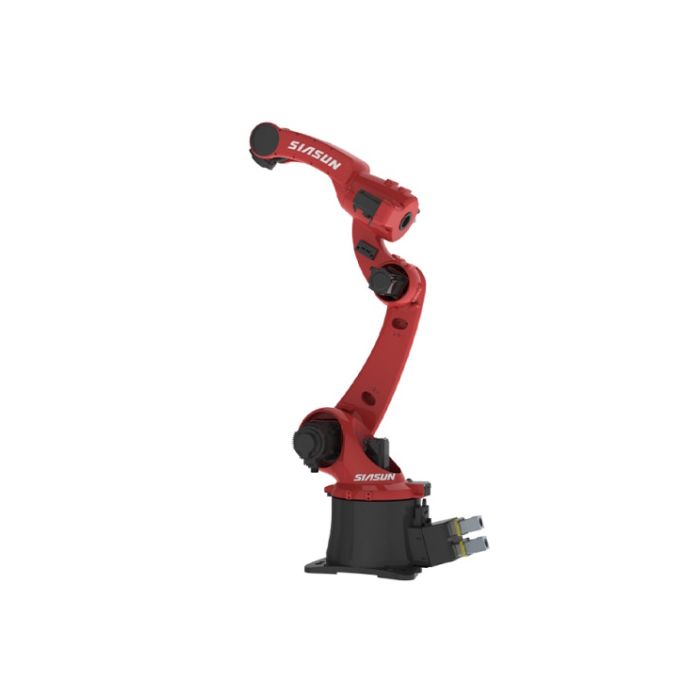
In stock
- BRAND:
- SIASUN
- PART #:
- SR12A-12/1.46
- ORIGIN:
- China
- AVAILABILITY:
- SUBJECT TO AVAILABILITY
- SKU:
- SIASUN-SR12A-12/1.46
SIASUN Industrial Robot Arm with 1465mm Reach, 12kg Max Payload, 6 DOFs (SR12A-12/1.46)
Some welding jobs are won or lost in a space barely wider than the workpiece itself. The arm that carries the torch has to slip into that gap, hold its posture and stay out of the way of fixtures. The SIASUN Industrial Robot Arm with 1465mm Reach, 12kg Max Payload, 6 DOFs (SR12A-12/1.46) is built for exactly this kind of work: a compact, arc-welding-focused manipulator whose design starts from the weld seam and works backward to the robot.
The SIASUN SR12A-12/1.46 is available through this page, by quotation.
Background
SIASUN and the SR series
SIASUN is a Chinese robotics manufacturer whose industrial arms cover a wide span of payloads, from compact welding robots to heavy manipulators and palletizing machines. The SR12A-12/1.46 sits at the light end of that range. Its model code reads as a payload of 12 and a reach of 1.46 meters, and it is the arm the manufacturer developed specifically for demanding arc welding applications.
Within the same family you will find larger arms such as the SIASUN Industrial Robot Arm (SR25A-25/1.80) and the SIASUN Industrial Robot Arm (SR50A-50/2.15). The SR12A-12/1.46 is the one to look at when the job is welding in tight quarters rather than carrying heavy loads.
What sets the design apart
Three design choices define this robot. First, the hollow bow-shaped arm allows internal cabling, which gives greater flexibility in confined spaces. Cables that run inside the arm are protected from fixtures and from wear, and they take up no room outside the arm.
Second, the wire feeder is compactly integrated into the robot body, which improves wire feeding stability. A steady feed matters in welding, because an interrupted wire shows up as an inconsistent seam.
Third, the robot uses a special casting process with automotive engine-grade aluminum alloy. This achieves a weight reduction of 25% compared to the previous generation. Against that same previous generation, repeat positioning accuracy is increased by 40% and operational efficiency is boosted by 67%.
Technical Specifications
| Specification | Value |
|---|---|
| Model | SR12A-12/1.46 |
| Intended application | Arc welding |
| Degrees of freedom | 6 |
| Payload | 12 kg (26.5 lbs) |
| Reach | 1465mm |
| Repeatability | ±0.03mm |
| Protection (wrist) | IP65 |
| Power capacity | 2 KVA |
| Controller model | SRC M5 / SRC E5 |
| Mounting | Floor-mounted or ceiling-hung |
| Installation methods | Upright, inverted and side-mounted |
| Arm design | Hollow bow-shaped arm with internal cabling |
| Wire feeder | Integrated into the robot body |
| Weight reduction vs previous generation | 25% |
| Repeat positioning accuracy vs previous generation | Increased by 40% |
| Operational efficiency vs previous generation | Boosted by 67% |
Specifications as published by the manufacturer; confirmed against the datasheet at quotation.
The manufacturer has not published the weight of the robot, the axis speeds, the axis motion ranges, the wrist moment ratings, the power supply voltage, the operating temperature, the package contents, whether the controller is included in delivery, or the noise level; they are confirmed at quotation.
What makes the SR12A-12/1.46 different from a general-purpose robot arm?
A general-purpose arm is designed to do many things reasonably well. This one is designed around a single process. The hollow bow-shaped arm carries the cabling inside, so there is less hardware outside the arm to catch on a workpiece or a clamp. For arc welding in confined spaces, that is a practical advantage. The torch can approach from awkward angles because the arm itself presents a cleaner profile.
The integrated wire feeder is the second difference. Wire feeding is a weak point in many welding cells, and placing the feeder in the robot body keeps it compact and improves feeding stability. Combined with a repeatability of ±0.03mm, the arm is aimed at consistent seam placement from one part to the next.
The third difference is the mounting flexibility. The robot can be floor-mounted or ceiling-hung, which suits operations with small turning radii and narrow areas. The installation methods also include upright, inverted and side-mounted. That lets a cell designer choose the position that keeps the floor clear and the torch close to the seam.
How does it compare with the previous generation?
This arm improves on its previous generation on three points. Weight is reduced by 25% thanks to the automotive engine-grade aluminum alloy casting. Repeat positioning accuracy is increased by 40%. Operational efficiency is boosted by 67%.
A lighter arm means less mass to move, which supports the efficiency gain. The better repeat positioning means the torch returns to the same point more reliably, cycle after cycle.
Who is the SR12A-12/1.46 for?
The first group is fabrication shops that weld small and medium parts in tight fixtures, where the shape of the arm matters as much as its rating. The hollow arm and the ceiling or side mounting options give them room to lay out cells densely.
The second group is integrators building arc welding cells for clients. A robot that arrives with an integrated wire feeder and internal cabling reduces the amount of external routing they have to design and maintain. The IP65 wrist protection is also relevant in a welding environment.
The third group is plants upgrading older welding robots. The weight reduction, accuracy and efficiency gains over the previous generation are the reasons to review an older cell.
If the parts are larger and a longer reach is needed with the same payload class, look at the SIASUN Industrial Robot Arm with 2010mm Reach, 12kg Max Payload, 6 DOFs (SR25A-12/2.01). You can also browse the Small Payload range or the wider Robot Arms category.
What is the SR12A-12/1.46 used for?
- Arc welding of fabricated parts: the application the arm was developed for, from single parts to repeated production runs.
- Welding in confined spaces: the internal cabling and the compact arm profile help the torch reach into tight areas.
- Ceiling-hung welding cells: mounting from above frees up floor space and suits narrow areas.
- Side-mounted and inverted installations: alternative orientations let the robot reach seams that an upright robot would struggle to approach.
- Dense cell layouts: a slim arm that interferes less with the workpiece allows robots and fixtures to be placed closer together.
- Upgrades of existing welding lines: a lighter, more accurate arm to replace an earlier generation in an existing process.
Pricing and Availability
We do not list prices on this page. A quotation is the way to get started, and it covers the configuration you need. Delivery, customs and support are arranged with the quotation. The SR12A-12/1.46 is available on this page.
Frequently Asked Questions
What is the payload of the SR12A-12/1.46?
The payload is 12 kg (26.5 lbs).
How far can the arm reach?
The reach is 1465mm. This is the figure that appears in the model code as 1.46.
How precise is the robot?
Repeatability is ±0.03mm. Compared with the previous generation, repeat positioning accuracy is increased by 40%.
What is the protection rating?
The wrist protection is IP65.
How can the robot be mounted?
It can be floor-mounted or ceiling-hung. The installation methods are upright, inverted and side-mounted.
Which controller does it use?
The controller model is SRC M5 / SRC E5.
Where can I buy the SR12A-12/1.46 and what does it cost?
You can request a quotation for the SIASUN SR12A-12/1.46 on this page. We do not publish prices; the cost depends on the configuration and on delivery to your location, and it is given in the quotation.
Summary
The SIASUN SR12A-12/1.46 is a welding robot designed for gaps that leave little room: a hollow arm with internal cabling, an integrated wire feeder, a 12 kg (26.5 lbs) payload, 1465mm reach and ±0.03mm repeatability. Floor, ceiling, side and inverted mounting give the cell designer room to work, and the lighter casting improves on the previous generation. For arc welding where space is the real constraint, this page is the starting point.


