
SEER Robotics Robotic Automatic Charging Station (SCS-C4850D)
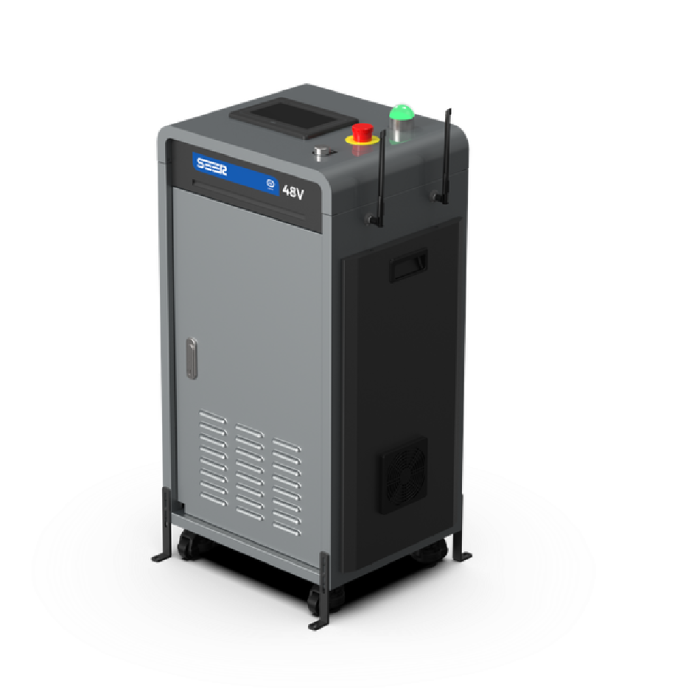
In stock
- BRAND:
- SEER ROBOTICS
- MODEL:
- SCS-C4850D
- PART #:
- SCS-C4850D
- ORIGIN:
- China
- Warranty:
- 12 MONTHS
- AVAILABILITY:
- SUBJECT TO AVAILABILITY
- SKU:
- SEER-Robotics-SCS-C4850D
SEER Robotics Robotic Automatic Charging Station (SCS-C4850D)
Every hour a robot spends tethered to a charger is an hour it is not working, and a warehouse notices that quickly. The SEER Robotics Robotic Automatic Charging Station (SCS-C4850D) is built for operators who want charging to be the quietest part of the shift: a floor-standing station that delivers power to 48 V autonomous forklifts, watches over the process itself and reports back to the people in charge.
The product is available through this page, by quotation.
Background
SEER Robotics and its customer base
SEER Robotics is listed on the Hong Kong exchange under the code 06106.HK. It describes itself as a platform-based embodied intelligent robotics company built around what it calls the Robot Brain. The company serves more than 2,500 customers worldwide with intelligent robotics solutions. Charging equipment may look like a side business for such a company, but it is a practical necessity. A fleet of mobile robots is only as productive as the infrastructure that keeps their batteries topped up, and a maker that supplies the vehicles' intelligence has every reason to supply the energy side as well.
The SCS-C4850D sits in a family of charging stations that SEER Robotics offers for different robots and battery systems. Operators with other vehicles or voltage classes can browse the full Charging Stations category to see the rest of the range.
Where the SCS-C4850D fits
The station is specified for a 48 V autonomous forklift. That focus matters. Instead of being a general-purpose power supply that an integrator has to adapt, it is a charger designed around a defined class of vehicle, with a defined voltage and current envelope, and with the interface and control functions a robot fleet needs. It delivers up to 3 kW of output at 48 V / 60 A, and it is compatible with various lithium batteries, so it can serve more than one battery type within the same forklift class.
Its intelligence is in the way it charges. Three charging modes are supported: protocol-based, state-based and voltage-based. Users can customize the charging curves. The station also offers both automatic and manual fast charging, and a REMA160 connector is provided for manual charging when someone needs to plug a vehicle in by hand. In practice that means one unit can handle the routine, hands-off docking cycle and the occasional manual top-up without a second charger on the wall.
Technical Specifications
| Specification | Value |
|---|---|
| Model | SCS-C4850D |
| Dimensions (L x W x H) | 580 x 460 x 980 mm |
| AC input voltage | 110 V to 120 V / 220 V to 240 V |
| Input frequency | 50 / 60 Hz |
| DC output voltage | 32 V to 60 V |
| Maximum output power | 1500 / 3000W |
| Rated output | Up to 3 kW at 48 V / 60 A |
| Charging time | Fully charging in as fast as 1 hour |
| Connector for manual charging | REMA160 |
| Network | Wi-Fi (recommended), Wired, 5G |
| Working temperature | 0℃ to 40℃ |
| Reference standard | EN 62477-1:2012+A11:2014+A1:2017+A12:2021 |
| Suitable product model | 48 V, autonomous forklift |
| Battery compatibility | Various lithium batteries |
Specifications as published by the manufacturer; confirmed against the datasheet at quotation.
The manufacturer has not published the package contents, the charging efficiency, the cable length, the mounting method or the certifications; they are confirmed at quotation.
What makes the SCS-C4850D different from a generic lithium charger?
A generic charger delivers current and leaves the rest to someone else. The SCS-C4850D is designed as part of a robot workflow. It supports protocol-based, state-based and voltage-based charging, and because the charging curves can be customized, a site can match the behavior of the station to the battery it actually uses, instead of accepting a single fixed profile.
Protection is the second difference. The station has built-in safeguards against over-voltage, over-current, short-circuit, reverse connection, leakage and overheating. Six separate protections matter in a busy facility, where connectors are used many times a day and a fault should end in a safe shutdown instead of damage to a battery.
The third difference is operation. An integrated human-machine interface covers data display, parameter adjustment, network setup, log event query and device control, so the station is ready to operate independently upon deployment. A technician can configure it at the unit without a separate laptop session. For supervision from a distance, the system can be monitored and controlled remotely via Roboshop, which keeps all operational status under instant supervision.
How does the station connect and power up?
On the electrical side, the station accepts AC input of 110 V to 120 V or 220 V to 240 V at 50 / 60 Hz. That range suits sites with different supply standards, which is common across the Caribbean, where a facility may run on either system. The DC output ranges from 32 V to 60 V, and the maximum output power is 1500 / 3000W. The rated delivery for the forklift application is up to 3 kW at 48 V / 60 A, with a full charge in as fast as 1 hour.
On the network side, Wi-Fi is the recommended connection, with wired and 5G also supported. The station works within a temperature range of 0℃ to 40℃, and it follows the reference standard EN 62477-1:2012+A11:2014+A1:2017+A12:2021. The footprint is 580 x 460 x 980 mm, which is compact enough to place along a warehouse wall or at the end of an aisle.
Who is the SCS-C4850D for?
The first group is operators of 48 V autonomous forklifts. Their vehicles are the match for this station, and the quick charging time is aimed at keeping those vehicles in service. Warehouse and distribution managers will see the value in a charger that works without an attendant, reports its status and can be supervised from a desk.
The second group is integrators building robot cells or fleet deployments. They need clear voltage ranges, network options and a connector for manual charging, and they need a station that can be commissioned through its own interface. The wide AC input range also helps when the same design is installed at several sites with different supply voltages.
The third group is factory operators who are adding mobile robots to an existing line. Our Factory Robots page shows the vehicles and systems these stations support. Buyers whose vehicles run on a different battery system should look at other models in the range, such as the SCS-C48100D or the SCS-C4860, and send us the vehicle details.
What is the SCS-C4850D used for?
- Automatic charging of autonomous forklifts. The station supplies up to 3 kW at 48 V / 60 A to the vehicles it is specified for.
- Manual fast charging. The REMA160 connector lets staff charge a vehicle by hand when it has not docked on its own.
- Matching different lithium batteries. Protocol-based, state-based and voltage-based modes, with customizable curves, let a site adapt the charge to its battery.
- Protecting batteries and equipment. Safeguards against over-voltage, over-current, short-circuit, reverse connection, leakage and overheating guard the vehicle and the station.
- Local commissioning and diagnosis. The built-in interface handles parameters, network setup and log event queries at the unit.
- Remote fleet supervision. Roboshop gives managers monitoring and control of the station's operational status from elsewhere on site or beyond.
Pricing and Availability
We do not publish prices for this station. Every project is quoted individually, so tell us your vehicle type, battery system, supply voltage and number of stations, and we will prepare a quotation. Delivery, customs and support are arranged together with the quotation, so you receive one clear plan instead of separate arrangements. The SEER Robotics Robotic Automatic Charging Station (SCS-C4850D) is available on this page.
Frequently Asked Questions
Which vehicles does the SCS-C4850D suit?
It is made for a 48 V autonomous forklift and works with various lithium batteries. Send us your vehicle and battery details and we will take it from there.
How fast can it charge?
It delivers up to 3 kW at 48 V / 60 A, fully charging in as fast as 1 hour.
What supply voltage does it need?
The AC input is 110 V to 120 V or 220 V to 240 V at 50 / 60 Hz. The DC output ranges from 32 V to 60 V.
How does the station connect to the network?
It supports Wi-Fi, which is the recommended option, as well as wired and 5G connections. Remote monitoring and control run through Roboshop.
What protections are built in?
The station protects against over-voltage, over-current, short-circuit, reverse connection, leakage and overheating.
What temperature can it work in?
The working temperature range is 0℃ to 40℃.
Where can I buy the SCS-C4850D and what does it cost?
You can request it through this page, and we will answer with a quotation. The cost depends on your project, so we do not list a price here.
Summary
Charging should not be the part of the day that anyone has to think about. The SCS-C4850D tries to make that true for 48 V autonomous forklift fleets: up to 3 kW at 48 V / 60 A, three charging modes with customizable curves, six built-in protections, an integrated interface and remote supervision through Roboshop. If it matches your vehicles, this page is the starting point.


