
SEER Robotics Robotic Automatic Charging Station (SCS-C24100D)
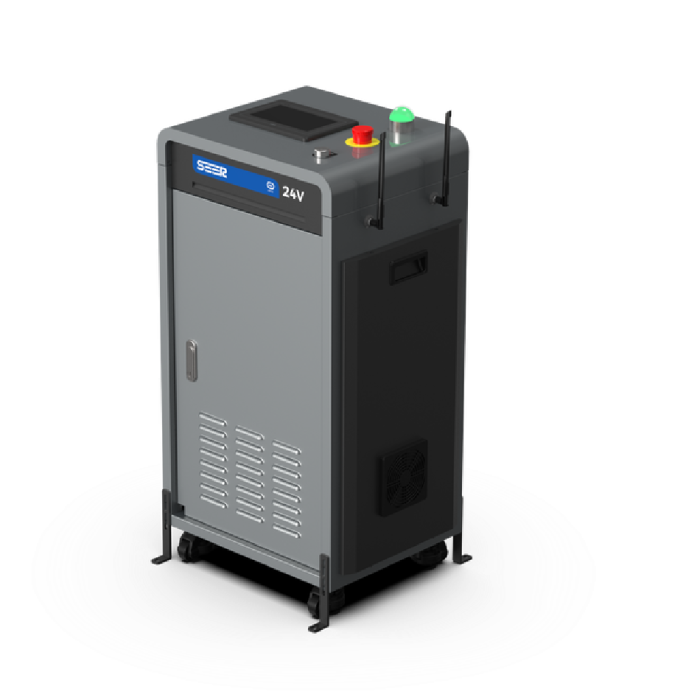
In stock
- BRAND:
- SEER ROBOTICS
- MODEL:
- SCS-C24100D
- PART #:
- SCS-C24100D
- ORIGIN:
- China
- Warranty:
- 12 MONTHS
- AVAILABILITY:
- SUBJECT TO AVAILABILITY
- SKU:
- SEER-Robotics-SCS-C24100D
SEER Robotics Robotic Automatic Charging Station (SCS-C24100D)
A robot fleet is only as dependable as the quiet corner where it recharges. The SEER Robotics Robotic Automatic Charging Station (SCS-C24100D) is built for that corner: a floor-standing 24 V charger that delivers up to 3 kW, protects the battery with five safeguards and can be watched from a screen far away from the warehouse floor.
This product is available through this page, by quotation.
Background
SEER Robotics and its lineage
SEER Robotics is listed in Hong Kong under the code 06106.HK. It describes itself as a platform-based embodied intelligent robotics company built around the Robot Brain, and it serves more than 2,500 customers worldwide with intelligent robotics solutions. A company with that kind of installed base has to think about the whole working day of a robot, not only about how the robot drives. Charging is part of that day, and this station comes from the same maker as the vehicles and software it is meant to serve.
The charging station family includes several versions. Besides the SCS-C24100D described here, the sources name the SCS-C4850D and the SCS-C48100D. Every figure on this page belongs to the SCS-C24100D only. If you are comparing versions, treat each model page as its own record.
Positioning and key technology
The SCS-C24100D is a robotic automatic charging station. According to the manufacturer, it is suited to a 24 V autonomous forklift and is compatible with various lithium batteries. Its output reaches up to 3 kW at 24 V and 100 A, and a full charge can take as little as 1 hour.
Three ideas define the design. The first is power with protection: five safeguards cover over-voltage, over-current, short circuit, leakage and over-temperature. The second is flexibility: protocol-based, state-based and voltage-based charging modes, with charging curves that the user can customize. The third is visibility: an integrated human-machine interface (HMI) on the unit, and remote monitoring and control through Roboshop. Together they make a charger that can work on its own once it is deployed and still be supervised from a distance.
Technical Specifications
| Specification | Value |
|---|---|
| Dimensions (L x W x H) | 580 x 460 x 980 mm |
| Output power and rating | Up to 3 kW output with 24 V / 100 A, fully charging in as fast as 1 hour |
| AC input voltage | 110 V to 120 V / 220 V to 240 V |
| Input frequency | 50 / 60 Hz |
| DC output voltage | 16 V to 32 V |
| DC output current | 50 / 100 A |
| Maximum output power | 1500 / 3000W |
| Connector for manual charging | REMA160 |
| Network | Wi-Fi (recommended), Wired, 5G |
| Working temperature | 0°C to 40°C |
| Plug specification | GB 16A |
| Reference standard | EN 62477-1:2012+A11:2014+A1:2017+A12:2021 |
| Protection | Five safeguards: over-voltage, over-current, short circuit, leakage and over-temperature protection |
| Charging modes | Protocol-based, state-based and voltage-based, with user-customizable charging curves |
| HMI | Data display, parameter adjustment, network setup, log event query and device control |
| Remote monitoring | Monitor and control remotely via Roboshop |
| Suitable product model | 24 V, autonomous forklift |
| Battery compatibility | Various lithium batteries |
Specifications as published by the manufacturer; confirmed against the datasheet at quotation.
The manufacturer has not published the package contents, the charging cable length, the efficiency, the noise level, the mounting method or any certifications beyond those listed above; they are confirmed at quotation.
What makes the SCS-C24100D different from a plain battery charger?
A plain charger pushes current into a battery and leaves everything else to chance. This station treats charging as a managed process. It offers three charging modes, and the user can customize the charging curves, so the profile can be matched to the lithium battery in the robot rather than the other way round. That matters in a mixed fleet, where not every battery asks for the same treatment.
The second difference is the five safeguards. Over-voltage, over-current, short circuit, leakage and over-temperature protection are all named by the manufacturer, and together they cover the faults that matter most when a high-current DC output is working around people and equipment.
The third difference is that the station is ready to operate independently upon deployment. The built-in HMI shows data, lets staff adjust parameters, set up the network, query logged events and control the device. Nobody needs a laptop to find out why a charging session stopped. When a supervisor does prefer a wider view, Roboshop provides remote monitoring and control, so operational status stays under instant supervision.
How does the SCS-C24100D connect and power up?
On the supply side, the station accepts an AC input of 110 V to 120 V or 220 V to 240 V at 50 / 60 Hz, which gives it room to fit different site supplies. The plug specification is GB 16A, so check that against your outlets when you request a quotation.
On the output side, the DC voltage range is 16 V to 32 V and the DC output current is listed as 50 / 100 A, with a maximum output power of 1500 / 3000W. The headline rating is up to 3 kW at 24 V / 100 A. For network access the manufacturer lists Wi-Fi (recommended), wired and 5G. For manual charging, the connector is REMA160.
The working temperature range is 0°C to 40°C, so the station suits indoor spaces where conditions stay inside that band. The unit measures 580 x 460 x 980 mm, which is worth comparing against the floor space you have planned beside the robot's docking point.
Who is the SCS-C24100D for?
The first group is operators of autonomous forklifts. The manufacturer names a 24 V autonomous forklift as the suitable product model, and the up-to-3 kW output is aimed at keeping such a vehicle working through long shifts.
The second group is integrators and robot builders who work with lithium batteries. Charging modes that can follow the battery's own protocol, its state or its voltage, along with adjustable curves, give them room to fit the station to their design rather than redesign the battery.
The third group is warehouse and plant managers who want charging status to be visible. The HMI gives staff on the floor the data and the event log, and Roboshop gives supervisors the same oversight remotely.
If your robots run on a different battery system, this is not automatically the right model. The family also includes the SCS-C4850D and the SCS-C48100D, and you can browse the wider Charging Stations category. Confirm the battery voltage of your fleet before you choose.
What is the SCS-C24100D used for?
- Charging autonomous forklifts. The station is listed for a 24 V autonomous forklift, with up to 3 kW output at 24 V / 100 A.
- Charging lithium-battery robots. It is compatible with various lithium batteries, which suits mixed robot fleets.
- Matching charging to the battery. Protocol-based, state-based and voltage-based modes, plus customizable curves, let the charge follow the battery's needs.
- Manual fast charging. The REMA160 connector supports manual charging when a vehicle needs to be topped up by hand.
- On-site supervision. The HMI offers data display, parameter adjustment, network setup, log event query and device control at the unit.
- Remote oversight. Roboshop allows the system to be monitored and controlled remotely, over Wi-Fi, wired or 5G connections.
Pricing and Availability
The SCS-C24100D is sold by quotation only, so there is no price on this page. Send us your request with your battery voltage, your site's AC supply and the quantity you need, and we will respond with a quotation. Delivery, customs and support are arranged with the quotation. The product is available on this page.
Frequently Asked Questions
What battery voltage does the SCS-C24100D suit?
The manufacturer lists the suitable product model as 24 V, autonomous forklift. The output rating is up to 3 kW at 24 V / 100 A.
How fast can it charge?
The manufacturer states that it can fully charge in as fast as 1 hour. The actual time depends on the battery being charged.
What protections does it include?
It has five safeguards: over-voltage, over-current, short circuit, leakage and over-temperature protection.
Can I monitor it remotely?
Yes. The system can be monitored and controlled remotely through Roboshop, and the network can be Wi-Fi (recommended), wired or 5G.
What AC supply does it need?
The AC input is 110 V to 120 V or 220 V to 240 V at 50 / 60 Hz. The plug specification is GB 16A, so please check it against your outlets.
What operating temperature is it rated for?
The working temperature is 0°C to 40°C. It is best suited to indoor sites that stay within that range.
Where can I buy the SCS-C24100D and what does it cost?
It is available through this page, by quotation. We do not print prices; send a request and we will reply with a quotation that covers delivery, customs and support.
Summary
The idea behind the SCS-C24100D is simple: the corner where a robot recharges should be as capable as the robot itself. It brings up to 3 kW at 24 V / 100 A, five safeguards, three charging modes with customizable curves, an on-unit HMI and remote oversight through Roboshop into one 580 x 460 x 980 mm cabinet. For operators of 24 V autonomous forklifts and lithium-battery robots, it is a considered answer to the charging question. If you want to put it into your own project, this page is the starting point.


