
SEER Robotics 2D Obstacle Avoidance Lidar (C214)
In stock
- BRAND:
- SEER ROBOTICS
- MODEL:
- C214
- PART #:
- C214
- ORIGIN:
- China
- Warranty:
- 12 MONTHS
- AVAILABILITY:
- SUBJECT TO AVAILABILITY
- SKU:
- SEER-Robotics-C214
SEER Robotics 2D Obstacle Avoidance Lidar (C214)
A robot that cannot see what is in front of it is only a very expensive obstacle. The SEER Robotics 2D Obstacle Avoidance Lidar (C214) exists to remove that problem: a small, light laser scanner that gives a moving machine a steady picture of what is in its way, without asking for much space, weight or power in return.
The product is available through this page, by quotation.
Background
SEER Robotics and its lineage
SEER Robotics (06106.HK) is a platform-based embodied intelligent robotics company built around the Robot Brain. It serves more than 2,500 customers worldwide with intelligent robotics solutions. That context matters when you look at a component like the C214. It is not a stand-alone gadget from a sensor catalog; it comes from a company whose business is making robots move and work in real facilities.
Across the SEER Robotics range you will find autonomous forklifts, pallet trucks and counterbalance trucks, as well as lidar sensors. Sensors such as the C214 sit at the point where the robot meets the physical world, which is why a robotics maker takes care over them.
Positioning and key technology of the C214
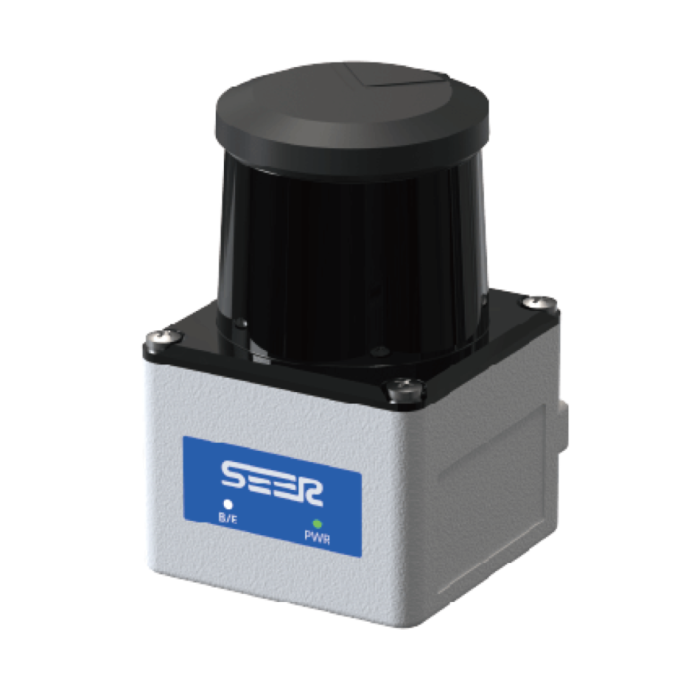
The C214 is a 2D LiDAR sensor with a measuring range up to 25 m and an Ethernet connection. A 2D lidar sweeps a laser across a single plane and reports the distance to whatever it meets. For a ground vehicle, that plane is usually enough to tell whether a pallet, a wall, a rack leg or a person stands in the way. The sensor is named for obstacle avoidance, so that is the job it is positioned for.
Three qualities define it. First, the precision: scanning precision reaches ±3 cm. Second, the footprint: the sensor measures 50 x 50 x 77 mm and weighs about 130 g. Third, the efficiency: power consumption is ≤3 W. Together they make a sensor that is easy to place on a robot and easy to live with.
The M12 circular connector adds a practical benefit. It gives seamless interchangeability and enhanced maintainability, which means a sensor can be swapped in the field without reworking the wiring around it.
Technical Specifications
| Specification | Value |
|---|---|
| Product type | 2D LiDAR Sensor |
| Interface | Ethernet |
| Measurement range | 0.05 m to 25 m |
| Accuracy | Scanning precision reaches ±3 cm |
| Dimensions (L x W x H) | 50 x 50 x 77 mm |
| Weight | About 130 g |
| Power consumption | ≤3 W |
| Working temperature | -10°C to 50°C |
| Storage temperature | -30°C to 70°C |
| Connector | M12 circular connector |
Specifications as published by the manufacturer; confirmed against the datasheet at quotation.
The manufacturer has not published the supply voltage, the Ethernet interface details, the response time, the contents of the box, the software compatibility or the connector cable length; they are confirmed at quotation.
What makes the C214 different from a navigation lidar?
Robot builders often ask whether one lidar can do every job. In practice, sensors are chosen for the task they carry. The C214 is described as an obstacle avoidance lidar: its role is to watch the space immediately around the machine and give it a reason to slow, steer or stop. Its measuring range starts at 0.05 m, so it can report objects very close to the robot, and it reaches out to 25 m, so it can also see what is coming.
SEER Robotics also lists a related sensor, the SEER Robotics 2D Navigation Lidar (H1E0-02C), which is named for navigation. We carry no figures for that model in this article, so a comparison of numbers belongs in a quotation conversation. The point is simply that avoidance and navigation are two different duties, and a robot may be fitted with a sensor for each.
What sets the C214 apart on its own terms is how little it demands. A weight of about 130 g and a power draw of ≤3 W leave almost no mark on a vehicle's mass or energy budget. For battery-powered machines, that is not a small thing: every watt spared by a sensor is a watt left for the drive.
How does the C214 fit into a compact robot design?
Integration is where many sensors disappoint. The C214 is built with compactness in mind, and the SEER Robotics description speaks of seamless integration at just 130 g. At 50 x 50 x 77 mm, it can be mounted low on a chassis or at the corner of a frame without crowding other components.
The connection side is just as considered. The Ethernet interface lets the sensor join a network rather than a one-off cable run, and the M12 circular connector is a familiar industrial format. Interchangeability and maintainability are the stated benefits: a technician can replace a unit and carry on, which keeps a fleet working and reduces time spent on service.
Temperature limits matter as well. The sensor works from -10°C to 50°C and can be stored from -30°C to 70°C. In the Caribbean, where warehouses, ports and open-sided yards can run warm, the upper working limit is worth checking against your site conditions before you commit. If your installation is outdoors or near heat sources, ask about it when you request your quotation.
Who is the C214 for?
The first group is robot builders and integrators who are putting together their own mobile platforms. They need a small sensor with a clear role, a network connection and a connector that is easy to service. The C214 matches that profile well.
The second group is logistics and warehouse operators who run, or plan to run, automated vehicles. If you are exploring autonomous handling, see our Logistics Robots category, where the vehicles that such sensors serve are found. For machines that move pallets, the SEER Robotics Autonomous Pallet Truck (SFL-CBD20) is one example from the same maker.
The third group is factory and plant engineers who add safety-minded sensing to automated carts and guided vehicles. Our Factory Robots category shows the wider field. Finally, educators and research teams building experimental robots will find a sensor with a modest power draw and a clear specification sheet easy to work with.
If your main need is navigation rather than avoidance, look at the SEER Robotics 2D Navigation Lidar (H1E0-02C) instead, or alongside the C214.
What is the C214 used for?
- Obstacle avoidance on mobile robots. The sensor watches the plane ahead and tells the robot when something is in its path.
- Automated guided vehicles. Carts and trucks that follow routes in a plant use a lidar to stop short of people and objects.
- Warehouse logistics. Machines moving goods between racks and docks need dependable detection in aisles.
- Industrial automation cells. Mobile units that serve production lines can use the sensor to keep clear of fixed equipment.
- Robot-building projects. Teams assembling their own platforms get a compact sensor with an Ethernet link.
- Fleet upgrades and replacements. The M12 connector supports quick exchange of a unit during maintenance.
Pricing and Availability
This product is sold by quotation only, and this article gives no prices. Send us your request, tell us about your application and quantities, and we will respond with a quotation. Delivery, customs and support are arranged with the quotation. The SEER Robotics 2D Obstacle Avoidance Lidar (C214) is available on this page.
Frequently Asked Questions
What is the measuring range of the C214?
The measurement range runs from 0.05 m to 25 m. Scanning precision reaches ±3 cm.
How large and how heavy is the sensor?
It measures 50 x 50 x 77 mm and weighs about 130 g. This makes it easy to place on small platforms.
How much power does it use?
Power consumption is ≤3 W, which leaves very little mark on a robot's energy budget.
What temperatures can it handle?
The working temperature is -10°C to 50°C and the storage temperature is -30°C to 70°C. Please check these limits against your site.
How does it connect?
It uses Ethernet and an M12 circular connector, a format that supports quick exchange of a unit during maintenance.
Can I discuss software with you before ordering?
Yes. Raise your control system and software needs when you request a quotation, so that your team gets answers for its own setup.
Where can I buy the C214 and what does it cost?
You can buy it through this page, by quotation. We do not print prices; request a quotation and we will reply with the terms for your order.
Summary
A robot that sees poorly stops often or crashes; one that sees well simply gets on with its work. The C214 is a small step toward the second case: a compact, low-power 2D lidar with a range of 0.05 m to 25 m, precision to ±3 cm, Ethernet and an M12 connector that makes servicing simple. It comes from SEER Robotics, a company that builds whole robots and knows what a sensor must do on one. For builders, integrators and operators who want to put it to work, this page is the starting point.


