
SEER Robotics 2D Navigation Lidar (H1E0-02C)
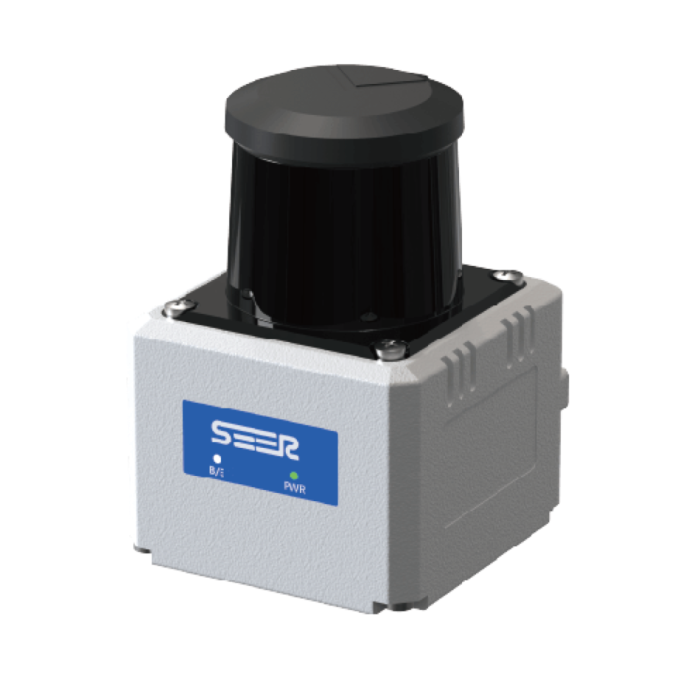
In stock
- BRAND:
- SEER ROBOTICS
- MODEL:
- H1E0-02C
- PART #:
- H1E0-02C
- ORIGIN:
- China
- Warranty:
- 12 MONTHS
- AVAILABILITY:
- SUBJECT TO AVAILABILITY
- SKU:
- SEER-Robotics-H1E0-02C
SEER Robotics 2D Navigation Lidar (H1E0-02C)
A robot that cannot tell where the wall is has no business carrying a pallet through a busy aisle. Everything a mobile machine does well begins with how clearly it sees the floor plan around it, and that is the job of the SEER Robotics 2D Navigation Lidar (H1E0-02C): a compact, Ethernet-connected laser scanner that gives a robot a flat, wide slice of its surroundings, again and again, as it moves.
The product is available through this page, by quotation.
Background
The company behind the sensor
SEER Robotics (06106.HK) is a platform-based embodied intelligent robotics company built around the Robot Brain, and it serves 2,500+ customers worldwide with intelligent robotics solutions. That background matters when you look at a sensor like this one. A company that builds complete robotic systems needs scanners that behave the same way from one unit to the next, and it needs connectors and housings that a maintenance team can deal with quickly.
For buyers in the Caribbean, this lineage is useful context. Many of the projects we hear about are not giant automation programs. They are a warehouse that wants to move pallets with less manual handling, a factory floor that needs a vehicle to find its own way, or a workshop building a robot of its own. A sensor from a maker that works across all of these settings is easier to plan around.
What a 2D navigation lidar does
A 2D lidar sends out laser light and measures what comes back, building a single plane of distance readings around the robot. Software then compares those readings with a map, or builds a map as the robot goes. This is the familiar approach for autonomous vehicles that must localize themselves in a building and keep a safe distance from walls, racks and people.
The H1E0-02C is a 2D LiDAR sensor with a measuring range up to 40 m and an Ethernet connection. Its scanning angle covers 270°, from -45° to 225°, so it looks across a wide arc in front of and beside the robot rather than only straight ahead. Its light-emitting frequency reaches 108KHz, which is part of its environmental adaptability.
Technical Specifications
| Specification | Value |
|---|---|
| Model | H1E0-02C |
| Type | 2D LiDAR sensor |
| Interface | Ethernet |
| Measurement range | 0.1 m to 40 m |
| Scanning angle | 270° (-45° to 225°) |
| Scanning precision | Reaches ±3 cm |
| Light-emitting frequency | Reaches 108KHz |
| Connector | M12 circular connector |
| Dimensions (L x W x H) | 60 x 60 x 86 mm |
| Weight | About 280 g |
| Working temperature | -10°C to 50°C |
| Storage temperature | -30°C to 70°C |
Specifications as published by the manufacturer; confirmed against the datasheet at quotation.
The manufacturer has not published the supply voltage, the Ethernet interface speed, the number of laser channels, the data output format, the package contents, the compatible controllers, the cable length or the shock and vibration rating; they are confirmed at quotation.
What makes the H1E0-02C easy to build into a robot?
Integration is often where a good sensor becomes a headache. The H1E0-02C answers this in three plain ways: its size, its weight and its connector.
At 60 x 60 x 86 mm and about 280 g, it is small and light enough to fit on the body of a compact vehicle without demanding a heavy bracket or a large cutout. A light sensor also puts less load on the mounting point, which is helpful on a vehicle that already carries a battery, drives and a payload.
The connector is the second point. The unit uses an M12 circular connector, which gives seamless interchangeability and enhanced maintainability. In practical terms, a circular M12 connector is a familiar industrial format, and a technician can unplug a scanner and fit a replacement without re-terminating wires. For a fleet operator in a humid, busy facility, fast swaps mean a vehicle spends less time out of service.
The third point is the Ethernet connection. Ethernet is a common way to bring sensor data to a controller, and many robot builders already have it in their wiring plans. Plan the controller side of the design together with us when you request the quotation.
How far and how accurately does it see?
Two numbers define most buying decisions for a navigation scanner: how far it reaches and how precise its readings are. The H1E0-02C measures from 0.1 m out to 40 m, and its scanning precision reaches ±3 cm.
The long reach helps in large spaces such as distribution halls, where walls and racks may be far away. More distant landmarks give localization software more to work with. The close limit of 0.1 m means the sensor can also report objects that are near the robot's body. The 270° scanning angle, running from -45° to 225°, provides a broad field of view so that the vehicle is not blind to what lies off to the sides.
The scanning precision of ±3 cm matters for tasks where a vehicle has to stop or turn at a defined point. Tighter readings give the navigation software a cleaner picture of its position. As always, the final result depends on mounting, mapping and software, which is why we recommend reviewing the datasheet with us before you commit to a design.
On temperature, the working range is -10°C to 50°C and the storage range is -30°C to 70°C. Caribbean sites are usually warm, so the upper working limit is worth comparing with the conditions where the robot will actually operate, including areas near roofs, loading doors and machinery.
Who is the SEER Robotics 2D Navigation Lidar (H1E0-02C) for?
Integrators and robot builders are the first group. If you are putting together an autonomous vehicle, a compact transport robot or a research platform, a scanner with a defined range, angle and connector lets you plan the mechanical and electrical design from known figures.
Warehouse and logistics operators are the second. Where goods move on pallets and trolleys, vehicles that navigate on their own can cut repetitive walking and carrying. Our Logistics Robots category shows the kinds of machines that rely on this type of sensing.
Factory operators are the third. Production sites often have fixed routes and tight aisles, and navigation scanners help vehicles hold their line. You can browse the Factory Robots category for related equipment.
If your priority is detecting obstacles in the vehicle's path rather than navigating by the map, take a look at the SEER Robotics 2D Obstacle Avoidance Lidar (C214). It is a sibling product from the same maker, and the two are often considered side by side when a vehicle needs both functions. Ask us about the differences when you request a quotation.
What is the SEER Robotics 2D Navigation Lidar (H1E0-02C) used for?
- Autonomous vehicle navigation. The scanner gives a vehicle a wide view of walls and fixtures so that it can work out where it is.
- Map building. Robots can record the shape of a facility as they drive and reuse the map later.
- Warehouse logistics. Pallet and trolley carriers can use the readings to follow routes through aisles.
- Factory transport. Vehicles carrying parts between stations can use it to keep to their path.
- Robot development. Builders and research teams can use a compact Ethernet scanner as a base for their own platforms.
- Fleet maintenance by swapping. The M12 connector lets a technician exchange a unit without a complex rewiring job.
Pricing and Availability
We do not list prices on this page. Quotation is the way to buy: tell us the quantity and the application, and we will respond with the details. Delivery, customs and support are arranged together with the quotation, so that you know what to expect before you decide. The SEER Robotics 2D Navigation Lidar (H1E0-02C) is available on this page.
Frequently Asked Questions
What is the measuring range of the H1E0-02C?
The measurement range is 0.1 m to 40 m. It is a 2D LiDAR sensor with a range up to 40 m.
How wide is the scanning angle?
The scanning angle is 270°, running from -45° to 225°. This gives a wide field of view around the mounting point.
How is the sensor connected?
It uses Ethernet for data and an M12 circular connector. The connector offers seamless interchangeability and enhanced maintainability.
How large and heavy is it?
The dimensions are 60 x 60 x 86 mm (L x W x H) and the weight is about 280 g. That makes it suitable for compact vehicles.
What temperatures can it handle?
The working temperature is -10°C to 50°C, and the storage temperature is -30°C to 70°C. Check these against your site conditions.
Can I get the supply voltage and the output format?
Ask us when you request the quotation, and we will go through them with you before you decide.
Where can I buy the SEER Robotics 2D Navigation Lidar (H1E0-02C) and what does it cost?
You can buy it through this page by requesting a quotation. We do not print prices; the cost is given in the quotation, together with delivery, customs and support arrangements.
Summary
A navigation robot is only as capable as its view of the world, and the H1E0-02C puts a wide, long-reaching and precise view into a package of 60 x 60 x 86 mm and about 280 g. Its 270° scan, 0.1 m to 40 m range, ±3 cm scanning precision, Ethernet link and M12 connector make it a practical choice for integrators, logistics teams and robot builders. The remaining details are settled with the quotation, and this page is the starting point.


