
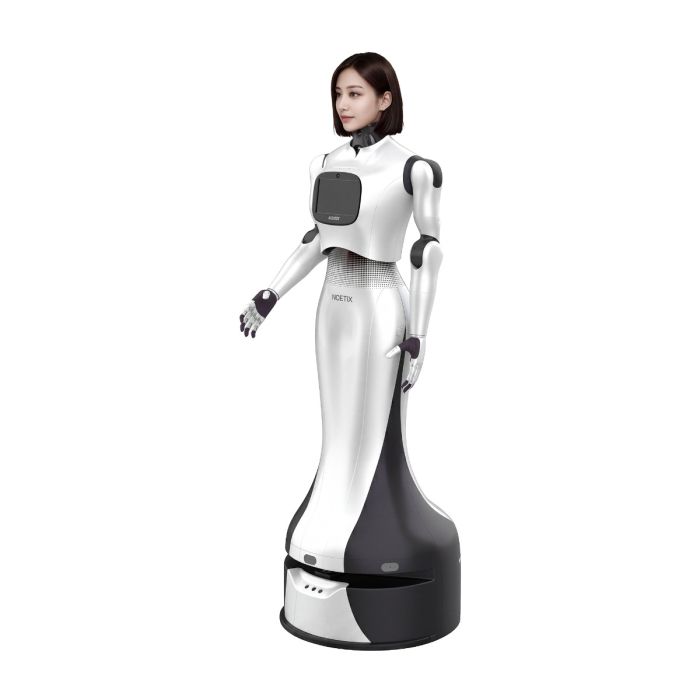
Noetix HOBBS W1 Wheeled Humanoid Bionic Robot
In stock
- BRAND:
- NOETIX
- MODEL:
- HOBBS W1
- PART #:
- HOBBS
- ORIGIN:
- China
- AVAILABILITY:
- SUBJECT TO AVAILABILITY
- SKU:
- Noetix-HOBBS
Noetix HOBBS W1 Wheeled Humanoid Bionic Robot
Most reception robots give visitors a screen and a synthetic voice. The Noetix HOBBS W1 Wheeled Humanoid Bionic Robot gives them a face that smiles back, a pair of hands that can do some work, and a base that rolls through the building on its own. It is built for the moment a guest walks into a hall, a school or a hospital corridor and decides whether the machine in front of them feels approachable.
The product is available through this page, by quotation.
Background
Noetix Robotics and its lineage
Hobbs W1 comes from Noetix Robotics, a Beijing company founded by researchers from Tsinghua University and Zhejiang University. That academic root shows in the product: the emphasis is on expressive faces, conversational AI and indoor autonomy, which are the areas where university robotics labs have spent years. Noetix also offers other humanoids in its range, including the Noetix Xiaonuo Hobbs 3 Bionic Humanoid Robot, which readers comparing the Hobbs line may wish to review.
For buyers in the Caribbean, where hotels, government offices, clinics and schools often rely on a friendly first greeting, a manufacturer with a research background and a clear focus on human-facing work is a useful starting point for a conversation.
Positioning and key technology
Hobbs W1 is a lifelike wheeled humanoid with a hyper-realistic silicone face. It is not a head on a stand. It combines a mobile base, two arms with dexterous hands, and a face driven by many small motors. It sits where two product families meet, and you can browse both: Wheeled Humanoids and Bionic Humanoids.
Several technologies work together. A large AI model handles conversation and keeps track of context. Lip sync matches the mouth to the speech. LiDAR, ultrasonic sensors and depth cameras guide the robot as it maps and moves through complex indoor spaces. The result is a machine that can greet, answer, guide and, within the limits of its arms and hands, handle manipulation tasks that reception-focused robots do not usually attempt.
Technical Specifications
| Specification | Value |
|---|---|
| Version | Hobbs W1 |
| Product type | Wheeled humanoid with a hyper-realistic silicone face |
| Active degrees of freedom | 54 |
| Degrees of freedom in the face | 32 (thirty-two facial motors) |
| Robotic arms | Five degrees of freedom |
| Dexterous hands | Six degrees of freedom |
| Runtime | About six hours under full load |
| Navigation sensors | LiDAR, ultrasonic sensors and depth cameras, with centimeter-level accuracy |
| Speech recognition | About 98% accuracy |
| Skin | Platinum silicone that resists oil and aging |
| Developer software | Android SDK, demos and documentation |
Specifications as published by the manufacturer; confirmed against the datasheet at quotation.
The manufacturer has not published the payload, the IP rating, the charging time, the package contents, the maximum speed or the battery capacity; they are confirmed at quotation.
What makes Hobbs W1 different from a typical reception robot?
The first difference is the face. Thirty-two motors move it to show smiles, anger, sadness and agreement. The skin is platinum silicone that resists oil and aging, and the hair feels like real human hair. A visitor reads these cues within seconds, and a face that reacts in step with the conversation tends to keep people talking rather than walking past.
The second difference is the body. Many reception units are fixed or have only simple gestures. Hobbs W1 carries five-degree-of-freedom arms and six-degree-of-freedom dexterous hands, which allows a range of manipulation tasks not typically seen in reception-focused robots. The 54 active degrees of freedom in total, 32 of them in the face, show how much of the design is given to expression and movement.
The third difference is independence. The robot can map and move through complex indoor environments and support daily operations with minimal human supervision. Staff do not need to escort it, and the sensor set of LiDAR, ultrasonic sensors and depth cameras helps it avoid obstacles while holding centimeter-level accuracy.
How does Hobbs W1 hold a conversation?
Conversation runs on a large AI model that follows context instead of answering each sentence in isolation. Speech recognition reaches about 98% accuracy, and the voice sounds smooth and natural. Lip sync ties the mouth movement to what the robot says, which matters because a mismatch between voice and lips is one of the quickest ways a lifelike face loses its credibility.
Businesses can also customize the face and swap it quickly. A hotel, a school or a public office can therefore adapt the look of the robot to its own setting. For teams that want to build their own services, Noetix offers an Android SDK, demos and documentation for developers.
Who is Hobbs W1 for?
Hospitality and public venues are the obvious first group. A robot that welcomes guests in a lobby, answers common questions and leads them to the right door can ease pressure on front-desk staff, and its expressive face suits places where warmth matters.
Schools and training centers form a second group. A humanoid that speaks, reacts and can be programmed through an Android SDK gives students something concrete to study in human-robot interaction, software and service design.
Hospitals and clinics may value the guidance role, since patients and families are often anxious and unsure where to go. Offices and exhibition halls can use the same strengths for reception and visitor flow.
Integrators and developers make up a fourth group. They can use the SDK, demos and documentation to build custom services on a platform that already has a face, a voice, hands and navigation. Buyers who want a different Noetix form can compare the Xiaonuo Hobbs 3 before deciding.
What is Hobbs W1 used for?
- Reception: greets visitors at a desk or entrance and answers their questions in natural conversation.
- Guidance: maps the building and leads guests to rooms, offices or wards with centimeter-level accuracy.
- Information service: uses the large AI model and clear speech to explain services, schedules and directions.
- Education: gives students a working platform for studying robotics, speech and expressive faces through the Android SDK.
- Light manipulation: uses its arms and dexterous hands for tasks beyond what a pure greeter can do.
- Brand presence: shows a customized face at events, exhibitions and public halls, where the look can be swapped quickly.
Pricing and Availability
No price is listed on this page. Quotation is the way to proceed: tell us where the robot will work, how many visitors it will meet and which languages and services you need, and we will prepare an offer. Delivery, customs and support are arranged together with the quotation, so that you see the whole project in one place. Hobbs W1 is available on this page.
Frequently Asked Questions
How many degrees of freedom does Hobbs W1 have?
It has 54 active degrees of freedom, and 32 of them are in the face. The arms have five degrees of freedom and the dexterous hands have six.
How long does it run on a charge?
It runs for about six hours under full load.
How does it find its way around a building?
It uses LiDAR, ultrasonic sensors and depth cameras to map and move through complex indoor environments. These sensors give centimeter-level accuracy and help it avoid obstacles.
Can the face be changed?
Yes. Businesses can customize the face and swap it quickly, which lets one robot suit different settings or brands.
Can developers build on it?
Noetix offers an Android SDK, demos and documentation for developers. That gives integrators a route to their own services.
Where is Hobbs W1 meant to work?
It serves as a guide and receptionist in halls, offices, schools and hospitals, moving through complex indoor environments with minimal human supervision.
Where can I buy Hobbs W1 and what does it cost?
You can request it through this page. The cost is given in a written quotation prepared for your project, and delivery, customs and support are arranged with it.
Summary
Hobbs W1 answers a simple question: what if the machine at the front desk looked and sounded like it was paying attention? Its silicone face with thirty-two motors, its large-model conversation, its arms and hands, and its LiDAR-guided wheeled base combine into one humanoid that can receive, guide and assist with little supervision. If that fits your hall, school, office or hospital, this page is the starting point.


