
Noetix E1 Embodied Intelligence Humanoid Robot
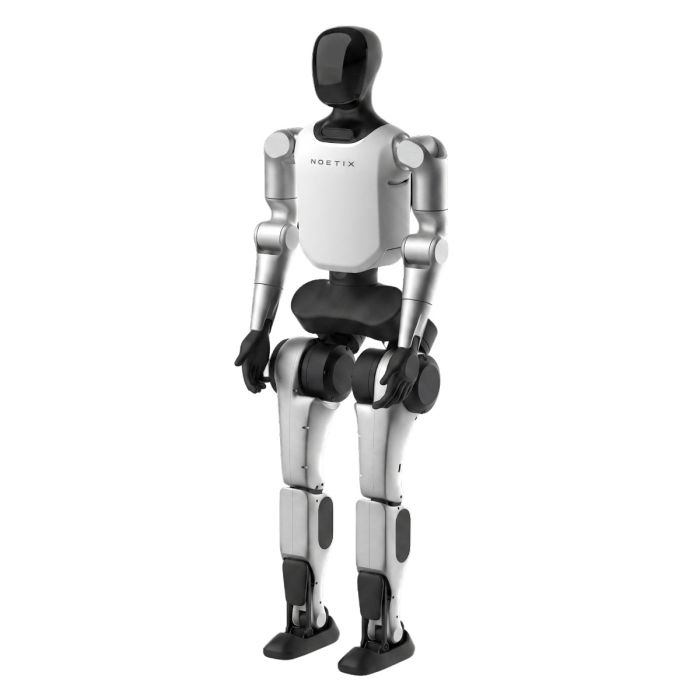
In stock
- BRAND:
- NOETIX
- PART #:
- E1
- ORIGIN:
- China
- AVAILABILITY:
- SUBJECT TO AVAILABILITY
- SKU:
- Noetix-E1
Noetix E1 Embodied Intelligence Humanoid Robot
A humanoid robot has to earn its floor space. In a showroom it must draw a crowd, in a classroom it must teach something, and on a developer's bench it must accept new hardware without a fight. The Noetix E1 Embodied Intelligence Humanoid Robot is built around that three-way test: it talks, it moves, and it takes expansion kits.
The Noetix E1 is available through this page, by quotation.
Background
The company behind the E1
NOETIX is the brand, and Noetix Robotics is the company that stands behind it. The company focuses on the R&D, production, and sales of consumer-grade and general-purpose humanoid robots. That focus shows in the E1. It is not a one-off research prototype or a single-purpose machine. It is a product meant to be sold, set up and supported in more than one kind of setting.
The E1 is sold as a pair of versions, the E1 and the E1 EDU. This page covers the E1. The EDU version has its own page, Noetix E1 EDU Embodied Intelligence Humanoid Robot, and the two should be compared there before an order is placed.
Positioning and key technology
The manufacturer describes the E1 as a robot with highly localized core components, mid-to-high performance at an affordable price, large model voice interaction, and a modular design for family, exhibition and enterprise scenarios. Three ideas sit inside that description.
The first is the voice layer. The E1 carries a new generation of intelligent voice large model, which supports multi-round interaction and scenario-based command recognition. A visitor can speak to the robot in a normal way instead of learning a fixed list of phrases.
The second is motion. The E1 runs self-developed high-precision motion control algorithms, and it can complete dancing, jumping and walking on complex terrains. Those are the actions an audience notices, and they are also the actions that test a robot's balance and joints.
The third is modularity. The dexterous hand, LiDAR and other multi-functional expansion kits can be freely combined. The robot is therefore a base that grows with the project, not a closed box.
Technical Specifications
| Specification | Value |
|---|---|
| Model | Noetix E1 |
| Dimensions (standing) | 136 cm * 47 cm * 29 cm |
| Total degrees of freedom | 23-28 DoF |
| Single-arm degrees of freedom | 5 DoF (Optional additional 2 degrees of freedom) |
| Waist degrees of freedom | 1 DoF (Optional additional 1 degree of freedom) |
| Joint output bearing | Cross roller + deep groove ball |
| Knee joint range | 0 - 135° |
| Hip joint range | P - 85° to +50°, R - 40° to +35°, Y - 40° to +53° |
| Sensing sensors | Depth camera, IMU |
| Wireless connectivity | Wi-Fi6, Blue tooth5.2 |
| End effector | Five-fingered hand |
| Expansion kits | Dexterous hand, LiDAR and other multi-functional kits, freely combined |
| Voice interaction | New generation intelligent voice large model; multi-round interaction and scenario-based command recognition |
| Development support | Technical support and SDK document |
Specifications as published by the manufacturer; confirmed against the datasheet at quotation.
The manufacturer has not published the maximum walking speed, the IP rating, the operating temperature, the charging time, the battery voltage, the in-box contents, the camera resolution or the operating system; they are confirmed at quotation.
What makes the E1 different from a talking-only or a motion-only robot?
Many robots in this field do one thing well. Some are good conversationalists on wheels or a fixed stand. Others are agile but silent, and they need a programmer in front of them to be useful. The E1 puts both abilities in one body.
On the voice side, multi-round interaction means the robot can follow a conversation across several turns. Scenario-based command recognition means it can match spoken instructions to the setting it is in. That matters at an exhibition stand, where a presenter wants to give a short spoken command and see the robot respond.
On the motion side, the joint design supports the actions the manufacturer names. The knee joint moves through 0 - 135°. The hip joint moves through P - 85° to +50°, R - 40° to +35° and Y - 40° to +53°. Joint output uses a cross roller and deep groove ball bearing combination. The arms have 5 DoF each, with an optional 2 additional degrees of freedom, and the waist has 1 DoF, with an optional 1 additional degree of freedom. The total runs from 23 to 28 DoF depending on how the robot is configured.
For perception, the E1 carries a depth camera and an IMU. LiDAR is available as an expansion kit, so a project that needs more environmental sensing can add it later.
How does the modular design help a project grow?
A humanoid bought for a single demonstration can become a limited asset once the demonstration is over. The E1 avoids that by letting kits be freely combined. The standard E1 has a five-fingered hand as its end effector, and a dexterous hand is listed among the expansion kits. LiDAR is another. The manufacturer also speaks of other multi-functional kits, and the details of those are confirmed at quotation.
Software follows the same logic. The manufacturer provides technical support and an SDK document, so a team can write its own behaviors on top of the robot instead of relying only on what ships with it. For a school, a training center or a company innovation team, that is the difference between a showpiece and a platform.
Connectivity is standard: Wi-Fi6 and Blue tooth5.2. A robot used at events or in shared labs can then be reached over a wireless network without extra adapters.
Who is the Noetix E1 for?
Exhibition and events teams will find the voice interaction and the dancing and jumping abilities most useful. A robot that answers visitors and moves with confidence holds attention at a trade fair, a mall display or a tourism venue.
Schools, colleges and training centers can use the E1 to teach robotics, control and human-robot interaction. The SDK document and technical support give instructors something to build a course around, and the optional extra degrees of freedom allow lessons to go deeper as students advance.
Enterprise innovation teams and developers can treat the E1 as a testbed for service, guidance and reception ideas. Families interested in a humanoid for home use are also within the manufacturer's stated scope, though a quotation conversation is the right place to talk through setup and support.
Buyers whose main interest is an education program should also look at the E1 EDU version, which is the sibling model aimed at that use. Compare the two before choosing.
What is the Noetix E1 used for?
- Exhibition demonstrations. Dancing, jumping and spoken interaction give a stand a moving centerpiece.
- Classroom robotics. Students study humanoid motion, joint ranges and sensing on a real machine.
- Voice-interaction projects. Multi-round conversation and scenario-based commands support guide and reception concepts.
- Software development. The SDK document and technical support let teams write and test their own behaviors.
- Manipulation trials. The five-fingered hand, the optional dexterous hand and the extra arm degrees of freedom support hands-on tasks.
- Terrain and sensing tests. Walking on complex terrains, a depth camera, an IMU and optional LiDAR support perception work.
Pricing and Availability
The Noetix E1 is supplied by quotation, and a quotation request is the way to begin. Delivery, customs and support are arranged with the quotation, so nothing is left to guesswork once the order is agreed. Tell us the version, the expansion kits and the intended use, and the quotation will cover them. The Noetix E1 is available on this page.
Frequently Asked Questions
What are the dimensions of the Noetix E1?
The standing dimensions are 136 cm * 47 cm * 29 cm.
How many degrees of freedom does the E1 have?
The total is 23-28 DoF. Each arm has 5 DoF with an optional 2 more, and the waist has 1 DoF with an optional 1 more.
Can the E1 talk with visitors?
Yes. It carries a new generation of intelligent voice large model that supports multi-round interaction and scenario-based command recognition.
Which sensors does the E1 carry?
The E1 carries a depth camera and an IMU. LiDAR is available as an expansion kit.
Is software support available?
Yes. The manufacturer provides technical support and an SDK document.
What is the difference between the E1 and the E1 EDU?
They are two versions of the same product line. The EDU version has its own page, and the figures on this page belong to the E1 only.
Where can I buy the Noetix E1 and what does it cost?
You can request a quotation on this page. The cost is given in the quotation, which also covers delivery, customs and support arrangements.
Summary
The E1 answers the floor-space question from the start of this page. It speaks in multi-round conversation, moves through dancing, jumping and complex terrain, and accepts a dexterous hand, LiDAR and other kits when a project needs more. It pairs 23-28 DoF with an SDK document and technical support, so it serves an exhibition hall, a classroom and a developer's bench alike. For a quotation on the Noetix E1 Embodied Intelligence Humanoid Robot, this page is the starting point.