
Noetix E1 EDU Embodied Intelligence Humanoid Robot
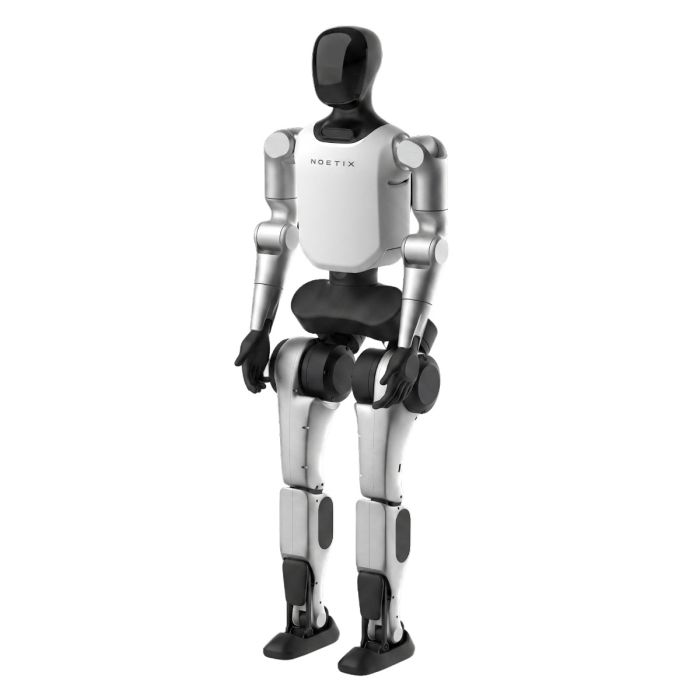
In stock
- BRAND:
- NOETIX
- MODEL:
- E1 EDU
- PART #:
- E1
- ORIGIN:
- China
- AVAILABILITY:
- SUBJECT TO AVAILABILITY
- SKU:
- Noetix-E1-EDU
Noetix E1 EDU Embodied Intelligence Humanoid Robot
Most humanoid robots ask a lab to choose between a platform it can program and one it can show off. The Noetix E1 EDU Embodied Intelligence Humanoid Robot is built to avoid that trade: it walks, dances and jumps, listens and answers in multi-round conversation, and leaves its hardware and software open to your own development work.
The product is available through this page, by quotation.
Background
The maker and the Geek Pioneer line
NOETIX is a robotics brand that builds humanoid platforms for teaching, research and development. The manufacturer's own description of this robot calls it the Geek Pioneer E1 and sums it up in one line: highly localized core components, large model voice interaction and modular expansion, supporting in-depth customized development. That sentence explains how the robot is meant to be used. It is not a closed demonstration unit. It is a base that a university, training center or integrator can build on.
Two versions are named in the manufacturer's material, the E1 and the E1 EDU. This page covers the E1 EDU, and every figure below belongs to that version. If you are comparing it with the standard model, the Noetix E1 Embodied Intelligence Humanoid Robot has its own page.
Positioning and key technology
The E1 EDU sits in the category of bipedal humanoids, a group of robots that move on two legs and share the proportions of a person. You can browse the wider range under Bipedal Humanoids. Within that group, the E1 EDU is aimed at education and development rather than at a single fixed task.
Three technical choices define it. First, the high computing module is an NVIDIA Jetson Orin Nano Super, and the computing power is listed as 6+67 TOPS. Second, voice interaction rests on an intelligent voice large model that supports multi-round conversation and scenario-based command recognition. Third, the design is modular: the dexterous hand, LiDAR and other multi-functional expansion kits can be freely combined, which gives the robot flexibility across different scenes. Together these make the platform a practical choice for teams that want to work on perception, speech and motion in one body.
Technical Specifications
| Specification | Value (E1 EDU) |
|---|---|
| Dimensions, standing (length x width x thickness) | 136 cm * 47 cm * 29 cm |
| Total degrees of freedom | 23-28 DoF |
| Single-arm degrees of freedom | 5 DoF (optional additional 2 degrees of freedom) |
| Waist degrees of freedom | 1 DoF (optional additional 1 degree of freedom) |
| End effector | Five-fingered hand (with optional dexterous hand) |
| Knee joint range | 0 - 135° |
| Computing power | 6+67 TOPS |
| High computing power module | NVIDIA Jetson Orin Nano Super |
| Power supply method | Lithium battery |
| Sensing sensors | Depth camera, IMU |
| Wireless connectivity | Wi-Fi6、Blue tooth5.2 |
| Voice interaction | Intelligent voice large model; multi-round interaction and scenario-based command recognition |
| Expansion kits | Dexterous hand, LiDAR and other multi-functional kits, freely combined |
| Motion capability | Dancing, jumping and walking on complex terrains |
| Software support | Technical support and SDK document |
Specifications as published by the manufacturer; confirmed against the datasheet at quotation.
The manufacturer has not published the IP rating, the walking speed, the battery voltage, the charging time, the operating temperature range, the package contents, the operating systems the SDK supports, the arm payload or the noise level; they are confirmed at quotation.
What makes the E1 EDU different from a typical demonstration humanoid?
A demonstration robot is designed to be watched. The E1 EDU is designed to be worked on. The difference shows in the details the manufacturer chose to publish. The total degrees of freedom are given as a range, 23-28 DoF, because the arms and waist can be extended: each arm has 5 DoF with 2 more available as an option, and the waist has 1 DoF with 1 more available. A lab that begins with the base body can add articulation later, when a project calls for it, instead of replacing the whole robot.
The hands follow the same logic. The standard end effector is a five-fingered hand, and a dexterous hand is available as an option. That lets a team start with gesturing and simple interaction and move toward more careful manipulation work as its research matures.
The computing side is also meant for development. With an NVIDIA Jetson Orin Nano Super and 6+67 TOPS, the robot can host perception and speech workloads on board, supported by a depth camera and an IMU. Wi-Fi6 and Bluetooth handle wireless links to other equipment and to your network. And because the manufacturer provides technical support and an SDK document, the path from unboxing to your own code is described rather than left to guesswork.
Can the E1 EDU move well enough for serious work?
The manufacturer states that the robot can smoothly complete high-difficulty actions such as dancing, jumping and walking on complex terrains. The knee joint range of 0 - 135° is part of what makes this possible, since deep knee flexion is needed for jumping and for stepping over uneven ground. At a standing size of 136 cm * 47 cm * 29 cm, the body is large enough to be taken seriously as a human-scale platform and compact enough for an ordinary classroom or laboratory.
For teams studying locomotion, that combination matters. You can test balance, gait and whole-body motion on a real bipedal body, and you can compare results against what you see in simulation.
Who is the E1 EDU for?
Universities and technical colleges are the clearest fit. A department that teaches robotics, control or artificial intelligence can give students a single body on which to study sensing, speech, motion and software, with an SDK document to guide them. Research groups in embodied intelligence will value the open development path and the modular expansion kits.
Training centers and vocational schools can use the robot to make a curriculum visible. Students tend to remember a lesson in which a humanoid listens, answers and moves in front of them. System integrators and developers can use the platform to prototype services, such as guided demonstrations or interactive displays, before committing to a larger program.
If your plans lean toward a different body style, compare the wider range under Research Robots. If you want the standard model rather than the EDU version, see the Noetix E1 Embodied Intelligence Humanoid Robot page and compare the two.
What is the E1 EDU used for?
- Robotics teaching. Students work on a real humanoid body with sensors, computing and an SDK document in hand.
- Embodied intelligence research. Teams connect perception, language and movement on one platform with on-board computing.
- Voice interaction projects. The voice large model supports multi-round conversation and scenario-based command recognition for human-robot dialogue studies.
- Locomotion experiments. Walking, jumping and movement on complex terrains give gait and balance work a physical test bed.
- Manipulation development. The five-fingered hand, the optional dexterous hand and the extra arm degrees of freedom support a staged move toward finer handling.
- Demonstrations and showcases. Dancing and interactive speech make the robot a strong centerpiece for open days and exhibitions.
Pricing and Availability
Pricing is prepared as a quotation, so that the version, the options you choose and your delivery location are all taken into account. Please send us your requirements, including whether you want the extra arm and waist degrees of freedom, the dexterous hand or the LiDAR kit. Delivery, customs and support are arranged together with the quotation. The Noetix E1 EDU Embodied Intelligence Humanoid Robot is available on this page.
Frequently Asked Questions
How many degrees of freedom does the E1 EDU have?
The total is 23-28 DoF. Each arm has 5 DoF, with 2 more optional, and the waist has 1 DoF, with 1 more optional.
What computing hardware does it use?
It uses an NVIDIA Jetson Orin Nano Super as its high computing power module, with computing power listed as 6+67 TOPS.
Which sensors does it carry?
The sensing sensors are a depth camera and an IMU. LiDAR is available as an expansion kit.
Can I add a dexterous hand?
Yes. The standard end effector is a five-fingered hand, and a dexterous hand is available as an option. Hands, LiDAR and other kits can be freely combined.
How does the robot communicate?
It supports Wi-Fi6 and Bluetooth for wireless connection. For speech it uses an intelligent voice large model with multi-round interaction and scenario-based command recognition.
Is software support included?
The manufacturer provides technical support and an SDK document for the E1 EDU.
Where can I buy the Noetix E1 EDU and what does it cost?
You can request it through this page. The cost depends on the options and delivery you need, so we prepare a quotation instead of printing a price.
Summary
The Noetix E1 EDU answers the old question of whether a humanoid should be a showpiece or a working tool by being both. It dances, jumps and walks on complex terrains, and it also gives a lab an NVIDIA Jetson Orin Nano Super, a depth camera, an IMU, a voice large model, expandable arms and waist, and an SDK document to build with. When you are ready to plan an education or research program around this robot, this page is the starting point.


