
Husarion ROSbot 3 PRO UGV
In stock
- BRAND:
- HUSARION
- MODEL:
- ROSbot 3
- ORIGIN:
- Poland
- Warranty:
- 12 MONTHS
- AVAILABILITY:
- SUBJECT TO AVAILABILITY
- SKU:
- Husarion-ROSbot-3-PRO
Husarion ROSbot 3 PRO UGV
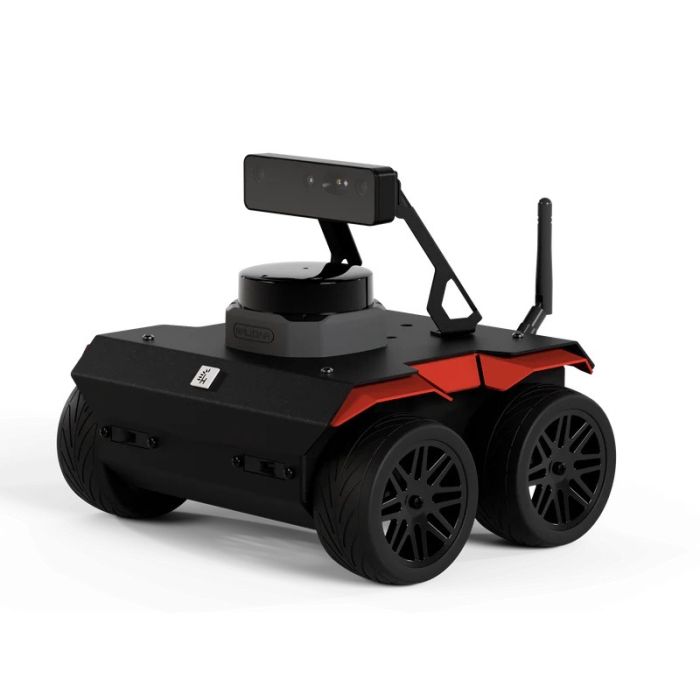
Most robot platforms ask you to build the robot before you can start the research. The Husarion ROSbot 3 PRO UGV turns that around: it arrives with its LiDAR, depth camera, inertial sensor and onboard computer already mounted, and its ROS 2 drivers already configured. A lab can power it on and begin work on the same day, which suits classrooms and research benches where time is the scarcest resource.
The product is available through this page, by quotation.
Background
The ROSbot line and its purpose
ROSbot 3 and ROSbot 3 PRO are an indoor mobile robot platform built for research and education. The robot is a compact four-wheel base with a powder-coated aluminum chassis, and it is designed around the Robot Operating System rather than around a closed vendor toolchain. The open-source ROS 2 drivers are pre-installed and configured, so the robot works out of the box.
That design choice matters to anyone who has lost a semester to driver work. Universities, training centers and development teams can standardize on one known platform, share the same software image across several units, and compare results between groups. Husarion lists the ROSbot 3 PRO among its unmanned ground vehicles, and you can see the wider range on the Husarion page or browse the UGVs category.
What the PRO designation means
The ROSbot 3 PRO shares its base with the standard Husarion ROSbot 3 UGV. The computer, drivetrain, battery pack, chassis and sensors on the base are the same. The difference lies in perception: the PRO carries an RPLIDAR S2 with 360 degree coverage and a Luxonis OAK-D Pro 3D camera, where the standard ROSbot 3 carries an RPLIDAR C1 and a Luxonis OAK-D Lite.
The onboard computer is a Raspberry Pi 5 with a quad-core ARM-8 Cortex A76 running at 2.4GHz, 8GB of RAM and 64 GB of MicroSD flash memory. It runs an Ubuntu-based operating system customized for ROS, specifically Ubuntu 24.04 with ROS 2 Jazzy preinstalled. A separate STM32F407 microcontroller is built in to handle the low-level side of the robot.
Technical Specifications
| Specification | Value (ROSbot 3 PRO) |
|---|---|
| Type | Indoor mobile robot platform for research and education |
| 3D camera | Luxonis OAK-D Pro |
| LIDAR | RPLIDAR S2, 360 degree |
| Single-board computer | Raspberry Pi 5 (ARM64 architecture), quad-core ARM-8 Cortex A76 @ 2.4GHz, 8GB RAM, 64 GB MicroSD |
| Operating system | Ubuntu 24.04 with ROS 2 Jazzy preinstalled |
| Built-in microcontroller | STM32F407 |
| Dimensions with camera and LiDAR | 200 x 233 x 197 mm / 7.9 x 9.2 x 7.7 in [L x W x H] |
| Weight | 2,84 kg / 100 oz (with camera and LiDAR), 2,45 kg / 86 oz (without camera and LiDAR) |
| Chassis material | Powder-coated aluminum plate, 1.5 mm thick |
| Maximum translational velocity | 1.0 m/s |
| Maximum rotational velocity | 420 deg/s (7.33 rad/s) |
| Maximum load capacity | Up to 5 kg / 176 oz (not in continuous work) |
| Battery life | 1.5h - 5h |
| Batteries | 3 x Li-Ion 18650 protected, rechargeable, 3500mAh capacity, 3.7V nominal voltage |
| Infrared distance sensors | 4 x VL53L0X Time-of-Flight, up to 200 cm range |
| IMU | BNO055 intelligent 9-axis absolute orientation sensor |
| Encoders | 4, magnetic, 48cpr, 12 poles |
| Rear panel USB | 2 x USB 2.0 host ports from SBC |
| Antenna | Dual-band, connected to the Wi-Fi USB adapter |
| Simulation | Simulation model available in Gazebo environment |
| Set contents | ROSbot 3/3 PRO, dedicated charger, USB Ethernet adapter, aluminium case |
Specifications as published by the manufacturer; confirmed against the datasheet at quotation.
The manufacturer has not published the IP rating, the operating temperature range, the camera resolution, the voltage of the complete battery pack or the power consumption; they are confirmed at quotation.
What makes the ROSbot 3 PRO different from the ROSbot 3?
The two robots look alike on the bench, and mechanically they are the same: the same chassis, the same Raspberry Pi 5, the same drivetrain, the same speeds and the same batteries. The difference is what the robot sees. The PRO carries the RPLIDAR S2 and the OAK-D Pro, while the standard version carries the RPLIDAR C1 and the OAK-D Lite.
For a buyer, this means the choice is about perception, not about mobility. If your work centers on mapping, localization and navigation, the sensors are the part of the platform you will lean on most, and the PRO configuration is the one to choose for stronger perception and SLAM work. If your course only needs a capable ROS 2 base for teleoperation and basic exercises, the standard ROSbot 3 covers the same ground with the lighter sensor set.
Can the ROSbot 3 PRO be used straight out of the box?
Yes. The ROS 2 drivers are installed and configured, and the operating system is Ubuntu 24.04 with ROS 2 Jazzy preinstalled. The set includes the robot, a dedicated charger, a USB Ethernet adapter and an aluminium case, so it can be stored and moved between rooms or campuses.
There is also a simulation model in the Gazebo environment. Students can test their code in simulation before they put it on the physical robot, which protects the hardware and lets a larger class share a smaller number of robots. Two USB 2.0 host ports on the rear panel and a dual-band antenna connected to the Wi-Fi USB adapter give you room to connect additional devices and reach the robot over the network.
Who is the ROSbot 3 PRO for?
The first group is university labs and research institutes. They need a repeatable indoor platform for SLAM, navigation and sensor-fusion experiments, and the combination of a 360 degree LiDAR, a 3D camera, a 9-axis IMU, wheel encoders and four distance sensors gives them several data sources on one robot.
The second group is educators. A robot that works out of the box, with a matching simulation model, lets an instructor spend class time on ROS 2 concepts rather than on setup. Technical schools and training centers in the Caribbean that are building robotics programs will find a single standard platform easier to teach on and to maintain.
The third group is development teams that prototype indoor autonomy and want a small base to try ideas before committing to a larger machine. Those who need a bigger or more rugged vehicle may look at the Husarion ROSbot XL UGV or the Husarion Panther Industrial Grade Indoor / Outdoor UGV (PTH12). Teams that do not need the upgraded perception can choose the standard ROSbot 3.
What is the ROSbot 3 PRO used for?
- SLAM and mapping. The 360 degree RPLIDAR S2 and the OAK-D Pro give the robot the data to build maps of indoor spaces.
- Autonomous navigation. Wheel encoders, the IMU and the LiDAR support localization and path planning experiments under ROS 2.
- Teaching ROS 2. A preconfigured robot with Gazebo simulation lets students move from simulated to physical work quickly.
- Sensor and perception research. The 3D camera, the LiDAR and four Time-of-Flight sensors allow comparison and fusion of different sensing methods.
- Obstacle avoidance testing. Distance sensors with up to 200 cm range add short-range detection beside the LiDAR.
- Light payload prototyping. The chassis carries up to 5 kg, though not in continuous work, so small add-ons can be mounted and tested.
Pricing and Availability
We do not publish prices on this page. A quotation is the way to buy: tell us your quantity, your institution and your location, and we prepare an offer for the ROSbot 3 PRO. Delivery, customs and support are arranged with the quotation, so you see the whole arrangement before you commit. The Husarion ROSbot 3 PRO UGV is available on this page.
Frequently Asked Questions
What computer does the ROSbot 3 PRO use?
It uses a Raspberry Pi 5 with a quad-core ARM-8 Cortex A76 at 2.4GHz, 8GB of RAM and 64 GB of MicroSD flash memory. A built-in STM32F407 microcontroller works beside it.
Which software comes installed?
The robot runs Ubuntu 24.04 with ROS 2 Jazzy preinstalled. The open-source ROS 2 drivers are installed and configured.
How fast does it move?
The maximum translational velocity is 1.0 m/s and the maximum rotational velocity is 420 deg/s (7.33 rad/s).
How long does the battery last?
Battery life is 1.5h - 5h. The robot uses three protected Li-Ion 18650 cells of 3500mAh capacity and 3.7V nominal voltage.
Can I test my code without the robot?
Yes. A simulation model is available in the Gazebo environment, so you can test the performance of the ROSbot before running on hardware.
Is the ROSbot 3 PRO meant for outdoor use?
It is an indoor mobile robot platform, built for research and education. For work in other environments, ask us when you request your quotation.
Where can I buy the ROSbot 3 PRO and what does it cost?
It is available through this page, by quotation. We do not list a price here; send a request and we will prepare an offer that includes delivery, customs and support.
Summary
The ROSbot 3 PRO answers the problem from the opening: it removes the weeks of assembly and driver work that stand between a lab and its first experiment. It joins a compact aluminum four-wheel base, a Raspberry Pi 5, a 360 degree RPLIDAR S2, a Luxonis OAK-D Pro, a 9-axis IMU and distance sensors with ROS 2 drivers that are ready on arrival. Its Gazebo model extends the same work into simulation. For teams in research, education and indoor autonomy development, this page is the starting point.


