
Husarion Lynx UGV
In stock
- BRAND:
- HUSARION
- MODEL:
- PANTHER
- PART #:
- PTH12
- ORIGIN:
- Poland
- AVAILABILITY:
- SUBJECT TO AVAILABILITY
- SKU:
- Husarion-Lynx-UGV
Husarion Lynx UGV
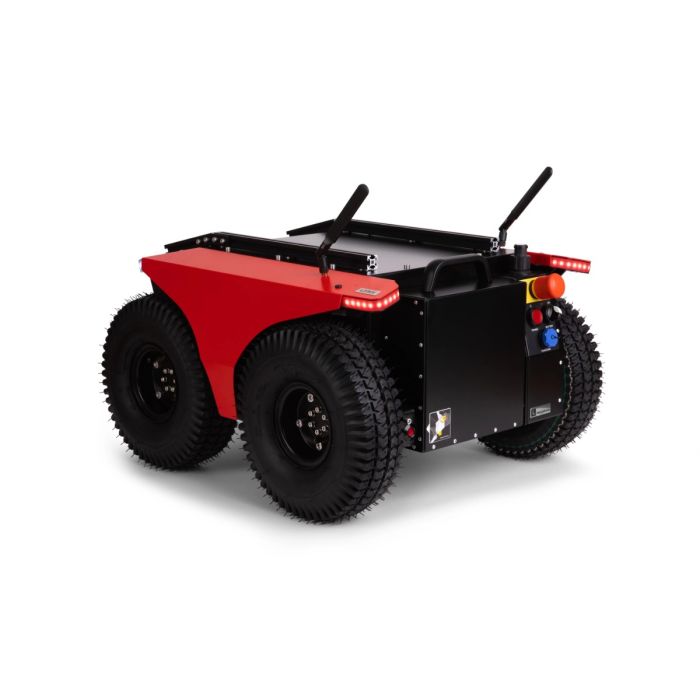
Most robots force a choice: a platform that is friendly to developers but afraid of the weather, or one that shrugs off the weather but gives you no way in. The Husarion Lynx UGV is built for teams that refuse that choice. It is a compact mobile base on all-terrain wheels, with power ports, a mounting rail and an open software driver all placed where an integrator expects to find them.
The Husarion Lynx UGV is available through this page, by quotation.
Background
Husarion and the Lynx lineage
Husarion is a robotics company known for mobile platforms that are meant to be extended rather than merely operated. Its vehicles are used by university labs, product developers and integrators who need a dependable mobile base under their own sensors, computers and arms. The Lynx belongs to this family and carries its habits: accessible interfaces, open software and a body that is made to be modified.
You can see the rest of the manufacturer's range on the Husarion page, and other vehicles of this class on the UGVs page. Buyers who want to compare the Lynx with an industrial-grade platform from the same maker can also look at the Husarion Panther Industrial Grade Indoor / Outdoor UGV (PTH12).
Positioning and key technology
Lynx is a compact and robust Unmanned Ground Vehicle platform designed for operation in both indoor and outdoor environments. It is not a finished application. It is a base that carries your payload, and it is meant to shorten the road between an idea and a working prototype.
Two things define it. The first is the drive: two brushless DC motors of 473 W each, driving all-terrain pneumatic wheels. The second is the integration surface: a T-slot mounting rail, accessible power ports and extensive communication interfaces for LIDARs, 3D cameras, manipulators and other components. On the software side, an open-source ROS 2 driver and a suite of software examples, including the open source autonomy stack, support development of your product or research project.
Technical Specifications
| Specification | Value |
|---|---|
| Dimensions (L x W x H) | 0.65 x 0.55 x 0.38 m |
| Weight (including battery) | 40 kg |
| Weight with WH05 wheels (manual) | 38.8 kg |
| Ground clearance | 85 mm |
| Protection index | IP54 / IP66 |
| Operating temperature | -20°C to 50°C |
| Max speed | 1.5 m/s |
| Max carrying capacity | 65 kg |
| Hill climb grade (with 36 / 65 kg cargo) | 90% (42°) / 56% (29°) |
| Traction force (nominal / max) | 362 N / 755 N |
| Motors | 2 x BLDC, 473 W each |
| Battery capacity / voltage | 720 Wh / 36V (nominal) |
| Battery chemistry | Lithium-Ion |
| Runtime | 4.5 h - 9 h |
| Output power (total / peak) | 1.0 kW / 1.8 kW |
| Charging temperature | 0°C to 45°C |
| Built-in computer | Quad-core 64-bit SoC @ 1.5GHz and 4GB RAM |
| IMU | PhidgetSpatial 3/3/3 Precision (3-axis compass, 3-axis gyroscope, 3-axis accelerometer) |
| Wheels (WH05) | All-terrain pneumatic wheels, tire size 4.00-4 |
| User power ports | Up to 780 W of total power with 5 V, 12 V, 19 V and 32–42 V options |
| Default package content | Lynx mobile base, charger, gamepad |
Specifications as published by the manufacturer; confirmed against the datasheet at quotation.
The manufacturer has not published the exact weight of the Lite version, the ingress rating test certificate, the list of communication interfaces or the service life independent of warranty; these are confirmed at quotation.
What makes the Lynx different from a bench-top research robot?
A bench-top robot is designed for a clean floor and a short demonstration. The Lynx is designed for a working day. Its operating temperature runs from -20°C to 50°C, its protection index is IP54 / IP66, and its ground clearance of 85 mm lets it leave the smooth floor of a laboratory and cross a yard, a gravel path or a test field. The pneumatic all-terrain wheels, with a tire size of 4.00-4, are part of that story.
The second difference is how much the platform lets you attach. A T-slot mounting rail gives you a place to bolt a sensor mast or a manipulator. The user power ports supply up to 780 W of total power at 5 V, 12 V, 19 V and 32–42 V, so most accessories can be powered directly from the vehicle without extra converters or a second battery. For a team that has spent a week finding clean power for one camera, this matters.
The third difference is computing. The built-in quad-core 64-bit SoC at 1.5GHz with 4GB RAM handles the base, and for heavier work the vehicle can be fitted with a user computer: an ASUS NUC, a Lenovo ThinkStation P360 Tiny or an NVIDIA Jetson Orin NX. That lets you match the compute to your perception or autonomy workload instead of accepting a single fixed choice.
How far and how heavy can the Lynx go?
The 720 Wh Lithium-Ion battery at 36V nominal gives a runtime of 4.5 h to 9 h. The real number depends on how you load the vehicle and what you ask of it. Charging is possible between 0°C and 45°C, which is worth remembering when the robot returns to a cold or very hot store room.
Maximum carrying capacity is 65 kg, against a vehicle weight of 40 kg including the battery. The two motors deliver a total output of 1.0 kW, with a peak of 1.8 kW. Traction force is 362 N nominal and 755 N at maximum. With 36 kg of cargo the vehicle climbs a hill grade of 90% (42°); with 65 kg the figure is 56% (29°). The maximum speed is 1.5 m/s, a pace suited to careful inspection and sensor work rather than racing.
The manual lists a weight of 38.8 kg for the configuration with WH05 wheels, while the overview page lists 40 kg including the battery.
Who is the Husarion Lynx UGV for?
University and institute laboratories are the natural first group. They need a platform on which students and researchers can test navigation, mapping and perception, indoors in the morning and outdoors in the afternoon. The open-source ROS 2 driver and the example software mean that the first working demonstration need not wait for weeks of low-level work.
Product developers are the second group. A company building an inspection tool, a delivery device or a sensing package can mount its own hardware on the Lynx and prove the concept before committing to a custom chassis. System integrators are the third: the power ports, the rail and the communication interfaces make it a base for client-specific payloads such as LIDARs, 3D cameras and manipulators.
Teams that expect to work with smaller, lighter indoor platforms may prefer the Husarion ROSbot XL UGV, and those who want a heavier, industrial-grade vehicle may compare the Panther mentioned above. Our team can help you decide which suits your project.
What is the Husarion Lynx UGV used for?
- Robotics research: a mobile base for testing navigation, mapping and perception on real surfaces.
- Prototype development: a platform that carries your own sensors and compute while the final product takes shape.
- Outdoor field experiments: repeatable trials on paths, yards and test fields with a vehicle that tolerates weather.
- Sensor and payload integration: mounting LIDARs, 3D cameras and manipulators on the T-slot rail and powering them from the user ports.
- Autonomy development: building on the open-source ROS 2 driver and the open source autonomy stack.
- Teaching and training: a sturdy, open platform for students learning to program real mobile robots.
Pricing and Availability
We do not list a price on this page. Every Lynx order depends on the version, the wheels and the user computer you choose, so we prepare a quotation for your configuration. Delivery, customs and support are arranged together with the quotation. The Husarion Lynx UGV is available on this page.
Frequently Asked Questions
What is in the default package?
The default package contains the Lynx mobile base, a charger and a gamepad. Computers and other options are listed in the quotation.
Which versions of the Lynx exist?
The sources name the LNX02L Lite and the LNX02S Standard. Version details are set out in the quotation for your configuration.
What software does the Lynx use?
It is supported by an open-source ROS 2 driver and a suite of software examples, including the open source autonomy stack.
Can I add my own computer?
Yes. The user computer options are an ASUS NUC, a Lenovo ThinkStation P360 Tiny or an NVIDIA Jetson Orin NX.
What temperatures can it work in?
The operating temperature is -20°C to 50°C. Charging is possible between 0°C and 45°C.
How much power is available for accessories?
The user power ports supply up to 780 W of total power, with 5 V, 12 V, 19 V and 32–42 V options.
Where can I buy the Husarion Lynx UGV and what does it cost?
You can buy it through this page by requesting a quotation. The cost depends on the configuration you choose, so it is given in the quotation and not as a fixed figure here.
Summary
The Lynx answers a simple frustration: robots that are easy to program but weak outdoors, and robots that are strong but closed. With a 65 kg carrying capacity, a 720 Wh battery, 780 W of user power, a T-slot rail and an open ROS 2 driver, it gives developers a base that is ready for real ground and real payloads. If you are planning a project on that footing, this page is the starting point.