
Galbot G1 Wheeled Humanoid Robot
In stock
- BRAND:
- GALBOT
- MODEL:
- G1
- ORIGIN:
- China
- AVAILABILITY:
- SUBJECT TO AVAILABILITY
- SKU:
- Galbot-G1
Galbot G1 Wheeled Humanoid Robot
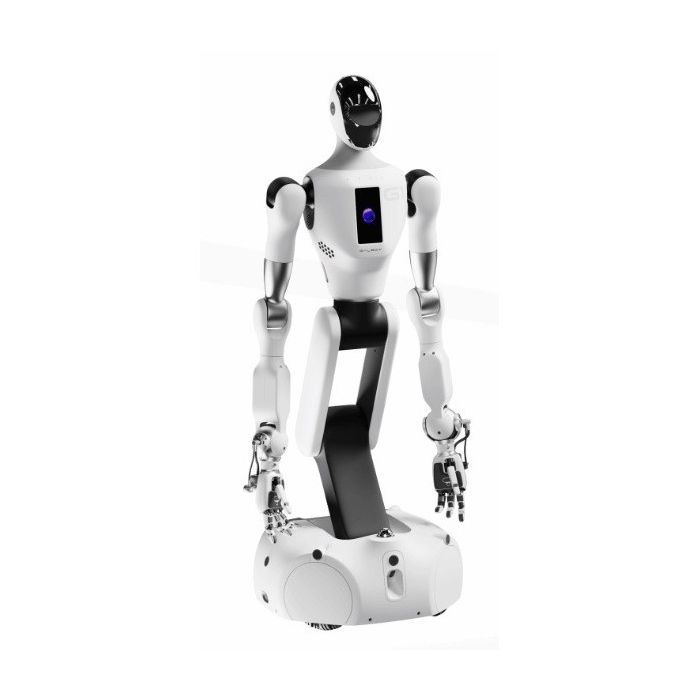
Most humanoid robots earn their headlines by walking. The Galbot G1 Wheeled Humanoid Robot makes a plainer argument: keep the base steady, put two capable arms at human working height, and let the robot spend its day on tasks rather than on balance. It is a general-purpose robot built for productivity, and that purpose shapes every choice in its design.
The product is available through this page, by quotation.
Background
The company behind the G1
The G1 comes from Galaxy General (Beijing Galbot Co.), a company founded in 2023 and co-founded by Peking University professor Wang He. The brand appears on the product as GALBOT. A university-linked start-up of this kind typically builds its machines around research in perception and manipulation, and the G1 follows that pattern: its emphasis is on what the robot can understand and handle, not on spectacle.
The company calls the G1 a general-purpose machine. In practice that means one platform meant to be taught many jobs, instead of a fixed-function unit sold for a single task on a single line.
Positioning and key technology
The G1 is equipped with Galbot's self-developed embodied multimodal large model. The model lets the robot flexibly perform a variety of tasks, and the manufacturer positions it for retail, industrial, medical and many other scenarios. An embodied model is one that links what a robot sees and senses to what its arms and base do, so a single system can take on different jobs.
The hardware matches that aim. A 4-wheel omnidirectional mobile chassis carries the robot through aisles and work areas. Two arms reach a wrist-center workspace from 0 to 2100mm vertically. Depth cameras and 6-axis force sensors in the wrists give the arms the feedback they need to handle objects, and a chassis fitted with 3D LiDAR, ultrasonic sensors and an IMU helps the robot keep track of its surroundings.
Technical Specifications
| Specification | Value |
|---|---|
| Product type | General-purpose robot built for productivity |
| Overall height (maximum) | 1730mm |
| Body weight | 92.5kg |
| Degrees of freedom (excluding chassis and end effector) | 21 |
| Payload capacity (wrist center) | 5kg per arm, 10kg total |
| Workspace (wrist center) | Vertical 0-2100mm, Horizontal 1900mm |
| Arm length (shoulder center to wrist center) | 710mm |
| Compute platform (G1) | NVIDIA AGX Orin 64GB 275TOPS |
| Network | WiFi 2.4/5GHz, Bluetooth 5.2 |
| Screen | 5.5-inch touchscreen, resolution 1920*1080 |
| Chassis sensors | 3D LiDAR x1, Ultrasonic sensor x8, IMU x1 |
| Wrist sensors (left and right combined) | Depth camera x2, Wrist 6-axis force sensor x2 |
| Chassis type | 4-wheel omnidirectional mobile chassis |
| Chassis dimensions (L/W/Projected Circle Diameter) | 600mm / 600mm / 625mm |
| Maximum speed | 1.5m/s |
| Operating time | 8 hours |
| Charging time | 3.5 hours with adapter |
| Battery capacity | 48V ⎓ 30Ah |
| Ingress protection | IP54 |
| Operating environment | 0-40°C, 90% humidity (no condensation) |
| Expansion interfaces | USB3.0 x2, HDMI |
| Standard accessory | Wired Charger |
| Optional accessories | Wireless Charging Dock, Spare Battery, Remote Controller |
Specifications as published by the manufacturer; confirmed against the datasheet at quotation.
The manufacturer has not published the certifications, the noise level, the hand dexterity specification or the availability of a software SDK; they are confirmed at quotation.
What makes the G1 different from a walking humanoid?
A walking humanoid spends a large share of its engineering on staying upright. The G1 sidesteps that problem with a 4-wheel omnidirectional mobile chassis measuring 600mm by 600mm, with a projected circle diameter of 625mm. An omnidirectional base can move in any direction without first turning, which is useful in narrow aisles, behind counters and around equipment. The top speed is 1.5m/s, which suits work among people better than it suits racing.
The second difference is reach. With a maximum height of 1730mm and a wrist-center workspace running from 0 to 2100mm vertically and 1900mm horizontally, the arms can work from floor level to well above head height. Each arm measures 710mm from shoulder center to wrist center and carries 5kg, so the two together handle 10kg. That is a working payload for shelves, trays, bins and boxes of modest weight.
The third difference is endurance. The robot is listed with 8 hours of operating time on a 48V ⎓ 30Ah battery, and charging takes 3.5 hours with the adapter. A wired charger is standard, while a wireless charging dock and a spare battery are optional, so a site can choose between plugging in during breaks and swapping power sources.
If a bipedal form is what a project needs, the Galbot ET1 Galaxy Star Bipedal Humanoid Robot is the sibling to compare.
What does the G1 Premium change?
Two versions are named: the G1 and the G1 Premium. The difference lies in compute. The G1 runs on NVIDIA Jetson Orin, and the table above gives its figure: NVIDIA AGX Orin 64GB 275TOPS. The G1 Premium upgrades to Jetson Thor for more onboard compute.
The table lists G1 figures only, and every figure in it belongs to the G1. Buyers who expect heavier onboard processing can ask for the G1 Premium when they request a quotation.
Who is the G1 for?
Retail operators are the first group. A robot that reaches from the floor to well above head height, moves through aisles and carries up to 5kg per arm fits shelf-facing work. Stores in the Convenience and Supermarket categories are the natural starting points for that kind of project.
Industrial and light-logistics teams are the second group. Two force-sensing arms, a sturdy base and an operating range of 0-40°C suit indoor work that involves handling and moving items. The IP54 rating gives some protection in everyday workshop conditions.
Medical and care facilities form the third group. The manufacturer names medical settings among the intended scenarios, and a buyer in this segment can state the site's compliance requirements when requesting a quotation.
Universities and research labs are the fourth group. The expansion interfaces, with USB3.0 x2 and HDMI, along with WiFi and Bluetooth 5.2, give integrators ways to connect their own equipment, and their software needs can be stated in the quotation request.
What is the G1 used for?
- Shelf work in stores. The arms reach from the floor to 2100mm vertically, covering low and high shelves in one pass.
- Carrying and handing over items. Each arm holds up to 5kg, so light goods can be moved or passed to staff and customers.
- Industrial handling. Force sensors in both wrists give the arms feedback while they grip and place objects.
- Medical-setting support. The embodied multimodal model is positioned for medical scenarios alongside retail and industrial ones.
- Guided information at the point of service. The 5.5-inch touchscreen at 1920*1080 gives people a screen to read and touch.
- Research and development. The compute platform and the expansion interfaces give teams a mobile two-arm base to build on.
Pricing and Availability
No price is printed on this page. A quotation is the way to buy: tell us the version, the site and the tasks you have in mind, and we will prepare it. Delivery, customs and support are arranged with the quotation. The Galbot G1 Wheeled Humanoid Robot is available on this page.
Frequently Asked Questions
How tall is the G1 and how much does it weigh?
The overall height is 1730mm at maximum, and the body weighs 92.5kg. The chassis measures 600mm by 600mm.
How much can the G1 carry?
The payload at the wrist center is 5kg per arm, which is 10kg in total. The workspace runs from 0 to 2100mm vertically and reaches 1900mm horizontally.
How long does the battery last?
The operating time is 8 hours on a 48V ⎓ 30Ah battery. Charging takes 3.5 hours with the adapter, and a spare battery and a wireless charging dock are available as options.
What sensors does the G1 carry?
The chassis has one 3D LiDAR, eight ultrasonic sensors and one IMU. The wrists hold two depth cameras and two 6-axis force sensors.
Can the G1 work in a humid or warm room?
The operating environment is 0-40°C with 90% humidity, without condensation. The ingress protection rating is IP54.
Is there a more powerful version?
Yes. The G1 Premium upgrades to Jetson Thor for more onboard compute, while the G1 runs on NVIDIA Jetson Orin. Ask for the Premium when you request a quotation.
Where can I buy the G1 and what does it cost?
The Galbot G1 Wheeled Humanoid Robot is available through this page by quotation. The cost depends on the version, the accessories and the delivery destination, and it is given in the quotation itself.
Summary
The G1 bets that a steady base beats a balancing act. Its omnidirectional chassis, two force-sensing arms with a generous vertical reach, 8 hours of operating time and a self-developed embodied multimodal model all serve one goal: getting useful work done in retail, industrial and medical settings. For a team ready to describe its site and its tasks, this page is the starting point.


