
Galbot ET1 Galaxy Star Bipedal Humanoid Robot
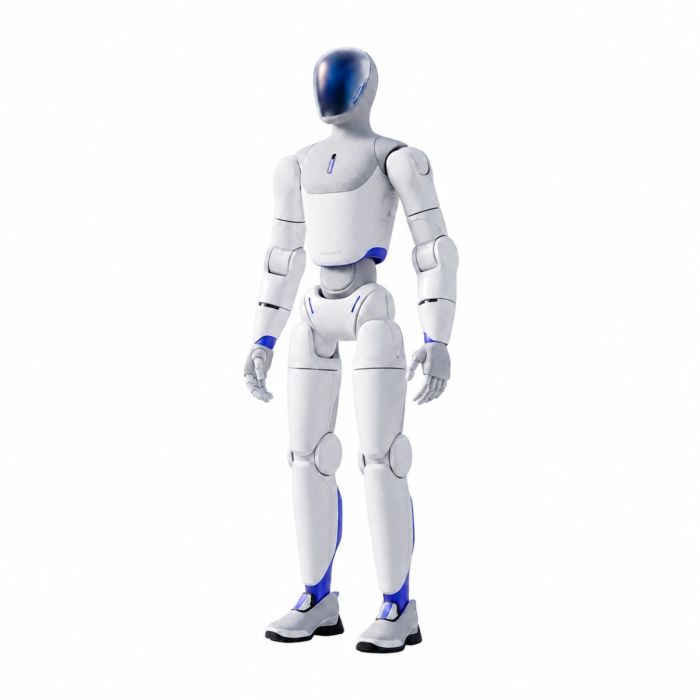
In stock
- BRAND:
- GALBOT
- MODEL:
- ET1
- ORIGIN:
- China
- AVAILABILITY:
- SUBJECT TO AVAILABILITY
- SKU:
- Galbot-ET1
Galbot ET1 Galaxy Star Bipedal Humanoid Robot
A robot that rolls can only go where the floor is flat. The Galbot ET1 Galaxy Star Bipedal Humanoid Robot is built for the places where it is not: it walks on two legs, and it is the first Galbot machine to do so without wheels. For a buyer who has watched wheeled platforms stop at a threshold, a step or a cluttered aisle, that is the reason to look closely.
The product is available through this page, by quotation.
Background
Galbot and the road from wheels to legs
Galbot is a Beijing company founded in 2023 by Peking University professor He Wang. It is young, and it has moved quickly. Its earlier humanoids stand on wheeled bases, a design that suits manipulation work: the platform stays stable while the arms and hands do the job. The Galbot G1 Wheeled Humanoid Robot is the best known of these, and the Galbot S1 Heavy Duty Wheeled Humanoid Robot carries the same idea into heavier duty.
The ET1 marks a change of direction. It is Galbot's first fully walking, bipedal humanoid robot, and it shifts the company away from the wheeled platforms it started with. Walking is harder to engineer than rolling, but a body with legs can share spaces built for people: corridors, rooms and workplaces that were never designed with robots in mind.
Positioning and key technology
The ET1 is a full-size humanoid of 1,230 mm in height and 30 kg in weight. That makes it a compact machine among bipedal humanoids, small enough to handle and move with reasonable effort, yet large enough to work at a human scale. It is listed with the other Bipedal Humanoids on this site, and it belongs to the wider family of Humanoids.
Three points define the engineering. First, the robot was trained on 100,000 hours of human motion data. Learning from human movement is a common route toward natural, fluid motion in a humanoid, because people are the model for the tasks these machines are meant to share. Second, the exterior uses flexible materials for safety, which matters when a machine is meant to work near people. Third, the ET1 incorporates motor solutions from Unitree, a name familiar to anyone who follows legged robotics.
Technical Specifications
| Specification | Value |
|---|---|
| Product | Galbot ET1 Galaxy Star Bipedal Humanoid Robot |
| Manufacturer | Galbot, Beijing (founded 2023) |
| Locomotion | Fully walking, bipedal |
| Height | 1,230 mm |
| Weight | 30 kg |
| Training data | 100,000 hours of human motion data |
| Exterior | Flexible materials for safety |
| Motors | Motor solutions from Unitree |
| Versions named | Standard, Pro, Flagship |
Specifications as published by the manufacturer; confirmed against the datasheet at quotation.
The manufacturer has not published the battery capacity, the runtime per charge, the walking speed, the payload, the IP rating, the connectivity, the contents of the box, the power input or the sensor details for the Pro and Flagship versions; they are confirmed at quotation.
What makes the Galbot ET1 different from the Galbot G1?
The difference starts at the floor. The G1 moves on a wheeled platform. The ET1 walks on two legs. Each choice has its place. Wheels are efficient and steady on smooth, level surfaces, and they suit long shifts of picking and placing in a fixed environment. Legs give up some of that simplicity in exchange for reach: a walking robot can in principle go where a person goes, including places where the ground is uneven or broken up by steps.
The ET1 is also the newer idea in the line. It is the company's first fully walking humanoid, and it moves Galbot away from the earlier wheeled designs. For a buyer, that means the ET1 is the one to examine when the question is mobility and how a humanoid fits into a space built for people, while the G1 remains the reference for wheeled operation. The ET1's height of 1,230 mm and weight of 30 kg belong to the ET1 alone, and they should not be read across to any other Galbot model.
Which versions of the Galbot ET1 exist?
Three versions are named: Standard, Pro and Flagship. The height, the weight, the training data, the exterior and the motor solutions are given for the ET1 as a whole, and no figure separates one version from another.
For that reason we do not describe what one version adds over another. If you need a particular version, name it in your request, and the differences are settled in the quotation.
Who is the Galbot ET1 for?
The ET1 suits several kinds of buyer, and the common thread is a need for a humanoid that walks.
Universities and research laboratories are the natural first group. A bipedal platform trained on human motion data gives teams a base for work on locomotion, balance and the learning of human movement, without having to build the machine from parts.
Robotics developers and integrators can use it to test how a walking humanoid behaves in a real workplace, and to judge whether legs offer something their customers need that wheels cannot.
Companies exploring service and hospitality roles may find value in a robot whose exterior uses flexible materials for safety, since public-facing work puts a machine close to people. Organizations that run demonstrations, training centers or technology showcases are a similar fit, because a walking humanoid draws attention and conveys the direction of the industry.
If your work is mainly manipulation in a fixed, level setting, a wheeled model may serve you better, and the Galbot G1 is the place to start. For heavier duty, look at the Galbot S1.
What is the Galbot ET1 used for?
- Locomotion research: a fully walking bipedal body for studying balance, gait and movement in a human-scale frame.
- Learning from human motion: a platform trained on 100,000 hours of human motion data, suited to work on how robots imitate and generalize human movement.
- Human-robot interaction studies: an exterior of flexible materials for safety makes it suitable for trials in which people and robot share a space.
- Service pilots: a trial machine for front-of-house and assistance tasks in places built for people, where legs may matter more than wheels.
- Education and training: a working humanoid for teaching robotics, control and artificial intelligence on real hardware.
- Demonstration and exhibition: a walking humanoid for trade shows, visitor centers and technology showcases.
Pricing and Availability
We do not print prices on this page. Every Galbot ET1 is supplied by quotation, so that the version, the configuration and the delivery destination can be settled first. Delivery, customs and support are arranged with the quotation, and you deal with one point of contact from request to handover. Send us your request and the details you need, and the Galbot ET1 Galaxy Star Bipedal Humanoid Robot is available on this page.
Frequently Asked Questions
How tall and how heavy is the Galbot ET1?
The ET1 is 1,230 mm tall and weighs 30 kg.
Does the Galbot ET1 walk or roll?
It walks. The ET1 is Galbot's first fully walking, bipedal humanoid robot, and it moves away from the wheeled platforms of earlier models such as the Galbot G1.
How was the Galbot ET1 trained?
It was trained on 100,000 hours of human motion data.
Is the Galbot ET1 safe to work around people?
Its exterior uses flexible materials for safety. Safety in your own setting still depends on how the robot is deployed, and we advise you to assess that for your site.
Who makes the motors in the Galbot ET1?
The ET1 incorporates motor solutions from Unitree.
What are the battery life, payload and IP rating?
We have no figures for these to give you here. They are given with the quotation, together with the walking speed, the connectivity and the contents of the box.
Where can I buy the Galbot ET1 and what does it cost?
You can buy it through this page. The cost depends on the version and the configuration, so it is given in a quotation rather than printed here; send us a request and we will respond with the details.
Summary
The Galbot ET1 answers a simple limit: wheels stop where the floor stops being flat. With two legs, a height of 1,230 mm, a weight of 30 kg, training on 100,000 hours of human motion data, a flexible exterior and Unitree motor solutions, it is Galbot's step from wheeled platforms into walking. Several details remain open, and we say so rather than guess. If you want a bipedal humanoid that can share human spaces, this page is the starting point.


