
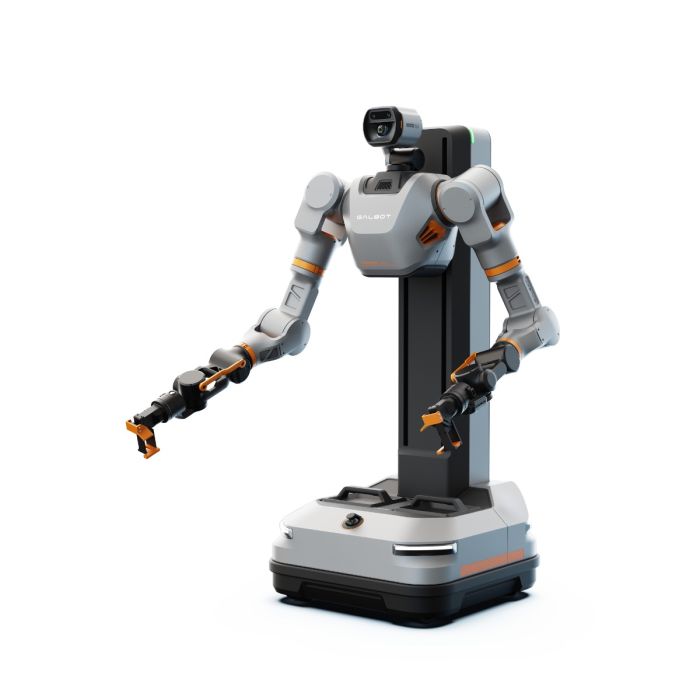
Galbot S1 Heavy Duty Wheeled Humanoid Robot
In stock
- BRAND:
- GALBOT
- MODEL:
- S1
- ORIGIN:
- China
- AVAILABILITY:
- SUBJECT TO AVAILABILITY
- SKU:
- Galbot-S1
Galbot S1 Heavy Duty Wheeled Humanoid Robot
Most humanoid robots are built to impress in a demo; the Galbot S1 Heavy Duty Wheeled Humanoid Robot is built to clock in for a shift. It trades walking legs for a four-wheel omnidirectional base, and it puts its engineering into things a factory manager cares about: carrying weight, staying on its feet for a full working day, and finding its way around without stickers on the floor.
The Galbot S1 Heavy Duty Wheeled Humanoid Robot is available through this page, by quotation.
Background
Where the S1 comes from
The S1 is described by its source as a heavy-duty industrial wheeled humanoid. That wording tells you most of what you need to know about its intent. It is not a research toy or a showroom greeter. It is a two-armed machine on a mobile base, sized for industrial work, with a standing height of 1793 mm and a weight of 320 kg.
Its most visible credential is where it works. The S1 has been deployed in the core production lines of manufacturing giants such as CATL. Production lines of that kind run on rhythm, repeatability and uptime, so a robot placed there is judged on the same terms as any other piece of plant equipment.
What defines the S1: wheels, vision and swappable batteries
Three design decisions shape the S1. The first is the base: a 4-wheel omnidirectional mobile base with a 730 mm by 730 mm footprint, which lets the robot move in any direction on a flat factory floor. The second is navigation: the robot operates purely on visual perception, so it needs no QR codes or labels for positioning. The third is power: a dual-battery quick-swap design lets the robot replace its own batteries autonomously, which supports 24/7 operation in demanding industrial environments.
Around these sit the working parts: two arms with a reach of 920 mm each, a lift with 750 mm of travel, head and chest cameras, 3D radar on the head and base, and force/torque sensors in the arms.
Technical Specifications
| Specification | Value |
|---|---|
| Product type | Heavy-Duty Industrial Wheeled Humanoid |
| Height (standing) | 1793 mm |
| Base / chassis dimensions (L/W) | 730 mm / 730 mm |
| Weight | 320 kg |
| Arm length | 920 mm |
| Lift travel | 750 mm |
| Base / chassis | 4-wheel omnidirectional mobile base |
| Payload | 30 kg rated, 50 kg peak |
| Max movement speed | 1.5 m/s |
| Camera (head) | Dual RGB cameras |
| Camera (chest) | Depth cameras x2 (L/R) |
| 3D radar | Head: x2, Base: x2 |
| F/T sensor | Arm: x2 |
| Battery life | 8 h |
| Charging time | 2 h |
| Remote controller | Included |
| Screen / display | 7-inch touchscreen |
| Safety | Power and Emergency Stop buttons; remote Emergency Stop included |
| Operating environment | 0-40°C, 0%-90% RH (no condensation) |
Specifications as published by the manufacturer; confirmed against the datasheet at quotation.
The manufacturer has not published the IP rating, the operating system, the noise level, the end effector options or the software development kit; they are confirmed at quotation.
What makes the Galbot S1 different from a legged humanoid?
The difference starts at the floor. A legged humanoid has to solve balance with every step, and that complexity is the price of reaching places a wheeled robot cannot. Most factories and logistics halls, however, are flat, and in them the wheels do the job with less drama. The S1 uses a four-wheel omnidirectional base, so it can reposition sideways or diagonally in tight aisles without turning around first. Its top movement speed is 1.5 m/s.
The second difference is the load. The launch release says the S1 achieves a continuous dual-arm payload of up to 50kg, a figure the manufacturer presents as pushing the industry's payload limits. The distributor specification table lists 30 kg rated and 50 kg peak. Whichever figure matters for your task, the S1 is aimed at lifting real material, not handing over light parts. A 320 kg body and a 730 mm by 730 mm footprint are part of how a machine of this class stays steady while the arms work.
The third difference is that the S1 works without positioning markers. It operates purely on visual perception, which removes the need to stick QR codes or labels around the site. For a facility that changes its layout often, that means less preparation work before a robot can start.
How does the Galbot S1 keep working around the clock?
Battery life is listed at 8 h and charging time at 2 h. On its own that is a long shift followed by a pause. The S1 goes further with its dual-battery quick-swap design: it can replace its batteries autonomously, which the source ties to 24/7 operation in demanding industrial environments. In practice this means the robot does not wait for a person to come and change a pack.
Safety hardware sits alongside this. The robot carries Power and Emergency Stop buttons, and a remote Emergency Stop is included, so an operator can halt it from a distance. A remote controller and a 7-inch touchscreen are also part of the package, giving staff two ways to interact with it directly.
Who is the Galbot S1 for?
The S1 suits manufacturers who have heavy, repetitive handling work on a production line and want a machine that can take it on without rebuilding the line around it. The CATL deployment shows the kind of setting it was made for: large-scale, continuous manufacturing where stability and rhythm matter.
It also suits integrators and engineering teams who are evaluating humanoid platforms for industrial customers and need a wheeled, vision-driven machine with force/torque sensing in both arms. Operations that run more than one shift will look closely at the battery swap. Companies in the Caribbean with plant or logistics floors that are level and indoors, within the 0-40°C and 0%-90% RH (no condensation) operating range, are a natural fit.
If your task needs a software development kit, a specific end effector or a particular ingress protection rating, raise it when you request a quotation, since those details are not published.
What is the Galbot S1 used for?
- Heavy material handling. Lifting and moving loads with two arms, using the 750 mm lift to work at different heights.
- Production line tasks. Working in core production lines, as it does at CATL.
- Continuous multi-shift work. Running on 8 h of battery and swapping its own batteries to keep going.
- Navigation in changing spaces. Moving by visual perception, with no QR codes or labels required for positioning.
- Force-sensitive manipulation. Using the force/torque sensors in the arms to feel what the hands are doing.
- Integration and evaluation projects. Giving engineering teams a wheeled humanoid platform to test against real industrial tasks.
Pricing and Availability
We do not print prices on this page. A quotation is the way to proceed, and it is where the configuration, the open specification points and your site requirements are confirmed together. Delivery, customs and support are arranged with the quotation. The Galbot S1 Heavy Duty Wheeled Humanoid Robot is available on this page.
Frequently Asked Questions
How tall is the Galbot S1 and how much does it weigh?
It stands 1793 mm tall and weighs 320 kg. Its chassis measures 730 mm by 730 mm.
How much can the Galbot S1 carry?
The distributor table lists 30 kg rated and 50 kg peak. The launch release speaks of a continuous dual-arm payload of up to 50kg. Share your load profile with us and we will confirm the figure for your task.
How long does the battery last?
Battery life is 8 h and charging takes 2 h. The dual-battery quick-swap design lets the robot change its batteries on its own.
Does the S1 need markers on the floor to navigate?
No. It operates purely on visual perception, so no QR codes or labels are needed for positioning.
What sensors does it carry?
It has dual RGB cameras in the head, two depth cameras in the chest, two 3D radar units in the head and two in the base, and two force/torque sensors in the arms.
What safety features are included?
It has Power and Emergency Stop buttons, and a remote Emergency Stop is included. A remote controller and a 7-inch touchscreen are also supplied.
Where can I buy the Galbot S1 and what does it cost?
You can request it through this page, by quotation. We do not list a price here; the quotation covers the configuration, delivery, customs and support.
Summary
The Galbot S1 is a humanoid that gives up legs to gain steadiness, reach and endurance. A four-wheel omnidirectional base, 920 mm arms, a 750 mm lift, vision-only navigation and a self-swapping dual-battery system all point to the same purpose: steady work on an industrial line, shift after shift. Its deployment in the production lines of manufacturers such as CATL shows the setting it was designed for. For teams in the Caribbean weighing a heavy-duty wheeled humanoid, this page is the starting point.


