
Fourier ArmMotus M2 Pro Upper Limb Rehabilitation Robot
In stock
- BRAND:
- FOURIER
- PART #:
- ArmMotus M2 Pro
- ORIGIN:
- China
- Warranty:
- 12 MONTHS
- AVAILABILITY:
- SUBJECT TO AVAILABILITY
- SKU:
- Fourier-ArmMotus-M2-Pro
Fourier ArmMotus M2 Pro Upper Limb Rehabilitation Robot
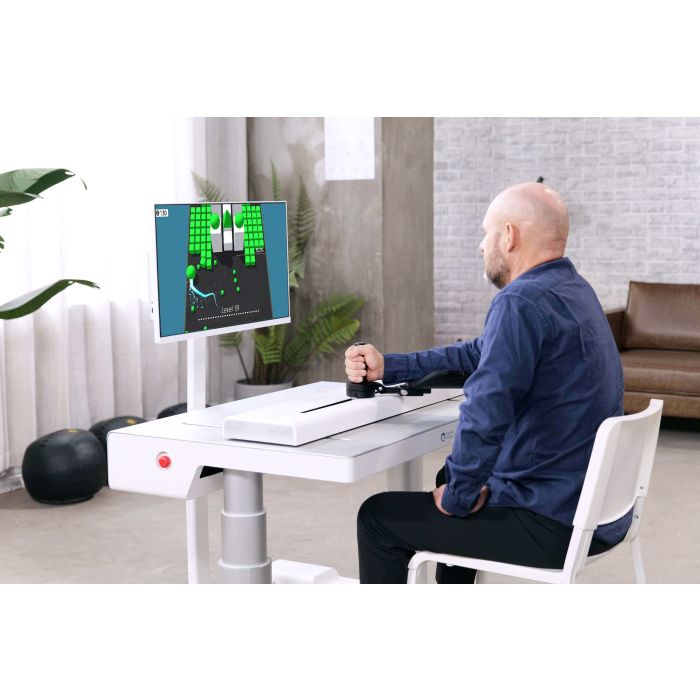
Most arm therapy asks a patient to repeat a movement until it is dull, and asks a therapist to count the repetitions. The Fourier ArmMotus M2 Pro Upper Limb Rehabilitation Robot turns that routine into a game on a robotic table, where motors, sensors and haptic feedback guide the hand through the exercise while the patient works toward a goal on screen.
The product is available through this page, by quotation.
Background
Fourier Intelligence and the M2 line
The M2 was developed by Fourier Intelligence as a robotic, height-adjustable workstation designed for upper limb rehabilitation. The Fourier M2 and the ArmMotus M2 Pro are referred to collectively as the M2, so the two names describe one family of equipment. The ArmMotus M2 Pro carries the platform features listed below. It sits within the wider Fourier rehabilitation range, which you can browse on the Fourier page, and within the Medical Robots category.
Rehabilitation robotics exists because recovery from stroke, injury or surgery depends on high volumes of well-controlled practice. A machine does not tire, and it can record what it sees. Clinics in warm, busy regions such as ours often work with small teams and large caseloads, so a device that holds a patient's attention through structured play can be valuable.
An end-effector design built around the hand and forearm
The M2 works as an end-effector device. It guides movement through the user's hand and forearm rather than controlling each joint individually. In practice the patient rests the arm on the training surface and the robot moves the point of contact, while the shoulder and elbow follow the path. The device enables controlled movement in two planes, using motors, sensors and haptic feedback, and it engages users in interactive, game-based exercises.
The therapy target is stated clearly: individuals with upper limb impairments affecting the shoulder and elbow. The system can also support postural stability and trunk control as part of a broader rehabilitation approach. It is therefore one tool in a program, not a replacement for the therapist's judgment.
Technical Specifications
| Specification | Value |
|---|---|
| Product | Fourier ArmMotus M2 Pro Upper Limb Rehabilitation Robot |
| Device type | Robotic, height-adjustable workstation for upper limb rehabilitation |
| Mechanism | End-effector device guiding movement through the user's hand and forearm |
| Motion planes | Controlled movement in two planes |
| Sensing and feedback | Motors, sensors and haptic feedback |
| Therapy modes | Passive, assistive, active and resistive |
| Target joints | Shoulder and elbow |
| Platform features | Ultra-thin Training Platform; Adjustable Dual Lifting Column; Infrared Safety Protection; Wide Chassis for wheelchair access |
| Training content | Extensive library of interactive games for goal-directed tasks |
| Training combinations | Motor control with cognitive training; isometric with dynamic strength training; single joint with ADL training; unilateral with bilateral arm training |
Specifications as published by the manufacturer; confirmed against the datasheet at quotation.
The manufacturer has not published the dimensions, the weight, the power requirements, the workspace range, the maximum output force, the connectivity, the included accessories, the display size or the certifications; they are confirmed at quotation.
What makes the ArmMotus M2 Pro different from a conventional therapy table?
A conventional table supports the arm but adds nothing to the exercise. The M2 Pro adds guided motion, measurement and motivation. Its therapy modes run from passive, where the robot moves the limb, through assistive and active, to resistive, where the patient works against the machine. A therapist can match the mode to the person's current ability and move to the next mode as the person progresses.
The platform itself is designed with the clinic floor in mind. The ultra-thin training platform and the adjustable dual lifting column let the workstation be set to the user, and the wide chassis allows wheelchair access, so a patient does not have to transfer to a chair first. Infrared safety protection is listed among the platform features.
The training library is the other difference. The extensive collection of interactive games motivates the user to complete intensive, repetitive, goal-directed tasks, which is exactly the part of therapy that patients tend to abandon when it feels like a chore.
How can one robot combine so many kinds of training?
The M2 Pro is built to pair training types that therapists often have to run separately. It can combine motor control with cognitive training, isometric strength with dynamic strength, single joint training with activities of daily living (ADL) training, and unilateral with bilateral arm training. A patient can therefore practice a reaching task that also asks for attention and memory, or move from working one arm to using both without changing equipment.
If your program centers on a three-dimensional approach to the arm, compare it with the Fourier ArmMotus EMU 3D Upper Limb Rehabilitation Robot.
Who is the Fourier ArmMotus M2 Pro for?
The first group is hospitals and rehabilitation centers that treat patients with shoulder and elbow impairments and want repeatable, measurable practice. A single workstation can serve many people because the height adjustment and wide chassis suit different bodies and wheelchair users.
The second group is outpatient and community clinics that need to keep patients engaged between supervised sessions. Game-based tasks give a visible goal, and the four therapy modes let one device cover early and later stages of recovery.
The third group is therapists who focus on function. The combination of single joint work with ADL training suits occupational therapy programs, where the aim is to carry strength and control into daily tasks.
Training and research institutions are a fourth group. They can use the device to teach robot-assisted therapy. If your work centers on the ankle or lower limb instead, look at the Fourier AnkleMotus Ankle Joint Rehabilitation Equipment or the Fourier ExoMotus M4 Lower-Limb Exoskeleton Rehabilitation Robot, which address those joints directly.
What is the Fourier ArmMotus M2 Pro used for?
- Passive movement therapy: the robot moves the patient's hand and forearm through a guided path when the person cannot yet move the arm alone.
- Assistive and active training: the device supports the movement only as much as needed, then lets the patient take over as strength returns.
- Resistive strengthening: the patient pushes against the device to build strength, and isometric work can be paired with dynamic work.
- Game-based repetition: interactive games keep patients working on intensive, goal-directed tasks.
- Cognitive and motor combination: exercises combine motor control with cognitive training in one session.
- Functional and bilateral practice: single joint training can be linked with ADL training, and unilateral work with bilateral arm training.
Pricing and Availability
No price is listed here, because the equipment is offered by quotation. Tell us about your clinic, your patients and your space, and we will prepare a quotation for the configuration you need. Delivery, customs and support are arranged with the quotation, so that you see the whole arrangement in one place. Everything you need to start that request is available on this page.
Frequently Asked Questions
What is the Fourier ArmMotus M2 Pro?
It is a robotic, height-adjustable workstation for upper limb rehabilitation, developed by Fourier Intelligence. It guides arm movement through game-based exercises.
Which joints does it treat?
It is designed for individuals with upper limb impairments affecting the shoulder and elbow. It can also support postural stability and trunk control as part of a broader rehabilitation approach.
What does end-effector mean here?
The device guides movement through the user's hand and forearm rather than controlling each joint individually. The shoulder and elbow follow the guided path.
Which therapy modes are available?
The system provides passive, assistive, active and resistive modes. This lets therapy be tailored to the user's level of ability and progression.
Can a wheelchair user train on it?
Yes, the platform features a wide chassis for wheelchair access. An adjustable dual lifting column sets the height of the workstation.
Are the dimensions and certifications listed?
Not in the table above. They are given with the quotation, together with the other details the table does not carry.
Where can I buy the Fourier ArmMotus M2 Pro and what does it cost?
You can request it through this page, by quotation. The cost depends on the configuration and is given in the quotation, together with delivery, customs and support.
Summary
The Fourier ArmMotus M2 Pro replaces dull counting with guided, game-based practice for the shoulder and elbow. It does this with an end-effector design, four therapy modes, a height-adjustable platform with wheelchair access, and a library of interactive games. Its training combinations let one workstation cover strength, control, cognition and daily-living tasks. If you are weighing it for your clinic, this page is the starting point.


