
Fourier ExoMotus M4 Lower-Limb Exoskeleton Rehabilitation Robot
In stock
- BRAND:
- FOURIER
- PART #:
- ExoMotus M4
- ORIGIN:
- China
- Warranty:
- 12 MONTHS
- AVAILABILITY:
- SUBJECT TO AVAILABILITY
- SKU:
- Fourier-ExoMotus-M4
Fourier ExoMotus M4 Lower-Limb Exoskeleton Rehabilitation Robot
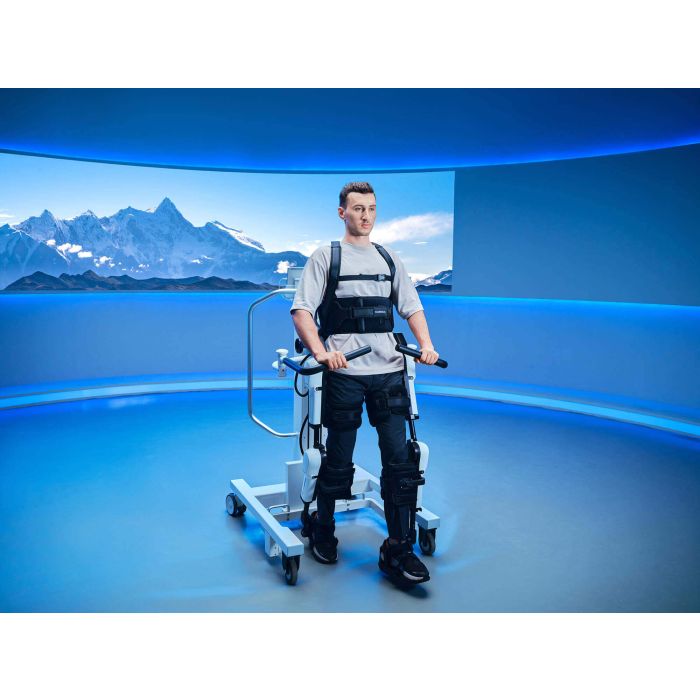
A therapist can have the right plan for a patient and still lose the first minutes of a session to straps, adjustments and equipment. The Fourier ExoMotus M4 Lower-Limb Exoskeleton Rehabilitation Robot is built to give those minutes back. It combines an exoskeleton, a balance support frame and a built-in chair, and it is operated from a tablet, so the session can start with the patient rather than with the machine.
The product is available through this page, by quotation.
Background
Fourier and the rehabilitation line
The ExoMotus M4 comes from Fourier, a robotics brand whose rehabilitation products sit alongside its other robotic systems. Within that range the M4 is the lower-limb gait trainer. It is meant for settings where a patient with a lower limb impairment needs to stand, step and walk under supervision, with the therapist keeping control of the session. You can browse the wider Fourier range, or see other devices in the Medical Robots category, to understand how the M4 fits into a clinic that also treats the upper limb, the ankle or the whole body.
Fourier describes the M4 as an ergonomic design with a built-in balance support frame, intended to give a comfortable and secure setting for gait training. The frame is not an accessory added later. It is part of the device from the start, and it shapes how the whole system is used.
Positioning and key technology
The M4 is aimed at individuals with lower limb impairments who need help with everyday ambulatory tasks. These include standing and walking on flat terrain and gentle inclines. Gait parameters can be personalized, so the same device can be set up for different patients rather than forcing everyone through one fixed pattern.
To make the device accessible to more patients, Fourier added a body-weight support frame and a built-in chair. The frame takes part of the load that a patient could not yet carry, while the chair gives a place to sit before and after training. Together they widen the group of people who can be considered for exoskeleton-assisted walking.
The second key element is openness. The M4 features EXOPS™, the Exoskeleton & Robotics Open Platform System, which allows suppliers to plug directly into the Fourier ecosystem and provide better solutions to customers. For a rehabilitation department that expects its equipment to grow over several years, this matters as much as the hardware.
Technical Specifications
| Specification | Value |
|---|---|
| Device dimensions (L x W x H) | 84 cm x 112 cm x 150 cm (±5cm) |
| User weight | Below or equal to 100 kg |
| User height | 150 cm - 190 cm |
| Weight of the support frame | 100 kilograms |
| Weight of the exoskeleton | 40 kilograms |
| Average setup time | Five minutes |
| Wheels | 4 low-friction wheels |
| Control | Tablet |
| Materials | Steel, aluminium, fabric and plastic |
| Open platform | EXOPS™ (Exoskeleton & Robotics Open Platform System) |
Specifications as published by the manufacturer; confirmed against the datasheet at quotation.
The manufacturer has not published the battery capacity, the battery life, the walking speed, the joint torque, the joint range of motion, the power supply, the connectivity, the IP rating, the contents of the box or the certifications; they are confirmed at quotation.
What makes the ExoMotus M4 different from a standalone exoskeleton?
Many people picture an exoskeleton as a wearable frame that does the walking for the user. The M4 takes a different view. Its balance support frame, body-weight support and built-in chair make it a complete training station rather than a single worn device. The patient is supported from the first moment of standing, and the therapist is not obliged to improvise safety around the machine.
The frame is also designed with the building in mind. It is supported by 4 low-friction wheels, and the outer width of the balancing support frame meets the entry requirements of conventional 1,000kg elevators and hospital entrances. A clinic does not have to dedicate a single room to the device. It can be moved to where the patient is, or to where the therapy space is free.
Setup is the other point of difference. The average setup time is five minutes, and the device is operated using a simple tablet. Time that would go to preparation can go to the patient. In a busy department with a full schedule, that adds up over a week of sessions.
How does the M4 support personalized training and measurement?
Rehabilitation is rarely one-size-fits-all, and the M4 reflects that. Users can customize training parameters such as stride length, speed and guidance force. These can be applied across overground walking, on-the-spot marching and assistive modes. A patient who is just beginning to bear weight and one who is working on a more natural stride can both be accommodated by changing the settings rather than changing the device.
The device also supports real-time monitoring of gait pattern, joint angles and step count during training, with automated reports for quantifiable rehabilitation data. For the therapist, this turns an impression of progress into numbers that can be compared from one session to the next. For the patient, it can make progress visible. For a research team, it gives a record that can be reviewed afterward.
The open platform adds a longer-term dimension. Because EXOPS™ lets suppliers connect to the Fourier ecosystem, a department that wants to extend the system with other solutions has a defined route for doing so. Departments that already work with connected tools may also wish to look at the Fourier InfinityNet Intelligent Cloud Rehabilitation Platform and the Fourier MetaMotus Galileo Biomechanics Analysis and Rehabilitation Platform. What connects to what is confirmed at quotation.
Who is the Fourier ExoMotus M4 for?
The M4 is for professional rehabilitation settings. Hospitals and rehabilitation centers are the most obvious buyers, particularly where therapists treat people with lower limb impairments and want a structured, supported way to practice standing and walking. The built-in balance support frame and body-weight support make it suitable for patients who could not safely attempt overground walking without help.
Clinical research groups are a second segment. Real-time monitoring of gait pattern, joint angles and step count, together with automated reports, gives researchers data they can work with. The open platform will also interest teams that wish to build on the system.
Training and teaching institutions are a third. A device that is set up in about five minutes and operated from a tablet is easier to demonstrate to students and new staff than one that needs long preparation.
The user range should be checked first. The M4 is specified for users up to and including 100 kg and with a height of 150 cm to 190 cm. Patients outside those limits are not covered by the published figures. A department that also treats other joints may pair it with the Fourier CycleMotus Series Active and Passive Rehabilitation Trainer for cycling-based work.
What is the Fourier ExoMotus M4 used for?
- Standing practice. The support frame and built-in chair let patients move between sitting and standing in a secure setting.
- Overground walking. Patients with lower limb impairments can practice walking on flat terrain and gentle inclines.
- On-the-spot marching. Stepping in place is available as a training mode when walking space or patient condition calls for it.
- Assistive training. Guidance force can be set to give the level of help that suits each patient.
- Gait data collection. Gait pattern, joint angles and step count are monitored live and summarized in automated reports.
- Platform development. EXOPS™ lets suppliers plug into the Fourier ecosystem to add further solutions.
Pricing and Availability
No price is shown on this page. The ExoMotus M4 is supplied by quotation, so that the configuration you need can be matched to your department. Delivery, customs and support are arranged together with the quotation. To begin, send your request and the Fourier ExoMotus M4 Lower-Limb Exoskeleton Rehabilitation Robot is available on this page.
Frequently Asked Questions
What patients can use the ExoMotus M4?
The published user limits are a weight of 100 kg or less and a height from 150 cm to 190 cm. It is intended for individuals with lower limb impairments.
How long does setup take?
The average setup time is five minutes. The device is operated using a tablet.
Can it be moved between rooms?
It rides on 4 low-friction wheels, and the outer width of the balancing support frame meets the entry requirements of conventional 1,000kg elevators and hospital entrances.
What training settings can be changed?
Stride length, speed and guidance force can be customized. They apply across overground walking, on-the-spot marching and assistive modes.
What data does it record?
It monitors gait pattern, joint angles and step count in real time during training. Automated reports give quantifiable rehabilitation data.
What is EXOPS™?
EXOPS™ stands for Exoskeleton & Robotics Open Platform System. It is the open platform that allows suppliers to plug directly into the Fourier ecosystem.
Where can I buy the Fourier ExoMotus M4 and what does it cost?
You can request it through this page, by quotation. No price is listed here; the quotation sets out the configuration, delivery, customs and support.
Summary
The time a therapist spends preparing equipment is time taken from the patient, and the ExoMotus M4 is designed around that fact. A balance support frame, body-weight support, a built-in chair, tablet control and an average setup of five minutes keep the session focused on the patient. Adjustable training parameters and real-time gait data make the work measurable, and the open EXOPS™ platform leaves room to grow. For a quotation on the Fourier ExoMotus M4 Lower-Limb Exoskeleton Rehabilitation Robot, this page is the starting point.


