
Fourier MetaMotus Galileo Biomechanics Analysis and Rehabilitation Platform
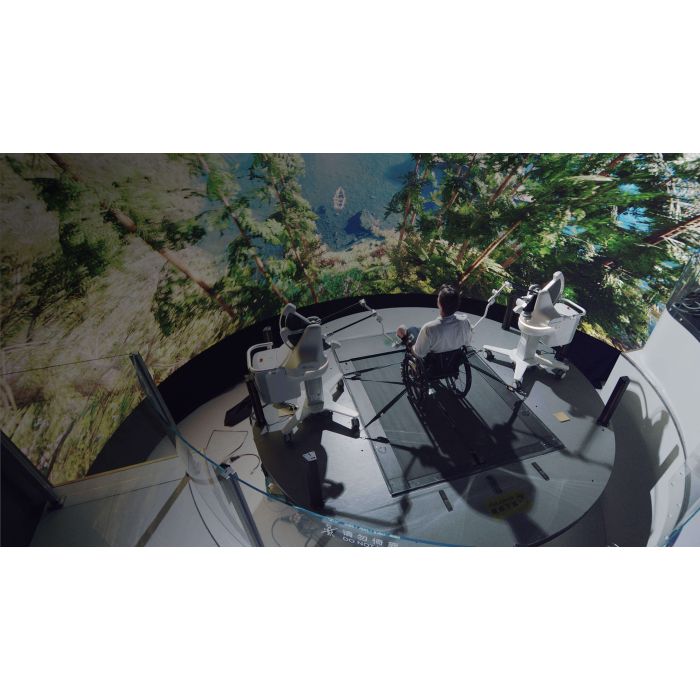
In stock
- BRAND:
- FOURIER
- PART #:
- MetaMotus Galileo
- ORIGIN:
- China
- Warranty:
- 12 MONTHS
- AVAILABILITY:
- SUBJECT TO AVAILABILITY
- SKU:
- Fourier-MetaMotus-Galileo
Fourier MetaMotus Galileo Biomechanics Analysis and Rehabilitation Platform
Most rehabilitation rooms ask a patient to imagine a street, a staircase or a crowded hall, and then to practice in a corridor. The Fourier MetaMotus Galileo Biomechanics Analysis and Rehabilitation Platform takes the opposite route: it builds the street around the patient, moves the floor beneath their feet, and measures what the body does in response.
The product is available through this page, by quotation.
Background
Fourier and its lineage
Fourier is a Chinese robotics company headquartered in Shanghai. Its name is attached to a family of rehabilitation products that reaches from single-joint trainers to lower-limb exoskeletons and cloud software. Within that family you will find the Fourier AnkleMotus Ankle Joint Rehabilitation Equipment and the Fourier ExoMotus M4 Lower-Limb Exoskeleton Rehabilitation Robot. You can browse the wider range under Fourier.
The MetaMotus Galileo was unveiled at RehabWeek 2023 and launched in November 2023. Where the devices above concentrate on one limb or one movement pattern, the Galileo is a whole-body room-scale system. It joins robotics, measurement and virtual reality in one platform.
Positioning and key technology
The Galileo is a biomechanics analysis and rehabilitation platform that integrates both virtual reality (VR) and robotics. It combines a 6-DoF Stewart platform, a 6-component force plate, an LED curved screen, a dual-belt treadmill, dynamic weight support, a motion capture system, rehabilitation robotics, exercise therapy equipment and human-computer interaction software. The aim is to make it the most advanced rehabilitation system by bringing these elements into one coordinated environment.
At its heart lie the Stewart platform and the force plate. An 8K UHD LED curved screen complements them and envelops patients in immersive virtual landscapes. What sets the platform apart is its Galileo X processor, which expands its utility into areas such as exposure therapy for PTSD. It also enables real-time multimodal data analysis for research and protocol development.
Technical Specifications
| Specification | Value |
|---|---|
| Product type | Biomechanics analysis and rehabilitation platform integrating virtual reality and robotics |
| Motion platform | 6-DoF Stewart platform |
| Force measurement | 6-component force plate |
| Display | 8K UHD LED curved screen |
| Treadmill | Dual-belt treadmill |
| Body support | Dynamic weight support |
| Processor | Galileo X processor |
| Other integrated components | Motion capture system, rehabilitation robotics, exercise therapy equipment, human-computer interaction software |
| Launch | November 2023 |
| Manufacturer | Fourier, headquartered in Shanghai |
Specifications as published by the manufacturer; confirmed against the datasheet at quotation.
The manufacturer has not published the dimensions, the weight, the power requirements, the treadmill speed range, the weight support capacity, the force plate range and accuracy, the motion capture system model, the motion platform travel, the software compatibility, the contents of the box or the certifications; they are confirmed at quotation.
What makes the Galileo different from a conventional treadmill or gait lab?
A conventional treadmill gives you a belt and a speed setting. A conventional gait laboratory gives you measurement, but usually in a setting that looks nothing like daily life. The Galileo puts both in one place. The patient trains on a dual-belt treadmill while a 6-component force plate and a motion capture system record the movement, and dynamic weight support helps the patient stay upright when they need it.
The Stewart platform adds a physical challenge that a fixed floor cannot. Because it has six degrees of freedom, the surface can move beneath the patient while the curved screen shows a matching landscape. The result is that assessment and training happen in the same session, on the same equipment, with the same data stream behind them.
The Galileo X processor is the part that ties this together. It enables real-time multimodal data analysis, so a therapist or researcher can look at several signals together instead of exporting them from separate systems. The processor also extends the platform into exposure therapy for PTSD, which is rare for a device that began as a movement trainer.
Can one platform cover early and later stages of rehabilitation?
That is the stated intent. The MetaMotus Galileo is designed to provide full spectrum rehab training from early to later stages, allowing wheelchair, balance and walking training. A patient who starts in a wheelchair and a patient who is ready to walk can both use the same installation.
For more advanced users, multi-tasking and anti-interference training is available. In practice, this means a patient can be asked to handle a second task or a distraction while moving, which is closer to the demands of daily life than quiet, single-task practice.
The platform also excels at comprehensive motor assessment. Therapists can measure and analyze the nuances of motor function and tailor treatment plans more effectively. The inclusive design supports a wide range of users, from those who rely on wheelchairs to individuals using prosthetic limbs.
Who is the Fourier MetaMotus Galileo for?
The first group is hospitals and rehabilitation centers that treat both adults and children. The system is effective for evaluating and treating a wide range of functional impairments, including neurological and musculoskeletal injuries, amputations, limb disabilities, cardiorespiratory dysfunction and degenerative diseases. A single room that serves many of these patient groups makes sense for a busy department.
The second group is research teams and protocol developers. Real-time multimodal data analysis lets them study movement and test new training protocols on the same platform that clinicians use for treatment.
The third group is humanoid robot developers. The Galileo supports humanoid robot training, testing and assessment by creating a diverse yet controlled environment, both for rehabilitation and for research. That is an unusual capability, and it makes the platform interesting to laboratories working on legged robots.
If your need is narrower, other Fourier products may suit you better. A service that wants to connect remote programs can read about the Fourier InfinityNet Intelligent Cloud Rehabilitation Platform. It is listed under Medical Robots.
What is the Fourier MetaMotus Galileo used for?
- Motor assessment. Therapists measure and analyze motor function and use the findings to tailor treatment plans.
- Wheelchair training. Patients who rely on wheelchairs train within the same environment as those who walk.
- Balance training. The moving platform and immersive screen give balance work a realistic challenge.
- Walking training. The dual-belt treadmill and dynamic weight support carry patients from early to later stages of gait recovery.
- Multi-tasking and anti-interference training. More advanced users practice movement under added tasks and distractions.
- Research and robot testing. Teams analyze multimodal data and test humanoid robots in a controlled environment.
Pricing and Availability
The Fourier MetaMotus Galileo is supplied by quotation, so no price is listed here. Please send us your requirements, and we will prepare a quotation. Delivery, customs and support are arranged with the quotation. The product is available on this page.
Frequently Asked Questions
What is the Fourier MetaMotus Galileo?
It is a biomechanics analysis and rehabilitation platform that integrates virtual reality and robotics. It was unveiled at RehabWeek 2023 and launched in November 2023.
What does the platform include?
It integrates a 6-DoF Stewart platform, a 6-component force plate, an LED curved screen, a dual-belt treadmill, dynamic weight support, a motion capture system, rehabilitation robotics, exercise therapy equipment and human-computer interaction software. The screen is an 8K UHD LED curved screen.
Who can use it?
It supports a wide range of users, from those who rely on wheelchairs to individuals using prosthetic limbs. It is effective for adults and children.
Which conditions does it address?
It evaluates and treats functional impairments such as neurological and musculoskeletal injuries, amputations, limb disabilities, cardiorespiratory dysfunction and degenerative diseases.
What does the Galileo X processor do?
It enables real-time multimodal data analysis for research and protocol development. It also expands the platform into areas such as exposure therapy for PTSD.
Can it be used to test humanoid robots?
Yes. It supports humanoid robot training, testing and assessment by creating a diverse yet controlled environment, both for rehabilitation and for research.
Where can I buy the Fourier MetaMotus Galileo and what does it cost?
You can request it through this page. The cost is given in a quotation prepared for your configuration, and no price is published here.
Summary
The Fourier MetaMotus Galileo moves rehabilitation out of the corridor and into a world that can be changed on demand. It combines a moving platform, force measurement, an immersive screen, a treadmill with weight support and an analysis processor. It serves wheelchair users, walkers, children, adults and robot developers. If you want to see how it fits your clinic or laboratory, this page is the starting point.


