
Fourier ArmMotus EMU 3D Upper Limb Rehabilitation Robot
In stock
- BRAND:
- FOURIER
- PART #:
- ArmMotus EMU
- ORIGIN:
- China
- Warranty:
- 12 MONTHS
- AVAILABILITY:
- SUBJECT TO AVAILABILITY
- SKU:
- Fourier-ArmMotus-EMU
Fourier ArmMotus EMU 3D Upper Limb Rehabilitation Robot
A therapist's hands do two jobs at once: they guide the arm and they feel how the patient answers. Most machines manage only the first. The Fourier ArmMotus EMU 3D Upper Limb Rehabilitation Robot is built around the idea that a device should also give way, so that the patient's own effort stays at the center of the session.
The product is available through this page, by quotation.
Background
The company behind the device
The ArmMotus EMU is made by Shanghai Fourier Intelligence Co., Ltd., of Shanghai, China. The company works in rehabilitation robotics, and its range covers upper limb, lower limb, ankle, cycling and biomechanics equipment, as well as a cloud platform for managing therapy data. You can browse the wider range on the Fourier page, and the clinical devices together under Medical Robots.
Within that range, the ArmMotus line is the one aimed at the arm. Another member of the family is the Fourier ArmMotus M2 Pro Upper Limb Rehabilitation Robot, which a clinic may wish to compare when it plans its upper limb program.
Positioning and key technology
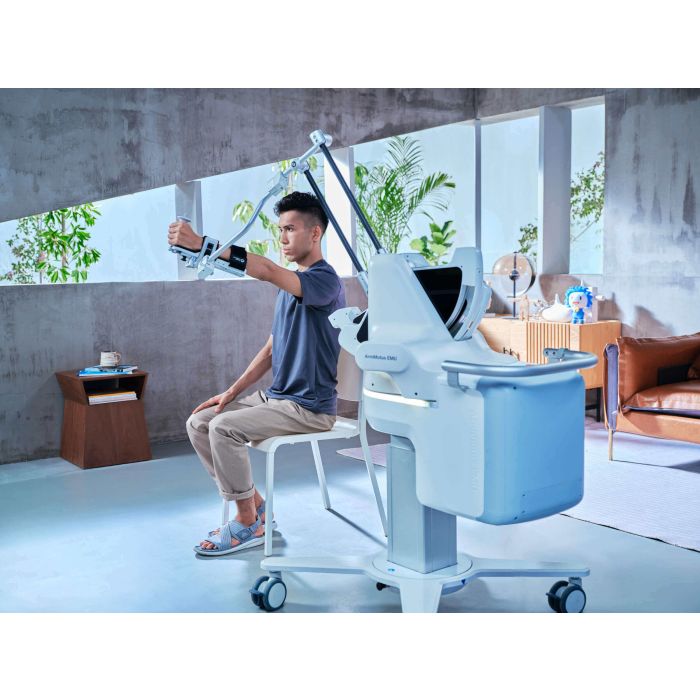
The ArmMotus EMU is a three-dimensional, back-drivable upper limb rehabilitation robot. Back-drivable means that the patient can move the device as well as the device moving the patient, so the machine does not fight the person using it. To achieve this, the design combines a cable-driven mechanism with a parallel structure made of lightweight carbon fibre rods. This combination reduces the friction and the inertia of the device.
The second pillar is force feedback. The technology lets the device simulate the therapist's hands, with assistance or resistance that can be adjusted. A patient who needs help to complete a reach receives it; a patient who is ready for more challenge meets resistance instead.
Technical Specifications
| Specification | Value |
|---|---|
| Product type | 3D back-drivable upper limb rehabilitation robot |
| Mechanism | Cable-driven |
| Structure | Parallel structure of lightweight carbon fibre rods |
| Dimensions | 131 cm (L) x 77 cm (W) x 126 cm (H) (± 5 cm) |
| Weight | 135 kg |
| Patient connection | Single point along the forearm |
| Training environments | Virtual (game) environment or real objects |
| Force feedback | Simulates the therapist's hands; assistance or resistance adjustable |
| Feedback during training | Real-time visual, audio and haptic |
| Measured and reported | Movement trajectory, strength, cognitive ability, ROM, motor control ability; report after training |
| Indication | Upper limb disability caused by neurological or musculoskeletal disorder |
| Manufacturer | Shanghai Fourier Intelligence Co., Ltd., Shanghai, China |
Specifications as published by the manufacturer; confirmed against the datasheet at quotation.
The manufacturer has not published the power requirements, the workspace size, the maximum output force, the connectivity, the display or software platform, the contents of the box, the certifications or the maximum user load; they are confirmed at quotation.
What makes the ArmMotus EMU different from a conventional arm trainer?
Many arm trainers fix the limb in a rigid frame or hold the hand on a handle that follows a single path. The ArmMotus EMU takes another approach. The patient is connected to the device at only one point along the forearm, and that is a deliberate design choice. Because there is no rigid exoskeleton around the joints, the person can move in a wide variety of ways: sitting or standing, with a free hand or with a handle.
This freedom matters in practice. Everyday tasks such as reaching for a cup, wiping a surface or lifting an object to a shelf are not done in a single plane. A device that follows the arm in three dimensions lets the therapist practice movements that resemble those tasks, rather than abstract exercises.
The second difference is the choice of training environment. Exercises can be carried out in a virtual game environment, where the screen gives the patient a goal and the visual, audio and haptic cues keep attention on the task. They can equally be carried out with real objects, which brings the session closer to daily life. A clinic can therefore use games for motivation and real objects for transfer, on the same device.
How does the device support the therapist?
The device provides a comprehensive upper limb training trajectory in which the therapist selects and customizes different movements according to the user's needs. The therapist stays in charge of the plan; the robot carries it out consistently and without tiring.
Measurement is the other half of the support. The device measures every movement trajectory, strength, cognitive ability, range of motion (ROM) and motor control ability, and it generates a report after the training. For a department that must show progress to patients, families, referring physicians or research partners, a report of this kind turns a session into a record. Clinics that want to manage therapy data in the cloud can also look at the Fourier InfinityNet Intelligent Cloud Rehabilitation Platform from the same manufacturer.
The robotic therapy also supports upper limb cooperation and mirror training. These are key parts of stroke rehabilitation and of other physical rehabilitation therapies, since they let the healthier arm guide and encourage the affected one.
Who is the Fourier ArmMotus EMU for?
The device is indicated for upper limb disability caused by a neurological disorder or a musculoskeletal disorder. In practical terms, the buyers are professional organizations that treat such patients.
- Hospitals and rehabilitation centers that treat people after stroke or other neurological events and need a repeatable way to deliver arm therapy.
- Orthopedic and musculoskeletal programs that work with patients whose arm function is limited by joint or muscle conditions.
- Research groups that value precise measurement of trajectory, strength and motor control.
- Private clinics and therapy practices that want to offer game-based and object-based training with documented results.
Buyers who are still comparing models within the range can look at the Fourier ArmMotus M2 Pro Upper Limb Rehabilitation Robot as well. Please state your clinical needs when requesting a quotation.
The device weighs 135 kg and occupies a footprint of 131 cm by 77 cm, so the room should be planned in advance.
What is the Fourier ArmMotus EMU used for?
- Guided arm movement. The therapist selects and customizes movements, and the device supports the patient through them.
- Assistance or resistance training. Force feedback simulates the therapist's hands, giving help or opposing the effort as needed.
- Game-based exercise. Virtual environments give the patient visible goals, with visual, audio and haptic cues.
- Practice with real objects. Training actions can be carried out with real objects to bring sessions closer to daily tasks.
- Mirror and cooperative training. The robot supports upper limb cooperation and mirror training for stroke and other physical rehabilitation therapy.
- Assessment and reporting. Trajectory, strength, cognitive ability, ROM and motor control ability are measured, and a report is generated after training.
Pricing and Availability
No prices are shown on this page. Quotation is the way to buy: send us your request and we will prepare an offer around your clinic's needs. Delivery, customs and support are arranged together with the quotation, so that nothing is left open after the order. The Fourier ArmMotus EMU 3D Upper Limb Rehabilitation Robot is available on this page.
Frequently Asked Questions
What is the ArmMotus EMU?
It is a 3D back-drivable upper limb rehabilitation robot from Shanghai Fourier Intelligence Co., Ltd. It uses a cable-driven mechanism and a parallel structure of lightweight carbon fibre rods.
How is the patient connected to the device?
The patient is connected at a single point along the forearm. This allows movement while sitting or standing, with a free hand or with a handle.
Can training be done without a screen?
Yes. Training can be carried out in a virtual game environment or with real objects.
What does the device measure?
It measures movement trajectory, strength, cognitive ability, ROM and motor control ability, and it generates a report after the training.
Does it support mirror training?
Yes. The robotic therapy supports upper limb cooperation and mirror training, which are key parts of stroke and other physical rehabilitation therapies.
What are the dimensions and weight?
The dimensions are 131 cm (L) x 77 cm (W) x 126 cm (H) (± 5 cm) and the weight is 135 kg.
Where can I buy the ArmMotus EMU and what does it cost?
You can request it through this page, by quotation. The cost is set in the quotation, together with delivery, customs and support, and no price is printed here.
Summary
The ArmMotus EMU follows a simple idea: a rehabilitation robot should behave less like a machine and more like a pair of attentive hands. Its cable-driven, back-drivable design, the single connection point at the forearm, adjustable assistance or resistance, and its reporting give therapists a tool that moves with the patient and records what happened. If that matches the needs of your clinic, this page is the starting point.


