
Fairino Cobot (FR3)
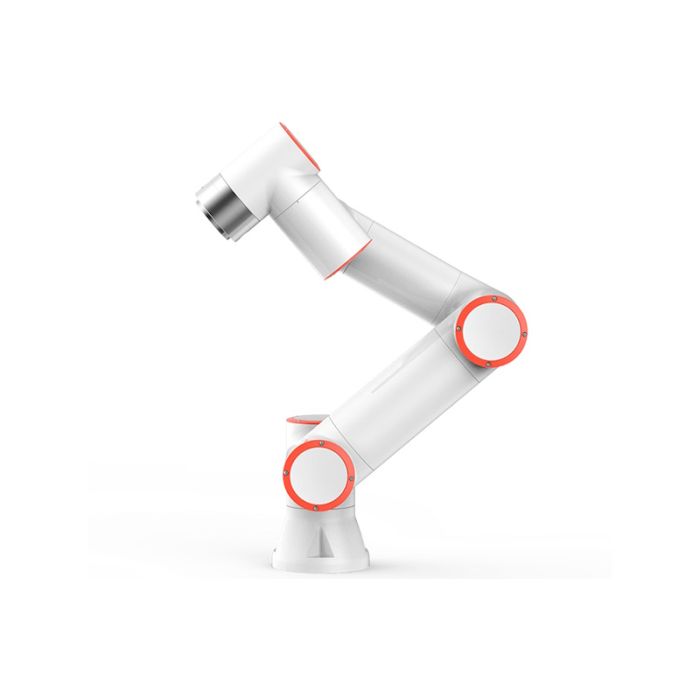
In stock
- BRAND:
- FAIRINO
- PART #:
- FR3
- ORIGIN:
- China
- AVAILABILITY:
- SUBJECT TO AVAILABILITY
- SKU:
- Fairino-FR3
Fairino Cobot (FR3)
A robot does not have to be big to be useful, and on a crowded workbench it often cannot afford to be. The Fairino Cobot (FR3) is the small arm in the FAIRINO line, made for stations where every square inch is already spoken for and an operator still needs to work beside the machine.
The product is available through this page, by quotation.
Background
The company and the FR-series
FAIRINO builds collaborative robots, or cobots: arms meant to work close to people without the heavy fencing that traditional industrial robots usually need. The company offers them as a family, with each model sized to a different payload and reach. The FR3 is the compact member of that family, and it shares the platform logic of its larger siblings. Buyers who learn one arm in the series can carry that knowledge to the next one.
That family approach matters to integrators and plant engineers. Once a team has chosen a software environment and a way of programming, it can add arms of different sizes without starting over. If a project outgrows the FR3, the Fairino FR5 Collaborative Robot (Cobot) and the Fairino FR10 Collaborative Robot (Cobot) are the neighboring models to look at. The full range is gathered in the Fairino category.
Positioning and key technology
The FR3 is a six-axis arm with 6 rotating joints. That is the layout that lets a tool approach a part from many angles, which is what assembly, dispensing, inspection and handling tasks usually call for. The manufacturer describes the arm as a way to automate compact workstations quickly and precisely, and the specification bears that out: a 3 kg payload, a 622 mm reach and ±0.02 mm pose repeatability.
The arm can be mounted in any orientation, so it can sit on a bench, hang from a frame or be fixed to a wall, depending on how the workstation is laid out. Its base footprint is 128 mm and it weighs about 15 kg, which keeps it manageable for a small team to move and reposition. It is offered in an IP54 version and an IP65 version, for dusty and damp environments. Programming is by direct teaching, a web interface or a teach pendant, which is meant to shorten commissioning time.
Technical Specifications
| Specification | Value |
|---|---|
| Payload | 3 kg |
| Reach | 622 mm |
| Degrees of freedom | 6 rotating joints |
| Pose repeatability | ±0.02 mm |
| Typical TCP speed | 1 m/s |
| IP classification | IP54 (IP65 optional) |
| Noise | <65 dB |
| Robot mounting | Any orientation |
| I/O ports | (DI) 2, (DO) 2, (AI) 1, (AO) 1 |
| Footprint | 128 mm |
| Weight | ≈15 kg |
| Operating temperature | 0–45°C |
| Average power | 220 W |
| Peak power | 280 W |
| Human-machine interface | 10.1 inch teach pendant or mobile terminal Web App |
| Software development | C/C++/Python / ROS/ROS2 |
| Programming methods | Direct teaching, a web interface or a teach pendant |
Specifications as published by the manufacturer; confirmed against the datasheet at quotation.
The manufacturer has not published the rated supply voltage of the robot arm, the joint torque limits, the collision detection sensitivity, the cable length from arm to controller, the included accessories or the safety certifications; they are confirmed at quotation.
What makes the FR3 different from a larger cobot?
The first difference is the one you can feel when you lift it. At about 15 kg with a 128 mm footprint, the FR3 is the lightest and narrowest arm in the six-model table the manufacturer publishes for the FR-series. A larger arm carries more and reaches farther, but it also asks for more room, a sturdier mounting surface and more power. The FR3 draws 220 W on average and 280 W at peak, which is modest for a robot arm.
The second difference is precision relative to size. The ±0.02 mm pose repeatability suits work where position matters more than force: placing small components, following a dispensing path, presenting a part to a camera. For work like this, extra payload would sit unused, and a smaller arm is usually the better fit for a small cell.
The third difference is the trade-off, and it is better stated openly. A 3 kg payload includes whatever tool is mounted on the flange, so heavy grippers or bulky end tools use up the capacity quickly. A 622 mm reach covers a compact workstation, not a wide table. If your parts or tools push beyond those limits, a larger sibling in the Cobots category will serve you better.
Which environment suits the IP54 and the IP65 version?
The FR3 is available in either an IP54 or an IP65 version. The specification lists IP54 as the standard classification, with IP65 optional. The manufacturer positions these versions for dusty and damp environments, so the choice comes down to the place where the arm will work.
A clean indoor workstation, such as an electronics bench or an inspection station, is the natural home of the standard version. Where dust, splashes or humidity are part of daily life, the IP65 option deserves a close look. Caribbean workshops and plants often deal with humid air, so it is worth stating your conditions when you ask for a quotation. The arm operates between 0 and 45°C, and noise is below 65 dB, which allows it to work near people without adding much to the sound of the room.
Who is the Fairino Cobot (FR3) for?
Small and mid-sized manufacturers are the clearest audience. A shop that assembles, tests or packs light parts can place the FR3 beside an operator and let it take over the repetitive steps, without redesigning the whole line. The ability to mount it in any orientation helps in tight layouts.
Integrators and system builders will value the programming options. The arm can be taught by hand, set up through a web interface or driven from a teach pendant, and software developers can work in C/C++/Python or with ROS and ROS2. That combination covers both the technician who wants quick setup and the engineer who wants to write custom control.
Schools, training centers and research labs form a third group. A compact arm with open software support is easy to place on a lab bench, and the 10.1 inch teach pendant or mobile Web App makes it approachable for newcomers. Buyers whose parts or tools are heavier should look instead at the FR5 or the FR10. You can also compare the Fairino Cobot (FR3-C) if you are weighing related models.
What is the Fairino Cobot (FR3) used for?
- Light assembly. Placing and fitting small parts at a bench where precision matters more than force.
- Dispensing and gluing. Following a repeatable path with a dispensing tool, pass after pass.
- Inspection. Presenting parts to a camera or gauge from a consistent position.
- Pick and place. Moving light items between trays, fixtures and conveyors within a compact reach.
- Light machine tending. Loading and unloading small parts at a nearby machine, within the payload limit.
- Training and development. Teaching automation skills and building custom applications through the available programming interfaces.
Pricing and Availability
Prices depend on the version, the environment and the project, so we handle every request by quotation. Tell us whether you need the IP54 or the IP65 version and what the arm will do, and we will respond with a proposal. Delivery, customs and support are arranged together with the quotation. The Fairino Cobot (FR3) is available on this page.
Frequently Asked Questions
What payload and reach does the Fairino Cobot (FR3) have?
The FR3 has a 3 kg payload and a 622 mm reach. It is a six-axis arm with 6 rotating joints.
How precise is it?
The pose repeatability is ±0.02 mm. The typical TCP speed is 1 m/s.
Is there a dust- and water-resistant version?
Yes. The FR3 is available as an IP54 or an IP65 version, with IP54 listed as standard and IP65 as optional.
How is the robot programmed?
You can use direct teaching, a web interface or a teach pendant. The interface is a 10.1 inch teach pendant or a mobile terminal Web App, and developers can use C/C++/Python or ROS and ROS2.
Can it be mounted on a wall or ceiling?
Yes. The robot mounting is listed as any orientation, so the arm is not limited to a flat tabletop.
What are the size, weight and power figures?
The footprint is 128 mm and the weight is about 15 kg. Average power is 220 W and peak power is 280 W.
Where can I buy the Fairino Cobot (FR3) and what does it cost?
You can request it through this page. The cost is given in a quotation that depends on the version and your project, and delivery, customs and support are arranged with it.
Summary
The FR3 shows that the right robot is often the smallest one that does the job. It combines a 3 kg payload, a 622 mm reach and ±0.02 mm repeatability in a light arm with a 128 mm footprint, mounts in any orientation and can be taught by hand or programmed in familiar languages. The IP54 and IP65 versions let you match the arm to the room, and larger FR-series siblings are there if your needs grow. If a crowded bench is holding your project back, this page is the starting point.