
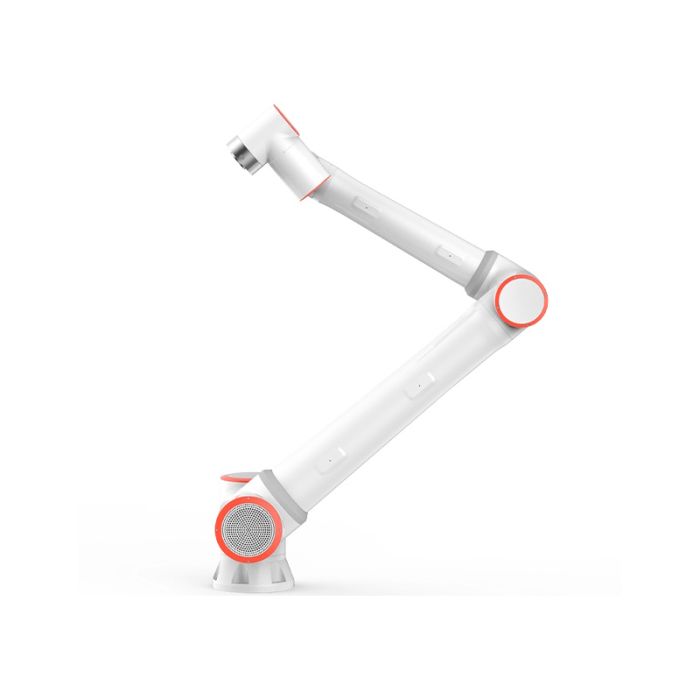
Fairino Cobot (FR20)
In stock
- BRAND:
- FAIRINO
- PART #:
- FR20
- ORIGIN:
- China
- AVAILABILITY:
- SUBJECT TO AVAILABILITY
- SKU:
- Fairino-FR20
Fairino Cobot (FR20)
Most people picture a collaborative robot handling light parts at a bench. The Fairino Cobot (FR20) is for the jobs that make you think twice: heavy cartons, large machines and work that sits well beyond arm's length. It is a 6-axis collaborative robot that carries a 20kg payload and reaches 1854mm from a base only 240mm wide.
The product is available through this page, by quotation.
Background
The FR20 within the Fairino range
Fairino describes the FR20 as a powerful, scalable and sustainable 6-axis collaborative robot built to empower the end user. Those three words say a good deal about how the arm is meant to be used. Powerful points to the payload and reach. Scalable points to a robot that can start with one task and grow into others. Sustainable points to automation that stays useful for years rather than for a single project.
The FR20 belongs to a family of cobots that also includes the Fairino Cobot (FR3), the Fairino FR5 Collaborative Robot (Cobot), the Fairino FR10 Collaborative Robot (Cobot), the Fairino Cobot (FR16) and the Fairino Cobot (FR30). A shop that works with several models can compare them side by side before deciding which one fits a given task. You will find every Fairino arm we list in the Fairino category.
Positioning: a heavier arm with a modest footprint
Fairino positions the FR20 for work where throughput matters. The manufacturer describes it as delivering reliable, high-throughput automation with a fairly compact footprint and fast deployment. In practice that means three things. The arm is meant for loads and distances that smaller cobots cannot cover. The base is small enough to fit into a cell that already exists. And the arm can be mounted in any orientation, so it can be placed on a floor stand, a wall or an overhead frame, depending on how the cell is laid out.
The arm is built from aluminium and steel and weighs about 85kg. That is a figure to plan for when you design the stand or the mounting plate. It also helps explain why the arm can be used where a larger payload and a long reach are both needed. For a wider view of this product type, browse the Cobots category.
Technical Specifications
| Specification | Value |
|---|---|
| Type | 6-axis collaborative robot |
| Degrees of freedom | 6 rotating joints |
| Payload | 20kg (Max: 25kg) |
| Reach | 1854mm |
| Pose repeatability (ISO 9283) | ±0.1mm |
| Typical TCP speed | 2m/s |
| IP classification | IP54 (IP65 optional) |
| Noise | <70dB |
| Robot mounting | Any orientation |
| Tool I/O power supply | 24V / 1.5A |
| Footprint | 240mm |
| Weight | ≈85kg |
| Operating temperature | 0 ~ 45°C |
| Materials | Aluminium, Steel |
Specifications as published by the manufacturer; confirmed against the datasheet at quotation.
The manufacturer has not published the rated power consumption, the communication interfaces of the control box, the safety certifications, the controller dimensions or the tool flange interface; they are confirmed at quotation.
What makes the FR20 different from a typical light-duty cobot?
The first difference is the load. A payload of 20kg, with a maximum of 25kg, moves the FR20 out of the light assembly class and into the work that people usually give to a conventional industrial robot: stacking boxes, loading heavy parts and handling bulky tooling. The tool itself counts toward that load, so the quotation stage is the right time to go through your gripper and the parts it has to lift.
The second difference is the reach. At 1854mm the arm covers a wide working area from a base of 240mm. A palletizing cell, for example, depends on this combination. The robot has to stand close enough to the conveyor and still be able to place a box in the far corner of the top layer. A short arm often forces a larger cell or a lifting column, and the long reach avoids some of that.
The third difference is that none of this is gained by giving up precision or speed. Pose repeatability is ±0.1mm under ISO 9283, and the typical TCP speed is 2m/s. Together with a noise level below 70dB and an operating temperature range of 0 ~ 45°C, the figures describe an arm that can work in a normal production hall alongside people, rather than behind a wall of noise.
How much protection does the FR20 offer against dust and water?
The FR20 is rated IP54 as standard, and IP65 is available as an option. The two ratings suit different places. IP54 is aimed at ordinary indoor workshops, where some dust and splashing may occur. IP65 is the choice when the arm will meet more dust or be washed down, for example in a packaging line that is cleaned often. If you expect either condition, state it when you ask for a quotation so that the correct version is quoted.
Who is the Fairino Cobot (FR20) for?
Manufacturers with palletizing at the end of the line are the clearest fit. A long reach and a 20kg payload let one arm serve a pallet position without a separate gantry or a fixed-guard cell. Machine shops and fabricators who tend large machines will also find the reach useful, since parts and fixtures for large machines tend to be heavy and awkward.
Packaging operations, assembly lines and inspection stations can use the arm as well. Fairino lists all of these among the intended applications. Integrators are another group. They can use the FR20 as the heavier member of a family of cobots and keep a consistent approach across projects.
If your parts are lighter and a long reach is not needed, one of the smaller models may be a better match, and the FR10 and FR16 pages are the places to start. If your loads are heavier than the FR20 allows, look at the FR30.
What is the Fairino Cobot (FR20) used for?
- Palletizing. Stack cartons and bags layer by layer, using the reach to cover the full pallet footprint.
- Large machine tending. Load and unload big machines where parts are heavy and the work area is wide.
- Heavy pick-and-place. Move loads that are too much for smaller cobots between conveyors, fixtures and containers.
- Assembly. Hold and position larger components with a repeatability of ±0.1mm.
- Inspection. Carry sensors or cameras around a part and present it for checking.
- Packaging. Fill cases and boxes at a steady rate with a typical TCP speed of 2m/s.
Pricing and Availability
We do not print prices on this page. Please request a quotation and tell us about your application, your payload and the environment the arm will work in. Delivery, customs and support are arranged together with the quotation. The Fairino Cobot (FR20) is available on this page.
Frequently Asked Questions
What payload can the FR20 carry?
The payload is 20kg, with a maximum of 25kg. Remember that the gripper or tool counts toward the load.
How far can the FR20 reach?
The reach is 1854mm. The base footprint is 240mm, so the arm can stand close to a conveyor or a pallet.
Is the FR20 protected against dust and water?
IP54 is standard and IP65 is optional. Tell us the conditions at your site so that the right version is quoted.
How accurate is the FR20?
Pose repeatability under ISO 9283 is ±0.1mm, and the typical TCP speed is 2m/s.
Can the FR20 be mounted on a wall or the ceiling?
Yes. The manufacturer lists the mounting as any orientation, so floor, wall and overhead installations are all possible.
What is normally supplied with the FR20?
Typically the cobot arm, the controller, a buttonbox, software and standard support for startup and integration. The exact scope is confirmed at quotation.
Where can I buy the Fairino Cobot (FR20) and what does it cost?
You can request it through this page, by quotation. The cost depends on the version, the configuration and the delivery, so we give it in the quotation rather than here.
Summary
Many cobots are chosen for being light and easy to move around. The Fairino Cobot (FR20) is chosen for the opposite reason: it takes the heavy, far-reaching work and does it from a small base. It offers a 20kg payload, 1854mm of reach, ±0.1mm repeatability and a choice of IP54 or IP65 protection, all in an arm that mounts in any orientation. If palletizing, large machine tending or heavy pick-and-place is on your list, this page is the starting point.


