
Elephant Robotics myGripper H100 Right Hand (4010700100)
In stock
- BRAND:
- ELEPHANT ROBOTICS
- MODEL:
- myGripper H100
- PART #:
- 4010700100
- ORIGIN:
- China
- Warranty:
- 12 MONTHS
- AVAILABILITY:
- SUBJECT TO AVAILABILITY
- SKU:
- Elephant Robotics Technology-4010700100
Elephant Robotics myGripper H100 Right Hand (4010700100)
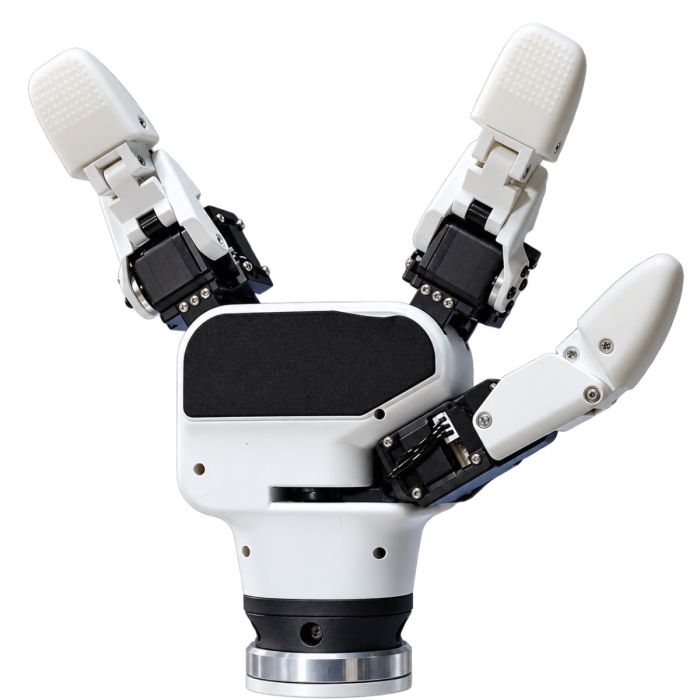
Most robotic grippers open and close like a pair of pliers; a hand with fingers and joints asks a different question of your research. The Elephant Robotics myGripper H100 Right Hand (4010700100) is a dexterous hand built for the lab bench and the classroom, where how an object is held matters as much as whether it is held at all.
The product is available through this page, by quotation.
Background
The company behind the hand
The myGripper H100 was developed by Shenzhen Elephant Robot Technology Co., Ltd., the company that markets its products under the Elephant Robotics name. Elephant Robotics is known for compact collaborative robot arms and the accessories around them, and the H100 sits in that family as an end-of-arm tool aimed at people who study and teach robotics. You can browse more of the maker's catalog on our Elephant Robotics page, or see related arms in the Cobots category.
The H100 was developed specifically for robot scientific research, teaching and related application scenarios. That purpose shapes the design: open communication, scripting support and real-time data matter more here than raw lifting capacity.
What sets the design apart
The H100 is a three-finger hand. The three fingers correspond to the human thumb, index finger and ring finger, which gives the hand a layout that resembles a human grasp while keeping the mechanism manageable. Six high-performance digital servo motors drive six movable joints, and the controller lets you work with several parameters at once: output torque, motion speed and absolute position.
Inside, the main control chip is an ESP32 with a 240MHz dual-core processor, 600 DMIPS, 520KB SRAM, Wi-Fi and dual-mode Bluetooth. The hand talks to your system over RS485 using the MODBUS protocol, and it supports high-frequency 100Hz communication so that the state of the hand can be watched in real time while it grasps. For a research group, this means grasp data can be collected at a steady rate without custom hardware in between.
This listing is the right-hand version. The line also includes a left-hand model and a left-plus-right combination, both described further below.
Technical Specifications
| Specification | Value |
|---|---|
| Product type | Three-finger dexterous robotic hand |
| Payload | 500g |
| Self-weight | 780g |
| Stroke (diameter) | 0 – 130mm |
| Motion speed | 60 degrees per second per joint |
| Number of fingers | 3 (thumb, index finger and ring finger equivalents) |
| Movable joints | 6 |
| Servo motors | 6 high-performance digital servo motors |
| Lifespan | 1,000,000 cycles or more |
| Power parameters | 24V, 2A |
| Electrical interface | M8 Pin aviation connector |
| Communication interface | RS485 |
| Protocol type | MODBUS |
| Communication frequency | 100Hz |
| Main control chip | ESP32 |
| Main control parameters | 240MHz dual-core, 600 DMIPS, 520KB SRAM, Wi-Fi, dual-mode Bluetooth |
| Software support | Python driver library via PyPI; ROS1 and ROS2 with RVIZ simulation |
| Fixing method | Screw fixing |
Specifications as published by the manufacturer; confirmed against the datasheet at quotation.
The manufacturer has not published the dimensions, the IP rating, the operating temperature range, the gripping force or the noise level; they are confirmed at quotation.
What makes the myGripper H100 different from a simple two-jaw gripper?
A parallel two-jaw gripper is excellent for repeatable pick-and-place of uniform parts, but it offers little insight into how a grasp is formed. The H100 has six movable joints across three fingers, so a user can shape the hand around an object and study the result. Because torque, speed and absolute position can each be controlled, a grasp can be gentle or firm, slow or quick, and the same routine can be repeated with one variable changed. That is the kind of control a student or researcher needs when comparing strategies.
The 100Hz communication is the second point of difference. During a grasp the host can read the status of the hand in real time, which fully meets the data collection needs of research environments. For work on learning-based manipulation or grasp analysis, a steady flow of state data is often more valuable than another few grams of payload.
Finally, the software side is open to the tools labs already use. A Python driver library can be installed from PyPI, and the hand works with both ROS1 and ROS2, including the RVIZ simulation environment, so the state of the robot can be displayed and real-time data collected from the same workstation that runs your experiments.
Is the Right Hand version the one for my setup?
The right-hand model is the correct choice when your project calls for a single hand mounted on the right side, or when you are replacing or adding to an existing right-hand unit. The figures for the H100 are the same across versions, so the choice is about handedness and quantity rather than capability. If you need a mirrored pair for two-handed or bimanual experiments, the Left + Right Hand version covers both sides in one order, while the Left Hand version suits a lab that already owns the right.
Who is the myGripper H100 Right Hand for?
University and institute labs are the most natural buyers. A three-finger hand with open communication, ROS support and a Python library fits a research workflow where code and data matter, and where the hand will be reprogrammed many times.
Educators and training centers form the second group. The H100 was developed with teaching in mind, and a hand that mirrors human finger layout makes lessons on grasping, kinematics and control easy to illustrate. Students can move from simulation in RVIZ to the physical hand without changing their software environment.
Developers and prototyping teams are a third group. If you are building a demonstration of dexterous manipulation, or testing whether a multi-finger approach suits your task before committing to a larger system, the H100 gives you a compact way to try it. Teams that want both hands should look at the combined version.
Buyers who need a lifting capacity far beyond 500g, or who need figures not listed in the table above, should ask us first so the details can be settled before an order is made.
What is the myGripper H100 Right Hand used for?
- Robotics research: studying grasp formation with controllable torque, speed and position across six joints.
- Data collection: logging the hand's state at 100Hz while it grasps, for analysis or for training models.
- Classroom teaching: showing students how a thumb-and-two-finger hand holds objects, using Python and ROS exercises.
- Simulation to hardware: developing in RVIZ with ROS1 or ROS2, then running the same logic on the physical hand.
- Custom control projects: driving the hand over RS485 with MODBUS from your own controller or software.
- Prototype demonstrations: building proof-of-concept manipulation tasks that need a hand-like grasp rather than a simple clamp.
Pricing and Availability
We do not list a price on this page. Quotation is the way to buy: tell us the version and quantity you need, and we will respond with the details. Delivery, customs and support are arranged together with the quotation, so you know the full picture before you commit. The Elephant Robotics myGripper H100 Right Hand (4010700100) is available on this page.
Frequently Asked Questions
How many fingers and joints does the myGripper H100 have?
It has three fingers, corresponding to the human thumb, index finger and ring finger, and six movable joints. Six digital servo motors drive the hand.
What payload can it handle?
The payload is 500g. The hand itself weighs 780g, and the stroke (diameter) is 0 – 130mm.
How do I connect and power it?
The hand uses an M8 Pin aviation connector and is powered at 24V, 2A. Communication runs over RS485 with the MODBUS protocol, and the hand is fixed in place with screws.
Which software does it work with?
A Python driver library is available through PyPI, and the hand is compatible with ROS1 and ROS2, including the RVIZ simulation environment.
How fast does it move and how long does it last?
Motion speed is 60 degrees per second per joint. The lifespan is 1,000,000 cycles or more.
What about gripping force, IP rating or size?
Dimensions, IP rating, operating temperature range, gripping force and noise level are not in the table above. Ask us when you request a quotation.
Where can I buy the myGripper H100 Right Hand and what does it cost?
You can buy it through this page by requesting a quotation. We do not print prices here; the quotation sets out the cost together with delivery, customs and support.
Summary
A hand earns its place when the question is how an object is held, not just whether it is held. The myGripper H100 Right Hand answers that with three fingers, six joints, six servo motors and a 100Hz data link, backed by Python, ROS1 and ROS2 support. It suits researchers, educators and prototype builders, and it comes in left, right and paired versions. To settle the open specifications and arrange delivery, this page is the starting point.