
Dobot LUMO L1 Humanoid Robot
In stock
- BRAND:
- DOBOT
- PART #:
- DBT-LUMO-L1
- ORIGIN:
- China
- Warranty:
- 12 MONTHS
- AVAILABILITY:
- SUBJECT TO AVAILABILITY
- SKU:
- Dobot-LUMO-L1
Dobot LUMO L1 Humanoid Robot
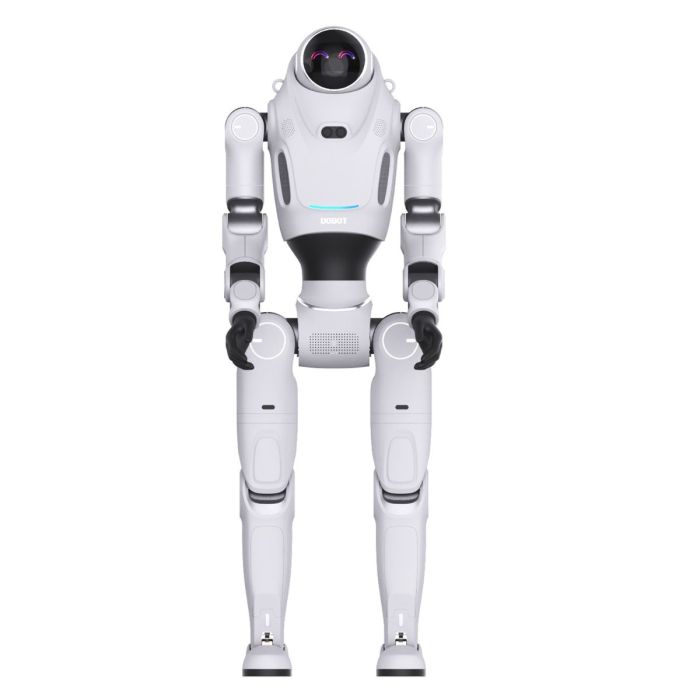
Most robots are asked to do one job well. A household companion, a classroom research platform and a front-of-house service unit usually mean three different machines, three sets of software and three budgets. The Dobot LUMO L1 Humanoid Robot is built on the opposite idea: one embodied AI humanoid that can sit with a family, teach a student and greet a customer, because it moves, expresses and learns in a human-like way.
The product is available through this page, by quotation.
Background
DOBOT and its road to humanoids
DOBOT is a robotics brand best known for compact robotic arms and for a growing family of embodied AI machines. Those machines include humanoids, wheeled humanoids, a six-legged bionic robot and a quadruped robot dog. Moving from arms to whole-body robots is a natural step for a company that already understands joints, torque and motion control. A humanoid is, in the end, a set of arms, legs and a head that must cooperate and keep their balance while the robot thinks.
LUMO L1 sits in the company's humanoid line as a versatile model. It is aimed at three groups of users: homes that want companionship, schools and laboratories that want a research and education platform, and businesses that want a robot for commercial service. If you are comparing robots of this type, our Bipedal Humanoids category and our Companion Robots category show the wider range.
Positioning and key technology
The LUMO L1 is a next-generation versatile embodied AI humanoid robot. Its software foundation is the self-developed DobotWAM Embodied AI Foundation Model. The body carries 30 degrees of freedom across the entire body, and the robot integrates high-precision navigation and obstacle avoidance systems to achieve a human-like gait and advanced dynamic performance.
Two details show what the robot is meant for. First, a bionic facial system with 15+ expressions works together with head movements and body language, so the robot can convey emotion more naturally. Second, a 5-zone capacitive touch sensor on the head lets people interact with it by touch as well as by sight and sound. The robot also supports secondary development, so it can be a teaching tool and not only a finished product.
It comes in two versions, the DOBOT LUMO L1 Standard and the DOBOT LUMO L1 Max. They share the same body and differ in weight and in AI computing, as the table below shows.
Technical Specifications
| Specification | LUMO L1 Standard | LUMO L1 Max |
|---|---|---|
| Product dimensions | 1240 mm(H) x 560 mm(W) x 244 mm(D) | 1240 mm(H) x 560 mm(W) x 244 mm(D) |
| Weight (with battery) | Approx. 40.5 kg | Approx. 41 kg |
| Total degrees of freedom | 30 across the entire body | 30 across the entire body |
| Operating time | Approx. 2 h (typical motion conditions) | Approx. 2 h (typical motion conditions) |
| Joint maximum torque | 130Nm | 130Nm |
| Single arm payload (without gripper) | 1.5kg | 1.5kg |
| AI computing | Rockchip RK3588, 6 TOPS | NVIDIA Jetson Thor T4000; 1,200 TFLOPS (FP4) |
| Communication method | Wi-Fi 6 (Support STA/AP), BLE 5.2 | Wi-Fi 6 (Support STA/AP), BLE 5.2 |
| Head touch sensor | 5-zone capacitive touch sensor | 5-zone capacitive touch sensor |
| Facial expressions | Bionic facial system, 15+ expressions | Bionic facial system, 15+ expressions |
| Remote controller | 1 included | 1 included |
| Battery | 1, packed separately | 1, packed separately |
Specifications as published by the manufacturer; confirmed against the datasheet at quotation.
The manufacturer has not published the walking speed, the battery capacity, the ingress protection rating, the charging time, the operating temperature range or the speaker and microphone specifications; they are confirmed at quotation.
What makes the LUMO L1 Standard different from the LUMO L1 Max?
The two versions have the same frame, the same 30 degrees of freedom, the same 130Nm joint maximum torque, the same 1.5kg single arm payload without gripper and the same operating time of approx. 2 h under typical motion conditions. The difference lies in two places. The Standard weighs approx. 40.5 kg with its battery, and the Max weighs approx. 41 kg.
The larger difference is the computing platform. The Standard uses a Rockchip RK3588 rated at 6 TOPS. The Max uses an NVIDIA Jetson Thor T4000 rated at 1,200 TFLOPS (FP4). The two ratings use different units, so they should not be set side by side as one simple ratio. What they do show is that the Max is built for a much heavier AI workload. For a team that wants to run its own embodied AI algorithms, visual perception or SLAM navigation, the choice of computing platform is the most important decision on the page.
If your use is mainly companionship, demonstration or teaching the basics of motion and interaction, the Standard covers the feature set in the table. If your project depends on heavier on-board computing, ask us about the Max when you request your quotation.
How does the LUMO L1 express itself?
A humanoid that only walks is a machine on legs. A humanoid that looks at you, tilts its head and changes its expression is a different experience. The LUMO L1 combines a bionic facial system of 15+ expressions with head movements and body language, a combination designed to convey emotion more naturally and to create human-like interactions.
The 5-zone capacitive touch sensor on the head adds a physical channel. A child or an elderly user can pat the robot and expect a response, and a visitor at a stand can try it without a screen or a menu.
The body supports natural walking, complex dance routines, kicking, flips and martial arts-inspired movements. These are dynamic, expressive actions, and they are as useful in a crowded exhibition hall as in a research lab. Wi-Fi 6 with STA/AP support and BLE 5.2 cover communication, and a remote controller is included in the package.
Who is the Dobot LUMO L1 Humanoid Robot for?
Families and individual enthusiasts are the first group. The robot is designed for home companionship, and its expressions and touch response suit people who want a lively presence at home. Anyone looking mainly at this role can also browse our Companion Robots category.
Universities, technical schools and research labs are the second group. Secondary development is supported for robotics, motion control, embodied AI algorithms, SLAM navigation, visual perception and human-robot interaction, so students can work with real hardware instead of simulations. Teams with demanding computing needs should look at the Max version, with its NVIDIA Jetson Thor T4000.
Businesses are the third group. Hotels, showrooms, museums, retail spaces and event organizers can use a humanoid to welcome visitors and draw a crowd. For these buyers the Standard is a reasonable starting point, and the Max is the choice when the project needs more on-board computing. Buyers who want to see the wider range of walking robots can visit our Bipedal Humanoids category.
What is the Dobot LUMO L1 used for?
- Home companionship: a responsive robot that expresses emotion through its face, head and body language and reacts to touch.
- Research on embodied AI: a platform for testing algorithms on a physical body with 30 degrees of freedom.
- Teaching robotics: hands-on study of motion control, SLAM navigation, visual perception and human-robot interaction.
- Commercial service: a humanoid that greets and engages people in public or customer-facing spaces.
- Demonstrations and exhibitions: dance routines, kicks, flips and martial arts-inspired movements that hold an audience.
- Secondary development projects: custom software built on the DobotWAM Embodied AI Foundation Model and the supported development areas.
Pricing and Availability
Prices are given by quotation, not printed on the page. Send us your request, tell us whether you want the Standard or the Max, and we will respond with a quotation. Delivery, customs and support are arranged with the quotation. The Dobot LUMO L1 Humanoid Robot is available on this page.
Frequently Asked Questions
What is the difference between the Standard and the Max?
The weight is approx. 40.5 kg for the Standard and approx. 41 kg for the Max. The Standard uses a Rockchip RK3588 at 6 TOPS, and the Max uses an NVIDIA Jetson Thor T4000 at 1,200 TFLOPS (FP4).
How long does the battery run?
The operating time is approx. 2 h under typical motion conditions. Ask us for the battery capacity and the charging time when you request your quotation.
How tall is the robot?
The product dimensions are 1240 mm(H) x 560 mm(W) x 244 mm(D) for both versions.
Can I develop my own software for it?
Yes. The robot supports secondary development for robotics, motion control, embodied AI algorithms, SLAM navigation, visual perception and human-robot interaction.
What does it come with?
One remote controller is included, and one battery is supplied, packed separately.
How does it connect?
It uses Wi-Fi 6 with STA/AP support and BLE 5.2.
Where can I buy the Dobot LUMO L1 Humanoid Robot and what does it cost?
You can request it through this page. The cost is given by quotation for the version you choose, and delivery, customs and support are arranged together with it.
Summary
The LUMO L1 answers a simple question: what if one humanoid could serve a living room, a classroom and a showroom? It does so with 30 degrees of freedom, a bionic face with 15+ expressions, a 5-zone touch sensor on the head and the DobotWAM Embodied AI Foundation Model. The Standard and the Max share the same body and differ in weight and computing power, so you can match the version to the work. If you are ready to compare them for your project, this page is the starting point.


