
Agilex TRACER 2.0
In stock
- BRAND:
- AGILEX
- PART #:
- TRACER 2.0
- ORIGIN:
- China
- AVAILABILITY:
- SUBJECT TO AVAILABILITY
- SKU:
- AgileX-TRACER-2.0
Agilex TRACER 2.0
Most indoor robots force a trade: either they are small enough to fit between benches and shelving, or strong enough to carry something worth moving. The Agilex TRACER 2.0 is built to refuse that trade. It is a compact two-wheel differential AGV for smart indoor logistics and robotics R&D, and it delivers more speed and strength in the same small footprint as before. For a team that needs a dependable base to build on, that is the whole appeal.
The product is available through this page, by quotation.
Background
AgileX and the TRACER lineage
AgileX Robotics builds mobile robot platforms for research labs, universities and industrial integrators. Its catalog covers wheeled chassis, tracked vehicles and kits for manipulation and autonomy, and you can browse the wider range in the AgileX category. Within that family, the TRACER line is the compact indoor option: a low, two-wheel differential base meant to carry sensors, computers and application hardware rather than to be a finished robot on its own.
The 2.0 generation keeps the small footprint but raises the working figures: 400W motor power, 2 m/s speed and 150KG payload. The 30AH battery doubles runtime for high-demand operations. For teams that already know the earlier TRACER idea, this is the same concept with more headroom.
Positioning and key technology
TRACER 2.0 is positioned as a drive platform for smart indoor logistics and for robotics R&D. In practice that means it sits between a toy-grade educational base and a fully engineered commercial delivery robot. You get a solid chassis, a motor and battery system, and open interfaces, and you add the rest.
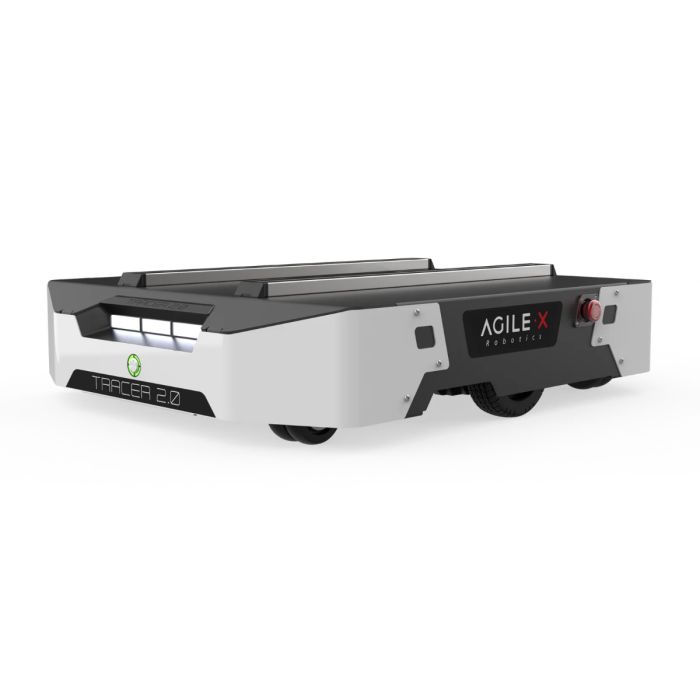
Several design choices support that role. An enhanced triple-arm structure keeps movement precise under load. The suspension is a swing arm, non-independent design. Aluminum T-slot rails on the body give you a secure way to mount external sensors or kits without drilling into the frame. On the software side, the platform supports the CAN bus protocol and comes with open-source SDK and software resources, plus documentation and examples for integration.
Technical Specifications
| Specification | Value |
|---|---|
| Product type | Compact two-wheel differential AGV |
| Dimensions | 702mm x 610mm x 169mm |
| Weight | 54-56kg |
| Motor | 2×400W Brushless motor |
| Speed | 2 m/s |
| Payload | 150KG |
| Battery | 24V 30Ah Lithium battery |
| Braking distance | 0.9m (Empty, deceleration 0.5) |
| Suspension | Swing arm non-independent suspension |
| Obstacle handling | 10 mm steps and 25 mm gaps |
| Protection | IP22 |
| Operating temperature | -10~40°C |
| Mounting | Aluminum T-slot rails |
| Communication | CAN bus protocol |
| ROS support | ROS 1 (Melodic, Noetic) and ROS 2 (Foxy, Humble) |
| Software | Open-source SDK and software resources |
Specifications as published by the manufacturer; confirmed against the datasheet at quotation.
The manufacturer has not published the package contents, the list of communication interfaces, whether a controller or remote is included, or the certifications; they are confirmed at quotation.
What makes TRACER 2.0 different from a typical small research base?
The first difference is how much it carries for its size. A body only 169mm high that carries 150KG gives integrators room to mount bins, shelves, inspection rigs or other equipment without moving to a much larger vehicle. Two 400W brushless motors and a top speed of 2 m/s mean the platform keeps pace with indoor logistics work instead of crawling.
The second difference is endurance. The 24V 30Ah lithium battery doubles runtime for high-demand operations. For a research team running long test sessions, or a pilot site where the robot should not return to the charger constantly, that matters more than a headline speed figure.
The third is the physical toughness of the chassis. The triple-arm structure and swing arm suspension keep movement controlled under load, and the platform handles 10 mm steps and 25 mm gaps. Indoor floors are rarely perfect: door thresholds, floor joints and cable covers are everyday obstacles, and a base that crosses them calmly saves integration headaches. With IP22 protection and a temperature range of -10~40°C, it is meant for indoor use, not wet or dusty outdoor work.
How open is TRACER 2.0 for software and sensor integration?
Quite open, and that is deliberate. The platform supports the CAN bus protocol for connections, and open-source SDK and software resources are provided. It works with ROS 1 (Melodic, Noetic) and ROS 2 (Foxy, Humble), and comes with full SDK documentation and examples. Teams that build on ROS can usually bring their own navigation stack, mapping tools and perception pipeline and connect them to the base.
On the hardware side, the aluminum T-slot rails let you attach lidar, cameras, compute modules or custom kits securely and reposition them as the project changes. This is why the platform suits R&D: you can start with a bare base, add one sensor at a time, and keep the mounting flexible. Because the integrator builds the complete system, you also stay in charge of the application-level safety design for the final machine.
Who is TRACER 2.0 for?
University labs and research institutes are the clearest fit. They need a base that is robust enough for daily use, documented well enough for students to learn on, and open enough to support new ideas in navigation, perception or multi-robot work.
Robotics integrators and system builders are a second group. If you are developing a transport robot for warehouses, workshops or production floors, TRACER 2.0 provides a proven chassis, motors, battery and CAN interface so that your effort goes into the application. Companies running pilot projects for indoor material handling will find the same logic: prove the concept on a standard base before committing to a custom design.
If your work is mainly outdoors, or needs a different drive layout, look at the other platforms in the AgileX range. Our team can help you compare options when you request a quotation.
What is TRACER 2.0 used for?
- Indoor logistics prototypes. Carry bins, totes or small shelving between stations in warehouses and workshops.
- Robotics research. Test navigation, SLAM and control algorithms on a stable differential-drive base with ROS 1 and ROS 2 support.
- Teaching and student projects. Give engineering students a real mobile platform with open SDK resources and examples.
- Sensor and payload testing. Mount lidar, cameras or custom kits on the T-slot rails and evaluate them in realistic indoor conditions.
- Tight-space transport. Move loads through aisles, labs and corridors where a compact two-wheel base can turn and fit.
- Custom AGV development. Use the chassis as the foundation for a purpose-built automated vehicle through the CAN bus interface.
Pricing and Availability
We do not publish prices on this page. Please request a quotation, and we will respond with the details for your project. Delivery, customs and support are arranged together with the quotation, so you know what to expect before you commit. The Agilex TRACER 2.0 is available on this page.
Frequently Asked Questions
What payload can TRACER 2.0 carry?
The payload is 150KG. Braking distance is 0.9m when empty at deceleration 0.5.
How fast does it travel?
The speed is 2 m/s, driven by two 400W brushless motors.
Can it be used with ROS?
Yes. It works with ROS 1 (Melodic, Noetic) and ROS 2 (Foxy, Humble), and SDK documentation and examples are included.
What battery does it use?
It uses a 24V 30Ah lithium battery, which doubles runtime for high-demand operations.
Is it suitable for outdoor use?
It is intended for indoor logistics and R&D. It carries IP22 protection and an operating range of -10~40°C, so it is not designed for wet outdoor conditions.
How do I attach sensors?
Aluminum T-slot rails on the body provide secure mounting for external sensors or kits. Connections use the CAN bus protocol.
Where can I buy TRACER 2.0 and what does it cost?
You can buy it through this page by requesting a quotation. We do not list a price here; the quotation covers the cost, delivery, customs and support for your order.
Summary
The Agilex TRACER 2.0 answers the old indoor-robot dilemma with a low, compact body that still carries 150KG, moves at 2 m/s and runs on a 24V 30Ah lithium battery. Its open CAN bus interface, ROS support, SDK resources and T-slot rails make it a practical base for labs, integrators and pilot projects. If you are ready to build on a small platform with real strength, this page is the starting point.