
Agilex Scout Mini 4WD Mobile Robot
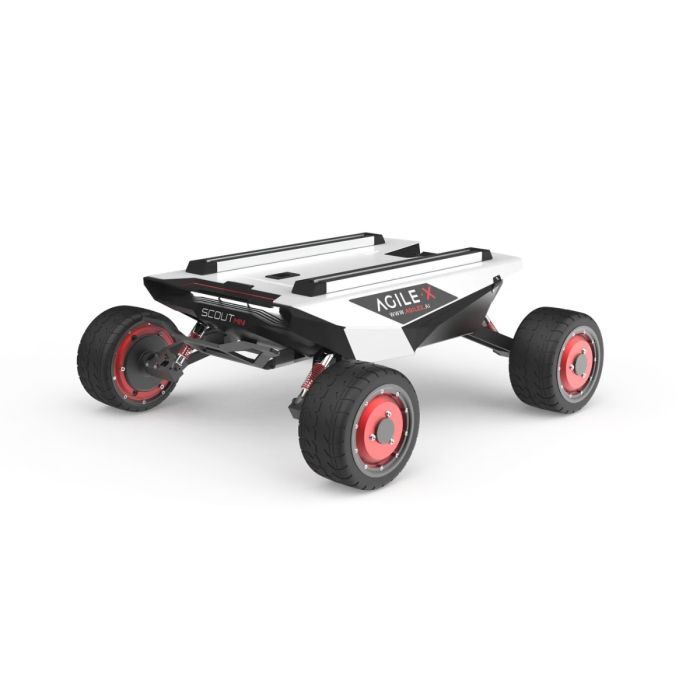
In stock
- BRAND:
- AGILEX
- PART #:
- SCOUT MINI
- ORIGIN:
- China
- AVAILABILITY:
- SUBJECT TO AVAILABILITY
- SKU:
- AgileX-Scout-Mini
Agilex Scout Mini 4WD Mobile Robot
Most robot bases force a choice: stay small enough for the lab, or grow big enough for the yard. The Agilex Scout Mini 4WD Mobile Robot is built for teams that refuse that trade. It is a small four-wheel-drive platform with independent suspension and rugged off-road tires, made to carry your own sensors, computers and code into places a desktop robot would never go.
The Agilex Scout Mini 4WD Mobile Robot is available through this page, by quotation.
Background
AgileX and the Scout family
AGILEX builds mobile robot platforms for developers, universities and integrators who would rather spend their time on software and sensing than on welding chassis. The Scout Mini sits in that tradition. It is a ground platform meant to be extended: the maker provides the drive base, the communication interfaces and the open software, and the user adds the rest. Other AgileX platforms are listed in the AgileX category, and the Scout Mini is the small, quick member of that group.
Several versions of the platform exist: the standard SCOUT MINI, the SCOUT MINI Off-road Version, the SCOUT MINI Wheat Wheel Edition and the SCOUT MINI with mecanum wheels. The figures in this article belong to the SCOUT MINI and its optional mecanum wheel package; none are given here for the other versions.
Positioning and key technology
The Scout Mini is a high-speed mini mobile robot with four-wheel drive, independent suspension and a lightweight power system, reaching a maximum speed of 10 km/h. Each wheel has its own servo drive, and the suspension is a double wishbone design. Together they let the robot climb 30° slopes. The motors are DC brushless units, four of them at 150W each.
A robot base earns its keep through what you can bolt onto it. The Scout Mini has aluminum T-slot rails on top for mounting external sensors or kits. It supports the CAN bus protocol for connections and is fitted with a serial port interface as well. Open-source packages are available for C++ and ROS, so a team can write its own control and navigation software on top of the platform instead of working around a closed system.
Technical Specifications
| Specification | Value |
|---|---|
| Drive | Four-wheel independent servo drive |
| Suspension | Double wishbone |
| Motors | DC brushless, 4 x 150W |
| Battery | 24V15Ah |
| Maximum speed | 10 km/h |
| Payload | 10 kg over long distances; up to 50 kg for shorter distances |
| Clearance | 115 mm |
| Obstacle height | 70 mm |
| Slope climbing | 30°, also with a payload |
| Max travel | 10 km |
| Protection level | IP22 |
| Communication interfaces | CAN, serial port (RS232) |
| Mounting | Aluminum T-slot rails |
| Software | Open-source SDK; packages for C++ and ROS |
| Optional wheels | Mecanum wheels package for omnidirectional driving |
Specifications as published by the manufacturer; confirmed against the datasheet at quotation.
The manufacturer has not published the net weight, the overall dimensions, the charging time, the operating temperature, the package contents, the remote controller details or the onboard computer; they are confirmed at quotation.
What makes the Scout Mini different from a typical indoor research base?
Many compact research bases are designed around smooth floors. They work well in a corridor and struggle on anything else. The Scout Mini starts from a different assumption. Its independent suspension keeps all four wheels working on uneven ground, its off-road tires are chosen for difficult surfaces, and its 115 mm clearance and 70 mm obstacle height let it deal with the kerbs, ruts and loose material common outdoors.
The drive system matters as much as the chassis. Four independently driven wheels and four 150W brushless motors give the platform the power to carry a working load rather than just itself. The payload is 10 kg over long distances and up to 50 kg for shorter distances, with slope climbing of 30° under load. For a team that wants to test a sensor mast, a small manipulator or a compute stack in realistic terrain, those are the figures that decide whether a platform is useful.
The platform is also open. A closed robot gives you a finished behavior and little else. The Scout Mini gives you CAN bus access, a serial interface, an open-source SDK and ROS support, so the behavior is yours to write.
Should I choose standard wheels or mecanum wheels?
The standard configuration steers by driving the wheels on each side at different speeds. It is simple and well suited to open ground and outdoor use. The optional mecanum wheels package allows the Scout Mini to drive omnidirectionally, so the robot can move sideways and position itself precisely in tight spaces.
The choice follows your work. If the robot mainly travels from one point to another over rough ground, standard wheels fit the purpose. If it has to maneuver in confined areas, such as a workshop, a test bay or a lab, the mecanum option is worth discussing. Tell us which you need when you request a quotation.
Who is the Scout Mini for?
Universities and technical schools are a natural fit. Students can learn mobile robotics on a real platform with real terrain, using ROS and C++ tools that match what they will meet in industry. The open software lowers the barrier, and the sturdy build tolerates the knocks that come with teaching.
Research and development groups use a base like this to test navigation, mapping and sensor fusion before committing to a larger, more expensive vehicle. The T-slot rails make it easy to change the sensor layout between experiments.
Integrators and prototype builders can use the Scout Mini as the moving part of a custom machine: an inspection cart, a small delivery platform or a mobile sensor station. For these buyers the payload figures and the CAN interface are the main points to check.
If you are weighing it against other platforms in the same range, the AgileX category shows the alternatives, and we can help compare them.
What is the Scout Mini used for?
- Teaching mobile robotics. A real four-wheel-drive platform for courses in navigation, control and ROS.
- Autonomous navigation research. A moving base for mapping, localization and path-planning experiments on varied ground.
- Sensor testing. Cameras, LiDAR and other instruments mounted on the T-slot rails and tested in motion.
- Prototype vehicles. A ready drive base for building custom carts, carriers and inspection machines.
- Outdoor field trials. Grass, gravel and slopes up to 30° where indoor bases would stall.
- Secondary development. Custom control software written through the CAN interface and the C++ and ROS packages.
Pricing and Availability
We do not list prices on this page. Quotation is the way to buy: tell us the version, the wheel type and the quantity you need, and we will prepare an offer. Delivery, customs and support are arranged with the quotation, so you know the full picture before you commit. The Agilex Scout Mini 4WD Mobile Robot is available on this page.
Frequently Asked Questions
How fast is the Scout Mini?
The maximum speed is 10 km/h.
What payload can it carry?
The payload is 10 kg over long distances and up to 50 kg for shorter distances.
Can it climb slopes?
Yes. It climbs 30° slopes, and it can traverse 30° slopes with a payload.
How do I connect my own sensors and computer?
The aluminum T-slot rails hold external sensors and kits. For communication, the platform has a CAN interface and a serial port interface.
Does it work with ROS?
Yes. Open-source packages are available for C++ and ROS, along with an open-source SDK and software resources.
Is a mecanum wheel version available?
An optional mecanum wheels package allows omnidirectional driving. Ask for it when you request your quotation.
Where can I buy the Scout Mini and what does it cost?
You can buy it through this page by requesting a quotation. The cost depends on the version, options and quantity, so we give it in the quotation instead of printing a price here.
Summary
The Scout Mini answers the question of how to keep a robot small without keeping it indoors. Four independent drive wheels, double wishbone suspension, off-road tires and a 24V15Ah battery give it the footing for rough ground, while the T-slot rails, CAN interface and ROS support leave the real work to your own sensors and code. Choose standard or mecanum wheels, and if the Scout Mini fits your project, this page is the starting point.


