
Agilex LIMO ROS2 (LIMO ROS2)
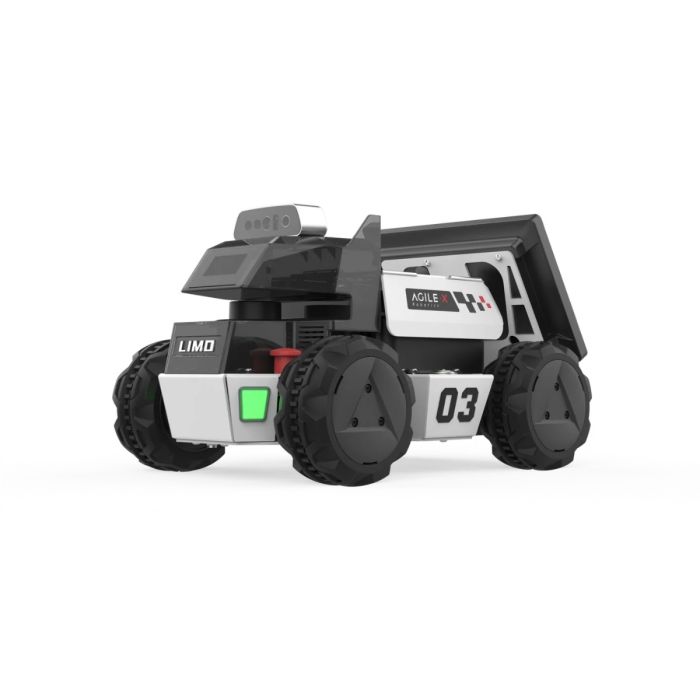
In stock
- BRAND:
- AGILEX
- PART #:
- LIMO ROS2
- ORIGIN:
- China
- AVAILABILITY:
- SUBJECT TO AVAILABILITY
- SKU:
- AgileX-LIMO-ROS2
Agilex LIMO ROS2 (LIMO ROS2)
Most robotics classrooms hit the same wall: the students understand the theory of mapping and navigation, but the robot on the bench runs an old software stack that nobody wants to build a career on. The Agilex LIMO ROS2 (LIMO ROS2) is built to remove that wall. It is a compact mobile robot that arrives with ROS 2 Humble on Ubuntu 22.04, a LiDAR, a depth camera and a simulation table, so the first day of work can be spent on algorithms instead of installation.
The Agilex LIMO ROS2 (LIMO ROS2) is available through this page, by quotation.
Background
AgileX Robotics and the LIMO line
The maker is AgileX Robotics CO,.ltd., a company based in China that builds mobile robot platforms for research, education and development work. You can browse more of its range in the AgileX category. Within that range, the LIMO name covers a small family of desktop-sized robots. The sources describe three versions: LIMO, LIMO PRO and LIMO ROS2.
What separates the versions is mainly the software generation they are built around. The LIMO ROS2 is the one aimed squarely at ROS 2 Humble. A ROS 2 package named Limo_ros2 exists for the series and is listed as compatible with LIMO, LIMO PRO and LIMO ROS2, so teams that already know one member of the family will find the others familiar.
Positioning and key technology
The LIMO ROS2 sits between a teaching toy and a full industrial vehicle. Its computing unit is an Intel NUC i7 running ROS 2 Humble on Ubuntu 22.04. This gives full access to open-source libraries for vision, navigation and motion, and it makes quick implementation of ROS and ROS 2 functions possible.
The sensing is a pairing of an EAI T-mini Pro LiDAR and an Orbbec Dabai depth camera. Together they support mapping, autonomous localization, navigation planning and dynamic obstacle avoidance. The battery capacity has been increased to 10000mAh, which greatly improves power and operational stability.
The platform also integrates two key open-source frameworks of the ROS 2 world: Navigation2 for mobile robot navigation and MoveIt2 for motion planning of robotic arms. That makes it a useful stepping stone for anyone who plans to move from a mobile base to mobile manipulation later.
Technical Specifications
| Specification | Value |
|---|---|
| Computing unit | Intel NUC i7 |
| Operating system | Ubuntu 22.04 |
| ROS version | ROS 2 Humble |
| LiDAR | EAI T-mini Pro |
| Depth camera | Orbbec Dabai |
| Battery capacity | 10000mAh |
| Dimensions | 322*220*251mm |
| Weight | 4.8kg |
| Control method | Mobile App / Command Control |
| Simulation and languages | ROS and Gazebo; Python and C++ |
Specifications as published by the manufacturer; confirmed against the datasheet at quotation.
The manufacturer has not published the payload, the maximum speed, the runtime, the IP rating, the operating temperature range, the contents of the box, the minimum turning radius or the maximum climbing angle; they are confirmed at quotation.
What makes the LIMO ROS2 different from the other LIMO versions?
The short answer is the software generation. The sources list the ROS version for the LIMO ROS2 as ROS 2 Humble on Ubuntu 22.04. Humble is a long-term support release of ROS 2, which matters for classrooms and labs that want a stack that stays supported for the length of a course or a research project.
The second difference is the way the platform is meant to be used. The LIMO ROS2 offers the opportunity to explore the latest features of ROS 2, with Navigation2 and MoveIt2 already part of the picture. Teams that start on ROS 2 today avoid a later migration from an older framework, which is often the most tedious part of a robotics project.
The Intel NUC i7 is also worth a thought. It simplifies the development and deployment of AMR software using ROS 2, and it supports deep learning work. A robot that carries its own capable computer can run perception and planning on board instead of depending on a laptop tethered over a network.
What can you actually run on it?
Out of the box the sources name three demonstration functions: Vision Line Following, YOLO Object Recognition, and Target Detection and Tracking Control. They are a practical way to show a class or a client what the sensors do, and each one can be taken apart and rebuilt as a student exercise.
The platform supports ROS and Gazebo, and it is compatible with Python and C++. Those two languages cover the vast majority of what robotics teams write, so there is no special language to learn. It also comes with a specially designed simulation table, which gives you a defined space for repeatable experiments on the desk instead of in a hallway.
Control is by mobile app or by command, so a beginner can drive the robot in minutes while a more advanced user works through the ROS 2 interfaces.
Who is the LIMO ROS2 for?
Universities and technical colleges are the obvious first group. A robot that fits on a table, runs a current ROS 2 release and includes a simulation table suits laboratory courses in navigation, perception and control. Several students can work with one unit without a large dedicated floor area.
Research groups form the second segment. Those prototyping AMR software, testing SLAM and navigation ideas, or trying out deep learning models for object recognition will value the on-board Intel NUC i7 and the LiDAR plus depth camera combination.
Training centers and makers across the Caribbean who want to build local robotics skills are a third group. The platform lets a teacher show the full chain from sensing to mapping to navigation on a single desk. Integrators evaluating autonomous navigation before committing to a larger vehicle can use it as a low-risk proving ground. Buyers who need a larger vehicle or a robotic arm can look at the other products in the AgileX category.
What is the LIMO ROS2 used for?
- Teaching ROS 2. Students learn nodes, topics and packages on a current Humble installation.
- Mapping and localization. The LiDAR and depth camera build maps and let the robot find its place in them.
- Navigation planning. Navigation2 is integrated for mobile robot navigation and path planning.
- Obstacle avoidance. The sensor suite supports dynamic obstacle avoidance in changing surroundings.
- Vision experiments. Line following, YOLO object recognition and target tracking are demonstration functions.
- Simulation and prototyping. Gazebo and the simulation table let teams test ideas before running them elsewhere.
Pricing and Availability
We do not print prices on this page. A quotation is the way to buy: tell us how many units you need and where they are going, and we respond with a quotation. Delivery, customs and support are arranged together with the quotation, so you know the full picture before you commit. The Agilex LIMO ROS2 (LIMO ROS2) is available on this page.
Frequently Asked Questions
Which software does the LIMO ROS2 run?
It runs ROS 2 Humble on Ubuntu 22.04, on an Intel NUC i7 computing unit. It supports ROS and Gazebo and is compatible with Python and C++.
Which sensors does it carry?
It has an EAI T-mini Pro LiDAR and an Orbbec Dabai depth camera. They support mapping, localization, navigation planning and obstacle avoidance.
How big is the battery?
The battery capacity is 10000mAh.
What are its size and weight?
The dimensions are 322*220*251mm and the weight is 4.8kg.
Can I use it for navigation and arm planning?
Yes. It integrates Navigation2 for mobile robot navigation and MoveIt2 for robotic arm motion planning.
How is it controlled?
You can control it with a mobile app or with commands. The ROS 2 package Limo_ros2 is compatible with LIMO, LIMO PRO and LIMO ROS2.
Where can I buy the LIMO ROS2 and what does it cost?
You can buy it through this page by requesting a quotation. The cost is given in the quotation together with delivery, customs and support arrangements; no price is printed here.
Summary
The wall between theory and a working robot is usually built from setup time and outdated software. The Agilex LIMO ROS2 (LIMO ROS2) tackles both: an Intel NUC i7 running ROS 2 Humble on Ubuntu 22.04, an EAI T-mini Pro LiDAR, an Orbbec Dabai depth camera, a 10000mAh battery and a simulation table, in a body measuring 322*220*251mm and weighing 4.8kg. For schools, labs and integrators who want to work with current ROS 2 tools from the first day, this page is the starting point.


