
Agilex HUNTER SE (HUNTER SE)
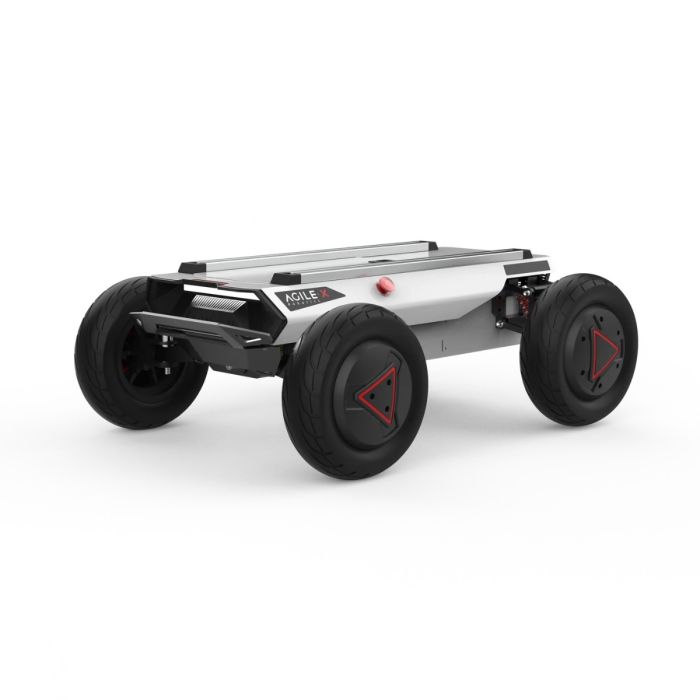
In stock
- BRAND:
- AGILEX
- PART #:
- HUNTER SE
- ORIGIN:
- China
- AVAILABILITY:
- SUBJECT TO AVAILABILITY
- SKU:
- AgileX-HUNTER-SE
Agilex HUNTER SE (HUNTER SE)
Most small robots turn like a shopping cart with a mind of its own. The Agilex HUNTER SE (HUNTER SE) turns like a car. Its Ackermann steering gives developers a chassis that sweeps through a bend, holds a predictable line and reaches a speed of 4.8 m/s, which suits the roads, paths and forecourts of an urban site far better than a platform that spins on the spot.
The product is available through this page, by quotation.
Background
AgileX Robotics and the HUNTER lineage
AgileX Robotics was founded in 2016 and describes its mission as advancing embodied intelligence and accelerating the global commercialization of robotics through full-stack robotic technologies and an open-source ecosystem. That open approach shows in the HUNTER SE: it supports the CAN bus protocol and comes with an open-source SDK and software resources, so engineers are not locked out of the machine they buy.
The HUNTER SE belongs to the HUNTER series. Its power system upgrades the sleek design of that series with an all-steel body, and it now features the latest wheeled motor structure technology. For teams that already know the series, the SE is the version built around higher speed and a sturdier shell. You can see the wider range of platforms from the manufacturer in the AgileX category.
Positioning and key technology
The HUNTER SE is an Ackermann steering wheeled robot designed for the challenging road conditions and speed requirements of urban areas. The aim is car-like driving capability for high speed autonomous applications. Ackermann geometry is the same principle used in passenger vehicles: the front wheels steer, the rear wheels drive, and the robot follows arcs instead of pivoting. For a navigation stack, that means motion models that resemble a real vehicle, which is useful when you are developing software that will one day run on something larger.
The design is modular, which allows easy reconfiguration and makes the platform adaptable to many functions. Aluminum T-slot rails provide secure mounting for external sensors or kits, so a lidar, a camera mast or a small enclosure can be fitted and moved as the project changes. Underneath, a swing arm suspension lets the robot pass common obstacles such as speed bumps.
Technical Specifications
| Specification | Value |
|---|---|
| Type | Ackermann steering wheeled robot |
| Speed | 4.8 m/s |
| Payload | 50 KG |
| Platform weight | 42Kg |
| Body | All-steel body |
| Battery | 24V30Ah Lithium Battery |
| Motors | 350W*2 (Brushless DC motor) |
| Minimum turning radius | 1.9m |
| Ground clearance | 120 mm |
| Mounting | Aluminum T-slot rails |
| Communication | CAN bus, CAN2.0B standard, baud rate 500K, MOTOROLA message format |
| ROS compatibility | ROS1 / ROS2 |
| Water resistance | Not waterproof |
Specifications as published by the manufacturer; confirmed against the datasheet at quotation.
The manufacturer has not published the dimensions, the IP rating, the runtime, the climbing ability, the charging time, the box contents, the certifications or the onboard sensors; they are confirmed at quotation.
What makes the HUNTER SE different from a skid-steer or differential-drive robot?
The difference starts with how the robot turns. A skid-steer or differential-drive base changes direction by running its sides at different speeds, which scrubs the tires and makes its path harder to predict at speed. The HUNTER SE steers its wheels the way a car does, with a minimum turning radius of 1.9m. That figure is a fact to plan around: the robot needs room to turn, and your route planning should respect it from the first simulation.
In return you get a platform that behaves like a vehicle. Linear velocity and steering angle are the two quantities that command its motion, and both can be controlled through the external CAN bus interface. That is a clean, small control surface. A planner that outputs a speed and a steering angle maps directly onto it, and the CAN2.0B standard at a baud rate of 500K with the MOTOROLA message format is documented for those who write their own drivers.
Software support removes much of the remaining friction. The platform is compatible with ROS1 and ROS2, and the open-source SDK and software resources are there for extended capabilities. A university lab or an integrator can therefore start with familiar tools rather than a proprietary stack.
The mechanical choices point the same way. The all-steel body gives the platform a sturdy shell, two 350W brushless DC motors drive it, and the 24V30Ah lithium battery powers it. The platform weighs 42Kg and carries a maximum load of 50 KG, which is enough for a sensor mast, a compute box and a small cargo module. Ground clearance is 120 mm.
What are the limits of the HUNTER SE?
Honesty about limits saves projects. The HUNTER SE is not designed for all-terrain use. Its swing arm suspension handles common obstacles such as speed bumps, but it is meant for roads, paved paths and similar surfaces rather than loose, steep or broken ground. It is also not waterproof, so it should not be operated in rain, standing water or wash-down conditions. If your site is rough or wet, compare the other platforms in the AgileX range before you commit.
Who is the HUNTER SE for?
University and institute labs are the natural first buyers. Ackermann kinematics are what autonomous-driving courses teach, and a robot that follows those rules lets students test planning, localization and control on real hardware at a manageable scale.
System integrators and start-ups building delivery, logistics or patrol prototypes form the second group. The T-slot rails let them mount their own sensors and cargo kits, and the CAN interface lets them connect their own computers. Because the speed and steering geometry resemble a road vehicle, early results transfer more readily to larger machines.
Facility and campus operators with paved routes, such as resorts, ports, industrial yards or school grounds, may also find it a good base for pilot projects in inspection or light transport. Those who need rough-terrain capability or wet-weather operation should look elsewhere in the range.
What is the HUNTER SE used for?
- Autonomous driving research: test planning and control on a platform that steers like a car.
- Urban delivery prototypes: carry a light load along paved routes with a vehicle-like motion model.
- Patrol and inspection pilots: mount cameras or lidar on the T-slot rails and run set routes.
- Sensor and kit integration: reconfigure the modular platform to suit each experiment.
- ROS development: build and test navigation software under ROS1 or ROS2.
- Teaching and training: give students hands-on experience with CAN control and Ackermann kinematics.
Pricing and Availability
We do not print prices on this page. Quotation is the way to proceed: tell us your application, your sensors and your quantity, and we will respond with a quotation. Delivery, customs and support are arranged together with the quotation, so nothing is left to chance after you decide. The Agilex HUNTER SE (HUNTER SE) is available on this page.
Frequently Asked Questions
How fast is the HUNTER SE?
The manufacturer states a speed of 4.8 m/s, made possible by the latest wheeled motor structure technology.
What payload can it carry?
The maximum load is 50 KG. The platform itself weighs 42Kg.
How is it controlled?
Linear velocity and steering angle are controlled through the external CAN bus interface, using the CAN2.0B standard at 500K with the MOTOROLA message format.
Does it work with ROS?
Yes. It is compatible with ROS1 and ROS2, and an open-source SDK and software resources are provided.
Can it be used outdoors in the rain?
No. The HUNTER SE is not waterproof and is not designed for all-terrain use. It is intended for roads and similar surfaces.
Can I mount my own sensors?
Yes. Aluminum T-slot rails provide secure mounting for external sensors or kits, and the modular design allows easy reconfiguration.
Where can I buy the HUNTER SE and what does it cost?
You can request a quotation on this page. The cost depends on your configuration and quantity, and it is given in the quotation rather than printed here.
Summary
The Agilex HUNTER SE (HUNTER SE) takes the way a car steers and puts it on a research-ready platform: Ackermann geometry, a speed of 4.8 m/s, an all-steel body, T-slot rails, a CAN interface and ROS1 and ROS2 compatibility. It is honest about its limits, since it is neither all-terrain nor waterproof, and it rewards teams whose routes are paved and whose software needs a predictable vehicle. If that matches your project, this page is the starting point.


