
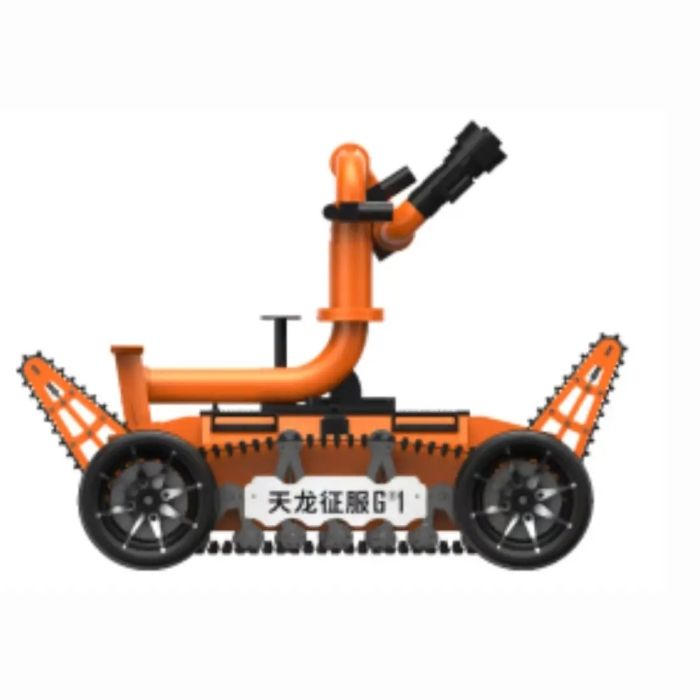
Topsky All-terrain fire fighting robot
In stock
- BRAND:
- TOPSKY
- MODEL:
- RXR-M80LGD
- PART #:
- RXR-M80LGD
- ORIGIN:
- China
- Warranty:
- 12 MONTHS
- AVAILABILITY:
- SUBJECT TO AVAILABILITY
- SKU:
- Topsky-RXR-M80LGD
Topsky All-terrain fire fighting robot
Most firefighting equipment is designed around the people who carry it. The Topsky All-terrain fire fighting robot, model Topsky-RXR-M80LGD, is designed around the place nobody should have to stand: a smoke-filled approach, a rubble-strewn yard, a slope slick with runoff. It puts a remotely controlled water monitor on a heavy tracked chassis and sends the machine ahead of the crew.
The product is available through this page, by quotation.
Background
The brand and the class of machine
TOPSKY is the brand behind a family of firefighting and reconnaissance robots. The range runs from small reconnaissance units to heavier fire extinguishing machines. Robots of this class are unmanned ground vehicles. They are driven by an operator at a safe distance and carry a working tool, here a water monitor, into conditions that are dangerous for people. Fire services, industrial fire brigades and rescue organizations use them where heat, smoke or unstable ground makes a manual approach unwise.
Within that family, the RXR-M80LGD is the all-terrain water-monitor model. Its job is to reach a firefighting position and deliver a large stream of water from there. For related machines, see the category Firefighting Robots.
Positioning and key technology
The RXR-M80LGD combines three ideas in one chassis. The structure is a track system with front and rear four-arm swing arms and tires. The tires are full metal, built for high-temperature environments. The drive is a DC motor powered by a large-capacity battery, and the control system uses a modular, distributed design.
The tracks give traction on loose or uneven ground. The swing arms help the machine go over obstacles and steep changes in level. The monitor on top offers spray and jet modes, a shoot and rod angle switch, and a swing function. Together they make a platform that can travel to a position and then work from it.
Technical Specifications
| Specification | Value |
|---|---|
| Weight | 564kg |
| Size | 1520*1340*1265mm |
| Structure | Track + front and rear 4 arm + tires design |
| Tires | Full metal tires, adapted to high-temperature environments |
| Drive and control | DC motor with large-capacity battery, modular distributed control design |
| Load capacity | 350kg |
| Walking speed | 2m/s |
| Climbing | ≥ 30° |
| Obstacle climbing | 550mm |
| Chassis clearance | 150mm |
| Working pressure | 1.0-1.4mpa |
| Flow rate | 19~80 L/S |
| Injection distance | ≥60-110 m |
| Horizontal rotation angle | 360 |
| Pitch angle | Electronic control 30~90 |
| Monitor function | Spray / jet mode switch, shoot / rod angle switching, swing function |
| Control distance | 1000m |
| Remote control distance | ≥300m |
Specifications as published by the manufacturer; confirmed against the datasheet at quotation.
The manufacturer has not published the battery capacity, the run time, the ingress protection rating, the explosion-proof rating, the camera specifications, the gas detection sensors, the charging time, the remote controller details or the contents of the box; they are confirmed at quotation.
What makes the RXR-M80LGD different from a fixed or towed monitor?
A fixed monitor covers only the ground within its own reach, and a towed one still needs people to position it. The RXR-M80LGD moves under its own power at a walking speed of 2m/s and takes the monitor to where the water is needed. Once it is there, the monitor turns through 360 horizontally and is pitched electronically between 30 and 90. The operator can change the stream by switching between spray and jet modes and by using the swing function.
These figures describe a serious water delivery. Flow rate is 19~80 L/S at a working pressure of 1.0-1.4mpa, and the injection distance is ≥60-110 m. A stream of that reach lets the machine work at a distance from the heat, instead of parking beside the fire.
The mobility figures matter as much as the water figures. The chassis climbs slopes of ≥ 30° and obstacles of 550mm, and it keeps 150mm of clearance under the body. With 564kg of weight and a load capacity of 350kg, it is a substantial machine rather than a light scout. That mass helps it stay stable while a high-flow stream is working.
How does it handle rough ground and heat?
The track-plus-arms-plus-tires structure is the key to the machine's behavior on bad surfaces. Tracks spread the weight and grip loose material. The front and rear swing arms let the machine change its attitude to deal with steps and debris. The full metal tires suit high-temperature environments, which is a practical point on a fire ground where rubber would be a weakness.
Control is by radio, with a control distance of 1000m and a remote control distance of ≥300m. Either way, the operator stays well back from the machine. The drive uses a DC motor with a large-capacity battery, and the modular distributed control design means the functions are handled by separate modules rather than one central unit.
Smaller or differently equipped machines suit other tasks. For a lighter wheeled unit, look at the Topsky Portable electric wheel four-wheel drive fire fighting robot. For smoke control as well as extinguishing, see the Topsky Firefighting smoke exhaust and fire extinguishing robot. Where a hazardous atmosphere calls for explosion protection, the Topsky Explosion proof fire extinguishing and smoke exhaust robot is the one to review.
Who is the Topsky All-terrain fire fighting robot for?
The first group is municipal and regional fire services that need a way to attack fires without committing crews to the most dangerous positions. Industrial fire brigades at large sites, such as fuel storage, ports and processing plants, are a second group. Their fire grounds often combine open yards, uneven surfaces and high heat, which is where a heavy tracked monitor is most useful.
Airports and transport operators form a third segment, since large open areas and long approaches reward a machine with long water reach and good mobility. Emergency planners and civil protection agencies are a fourth, because a robot of this kind can be held ready for incidents where the first priority is keeping responders out of harm's way.
If the task is mainly gathering information before any crews go in, a smaller machine such as the Topsky Small fire reconnaissance robot is a better fit. The RXR-M80LGD is for the moment when water has to be delivered in volume.
What is the Topsky All-terrain fire fighting robot used for?
- Remote fire suppression. The operator directs a high-flow water stream from a distance while the machine holds position near the fire.
- Working in heat. The full metal tires and tracked chassis allow the machine to approach a fire ground that is too hot for a crew.
- Crossing broken ground. With 550mm obstacle climbing and slopes of ≥ 30°, it can reach positions that wheeled vehicles cannot.
- Covering a wide area from one spot. A 360 horizontal rotation, an electronic pitch of 30~90 and a swing function let one position cover a large sector.
- Protecting assets. The stream can be used to cool structures and exposures near a fire, keeping people out of the danger zone.
- Carrying equipment. The 350kg load capacity gives the platform room beyond the monitor itself.
Pricing and Availability
This page does not print prices. Quotation is the way to proceed: tell us your application, your site conditions and your quantity, and we prepare an offer. Delivery, customs and support are arranged together with the quotation. The Topsky All-terrain fire fighting robot RXR-M80LGD is available on this page.
Frequently Asked Questions
What water flow does the robot deliver?
The flow rate is 19~80 L/S at a working pressure of 1.0-1.4mpa. The injection distance is ≥60-110 m.
How well does it handle obstacles and slopes?
It climbs obstacles of 550mm and slopes of ≥ 30°, and its chassis clearance is 150mm. The structure combines tracks, four swing arms and tires.
How is it controlled?
It is controlled remotely by radio. The control distance is 1000m and the remote control distance is ≥300m.
How much does it weigh and how big is it?
The weight is 564kg and the size is 1520*1340*1265mm. The load capacity is 350kg.
Can the monitor change its stream?
Yes. It offers a spray and jet mode switch, shoot and rod angle switching, and a swing function. It turns through 360 horizontally, with an electronically controlled pitch of 30~90.
What powers the robot?
A DC motor with a large-capacity battery drives it, under a modular distributed control design.
Where can I buy the Topsky All-terrain fire fighting robot and what does it cost?
You can request it through this page. The price is given in a quotation prepared for your requirements, so none is printed here.
Summary
The idea behind the RXR-M80LGD is simple: send the machine to the line that crews should not cross. A tracked chassis with four swing arms and metal tires gets it there, and a 360 rotating monitor with a flow rate of 19~80 L/S does the work once it arrives. If you are planning to put a robot ahead of your crews, this page is the starting point.


