
Xynova Prima 1
In stock
- BRAND:
- XYNOVA
- MODEL:
- Prima 1
- ORIGIN:
- China
- Warranty:
- 12 MONTHS
- AVAILABILITY:
- SUBJECT TO AVAILABILITY
- SKU:
- Xynova-Prima-1
Xynova Prima 1
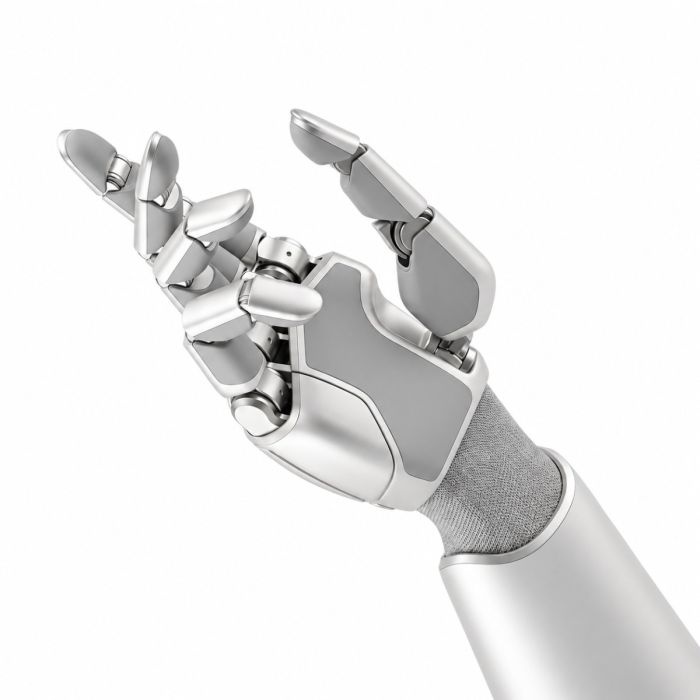
Most robot hands are judged by how hard they can squeeze. The Xynova Prima 1 asks a different question: how gently, how quickly and how truthfully can a hand feel what it touches? It is a research-grade, fully articulated, direct-drive hand built on a 1:1 copy of the human hand, and it is aimed at teams that need to study contact rather than simply survive it.
The Xynova Prima 1 is available through this page, by quotation.
Background
Who is Xynova?
The Xynova Prima 1 is made by Hangzhou Xynova Technology Co., Ltd., a supplier of key components for the humanoid robotics sector. The company researches, develops, produces and sells dexterous hands with a high number of degrees of freedom, along with high-torque-density rotary and linear actuators. That mix matters. A company that builds both hands and actuators understands the joint, the motor and the finger as one chain, and the Prima 1 shows this in its choice of drive and in its attention to backdrive behavior.
Xynova's work sits where humanoid robot builders shop for components rather than finished machines. A laboratory or a robot manufacturer can pair a hand with actuators from the same maker. Other hands from the maker, such as the Xynova Flex 2 Dexterous Robot Hand, are listed on this site, and the wider selection is gathered under Robot Hands.
How is the Prima 1 positioned?
The Prima 1 targets high-precision force control and cutting-edge embodied-intelligence research. In practical terms, it is a fit for high-fidelity data collection and algorithm validation platforms, where the quality of the recorded contact signal decides whether a learned policy can be trusted.
Three ideas define the hand. First, a 22 DoF biomimetic configuration gives the hand a joint structure close to that of a person. Second, a fully direct-drive design with zero backlash removes the gear play that blurs force signals and makes fine control harder. Third, visuo-tactile sensing across the hand gives the control software something closer to human-like perception. Together they describe a hand made for interaction that is safe, measurable and repeatable.
The hand is also built to sit comfortably beside people. Its ultra-low backdrive is meant for safe interaction, and its 190mm biomimetic human hand size means that tools, objects and workspaces made for people are within its reach. Together these define a new ecosystem of human-robot symbiosis.
Technical Specifications
| Specification | Value |
|---|---|
| Degrees of freedom | 22 DoF biomimetic configuration |
| Design | 1:1 biomimetic human hand design |
| Hand size | 190mm biomimetic human hand size |
| Hand weight | 0.65 kilogram |
| Frame | Lightweight alloy and composite frame |
| Drive type | Fully direct-drive, zero backlash |
| Fingertip force | 15N across four fingers |
| Lifting payload | Up to 20kg |
| Force control accuracy | 0.5N |
| Repeatability | 0.5mm |
| Single open/close cycle | 0.08s |
| Response bandwidth | 1kHz |
| Minimum backdrive torque | 0.04Nm |
| Sensing | Five-finger visuo-tactile sensing |
| Force sensing taxels | More than 300, across the fingertips, palm and back of the hand |
Specifications as published by the manufacturer; confirmed against the datasheet at quotation.
The manufacturer has not published the operating voltage, the communication interface, the power consumption, the IP rating, the package contents, the software and SDK support, the compatible robot arms or the operating temperature; they are confirmed at quotation.
What makes the Xynova Prima 1 different from a conventional robot gripper?
A conventional gripper is built to hold things. It opens, closes and applies a force, and for many factory tasks that is enough. A hand built for research has to do more: it must move in many ways, feel what happens at each contact point and let a controller act on that information without delay.
The Prima 1 answers each of those needs in turn. The 22 DoF configuration gives the fingers and thumb the range to form many grasp types rather than one. The direct-drive design with zero backlash means the motion at the joint is the motion the controller commanded, with no gear play in between. The 0.04Nm minimum backdrive torque means the hand yields easily when it is pushed, which is what makes contact with people and delicate objects safer.
Speed is the other half of the story. A 1kHz response bandwidth and a 0.08s single open/close cycle let the hand react quickly and articulate its fingers with agility. Because the force control accuracy is 0.5N and the repeatability 0.5mm, the same motion can be run again and compared with the last one. The force signal is transmitted without distortion and the hand natively supports hybrid force-position control, in which some directions are commanded by position and others by force.
None of this means strength has been given up. The hand delivers a 15N fingertip force across four fingers and lifts a payload of up to 20kg, so it handles a full range of human manipulation scenarios. Its mass of 0.65 kilogram, with a lightweight alloy and composite frame, keeps the load on a robot arm or humanoid wrist modest.
How does the tactile sensing work in the Prima 1?
Touch is where a hand either becomes useful for research or remains a mechanism. The Prima 1 carries five-finger visuo-tactile sensing for human-like perception. In addition, the sensor arrangement includes more than 300 force sensing taxels across the fingertips, palm and back of the hand.
Spreading the sensing across three regions is deliberate. The fingertips are where precise contacts happen. The palm carries the weight of larger objects and the back of the hand meets the surroundings when the hand pushes, slides or bumps. A hand that can report all three gives a learning system a fuller picture of what the manipulation really looked like, which is the raw material of data collection.
This sensing is paired with the low backdrive torque and the direct-drive design so that the signal reflects the actual interaction instead of the hand's own friction. For teams validating algorithms, a clean signal means differences in results come from the algorithm and not from the hardware.
Who is the Xynova Prima 1 for?
The Prima 1 is for research-grade work. Its natural buyers are university and corporate laboratories working on embodied intelligence, teams building data-collection setups for dexterous manipulation, and groups that validate control and learning algorithms against a real hand. Humanoid robot developers who want to test a lifelike hand before committing to a design will also find it a useful reference platform.
It also suits engineers who work on safe human-robot interaction. The low backdrive torque and the biomimetic size support experiments in which a hand and a person share the same space.
Buyers who want a different hand from the same maker can compare it with the Xynova Flex 2 Dexterous Robot Hand, and anyone browsing for alternatives can start from the Robot Hands category. If your project needs only a simple grasp, a hand of this sophistication may be more than you need; if you need to study how a hand touches, it is exactly the right kind of instrument.
What is the Xynova Prima 1 used for?
- High-fidelity data collection. Record rich contact information during dexterous manipulation to train learning systems.
- Algorithm validation. Test control and learning methods on a real hand that responds at a 1kHz bandwidth.
- Hybrid force-position control research. Use the native support for hybrid control to study tasks that need both accurate motion and controlled force.
- Humanoid robot development. Give a humanoid platform a hand built on a 1:1 copy of the human hand.
- Safe human-robot interaction studies. Explore handovers and shared tasks with a hand that has ultra-low backdrive.
- Tactile perception research. Examine how touch signals from the fingertips, palm and back of the hand support human-like perception.
Pricing and Availability
The Xynova Prima 1 is a quote-only product, and no prices are published. Send us a request describing your project and we will respond with a quotation. Delivery, customs and support are arranged together with the quotation, so you see the whole arrangement in one place. The Xynova Prima 1 is available on this page.
Frequently Asked Questions
How many degrees of freedom does the Xynova Prima 1 have?
It has a 22 DoF biomimetic configuration. The design is a 1:1 biomimetic human hand, with a size of 190mm.
How strong is the hand?
It delivers a 15N fingertip force across four fingers and a lifting payload capacity of up to 20kg.
How accurate is its force control?
Force control accuracy is 0.5N and repeatability is 0.5mm. The hand natively supports hybrid force-position control.
How fast does it open and close?
A single open/close cycle takes 0.08s, and the response bandwidth is 1kHz. The hand is fully direct-drive with zero backlash.
What sensing does it include?
It has five-finger visuo-tactile sensing, with more than 300 force sensing taxels across the fingertips, palm and back of the hand.
Which communication interface, voltage or software does it use?
The manufacturer has not published these details. Tell us about your robot arm and control setup when you ask, and we will go over it with you.
Where can I buy the Xynova Prima 1 and what does it cost?
You can request it through this page, by quotation. No price is listed; the cost is given in the quotation we prepare for your project.
Summary
The Xynova Prima 1 is less about squeezing hard and more about feeling well. A 22 DoF biomimetic structure, direct drive with zero backlash, a 0.04Nm minimum backdrive torque and visuo-tactile sensing with more than 300 taxels add up to a hand that can be studied as closely as it moves. With a 15N fingertip force, a payload of up to 20kg and a 0.08s open/close cycle, it still has the strength and speed that real manipulation demands. For research teams that care about contact quality, this page is the starting point.


